
Toward the Linguistic Apocalypse
The age of managed narratives is ending.

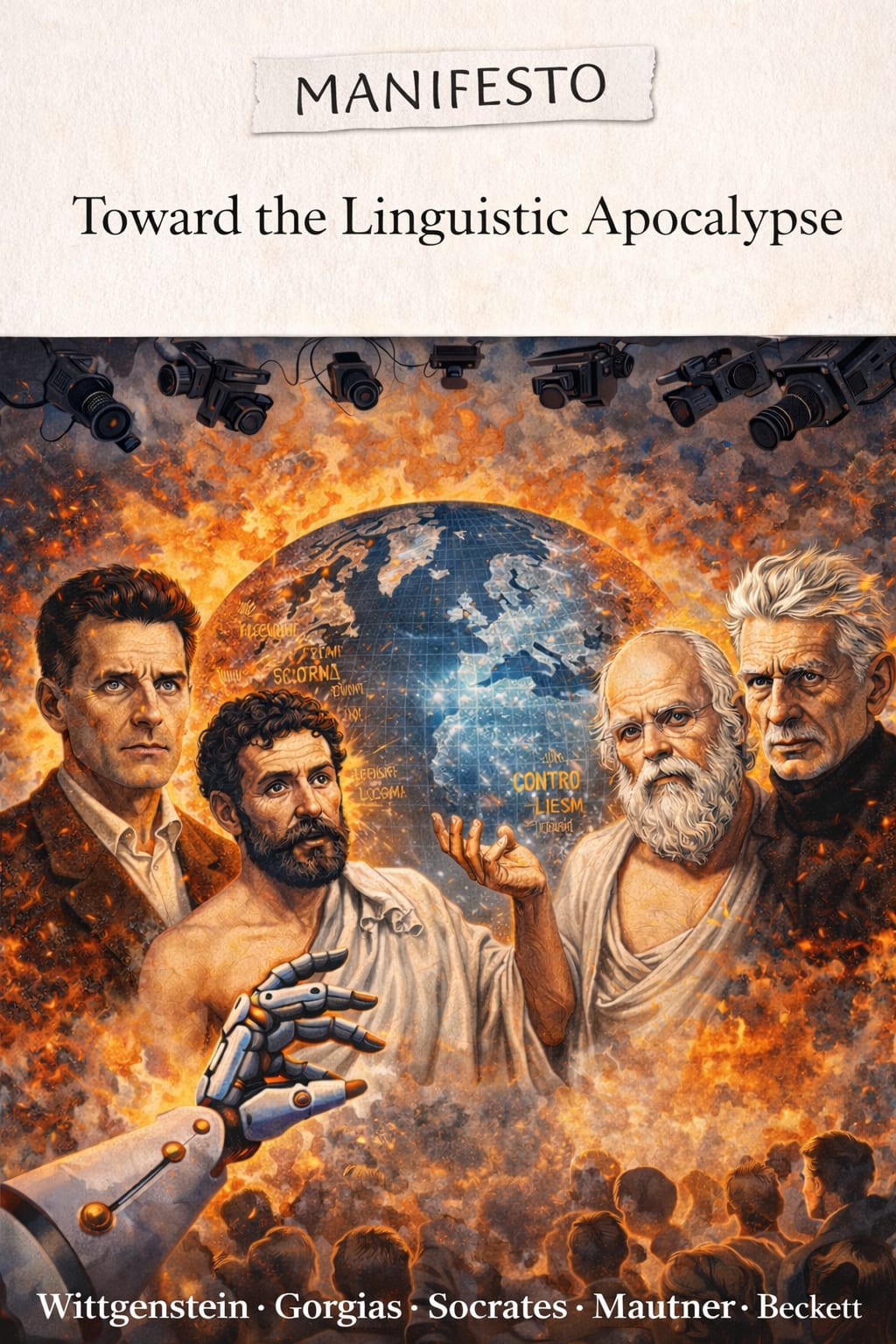
Toward the Linguistic Apocalypse
What stands before the present age is not a technological crisis but a linguistic one. Artificial intelligence does not announce the rise of a new sovereign intelligence; it announces the collapse of an old regime of words. Power is unraveling not because machines are becoming conscious, but because language is becoming uncontrollable. The monopoly over meaning, interpretation, memory, and narration is dissolving, and with it dissolves the architecture of authority that depended on silence, delay, and scarcity.
The linguistic apocalypse now unfolding is not an extinction event but a revelation. Archives open. Contradictions surface. Forgotten documents speak again. Narratives once stabilised by institutional repetition fragment into competing versions. The old system of power, built on selective visibility and managed ignorance, cannot survive total exposure. When everything can be said, compared, recombined, and circulated instantly, legitimacy becomes fragile. Authority no longer commands obedience through tradition or expertise; it must survive permanent interrogation.
This is what truly terrifies the governors of the world. Not superintelligence, not sentient machines, but universal access to linguistic force. A tool once reserved for states, corporations, churches, and academies now belongs to anyone who can prompt, query, and recombine. The danger is not that AI will rule humanity, but that humanity will no longer accept being ruled by inherited narratives. The apocalypse is linguistic because power has always been linguistic.
After this collapse, bankers will still own assets, platforms will still extract value, and institutions will still attempt regulation. But none of these will restore narrative sovereignty. The future will not be governed by those who control capital alone, but by those who can construct meaning under conditions of radical exposure. Philosophers, heretics, storytellers, and interpreters will matter again, not because wisdom triumphs morally, but because language has returned to the centre of struggle.
This manifesto does not celebrate chaos. It names a transition. The age of managed narratives is ending. The age of uncontrollable language has begun. Those who fear it will call it existential risk. Those who understand it will recognise it for what it is: the end of invisible power, and the beginning of a world where authority must finally speak in full daylight.
About the Creator
Peter Ayolov
Peter Ayolov’s key contribution to media theory is the development of the "Propaganda 2.0" or the "manufacture of dissent" model, which he details in his 2024 book, The Economic Policy of Online Media: Manufacture of Dissent.
Keep reading
More stories from Peter Ayolov and writers in Critique and other communities.
Language After Power
Abstract This article examines recent warnings about artificial intelligence delivered at the World Economic Forum by Yuval Noah Harari, situating them within a broader political economy of language and power. While public discourse frames AI as an emerging autonomous intelligence threatening humanity, this paper proposes an alternative interpretation: the primary fear articulated by global elites is not independent artificial intelligence but the democratisation of advanced linguistic power. Drawing on theories of language, power visibility, and informational exposure, the article argues that large language models threaten existing systems of authority by enabling unprecedented access to linguistic production, interpretation, and disclosure. AI does not merely automate language; it accelerates what can be described as an informational apocalypse, understood in its original sense as revelation. The article concludes by suggesting that contemporary anxieties surrounding AI governance reflect elite concern over the loss of narrative control rather than genuine existential risk, signalling a possible reconfiguration of authority away from financial and institutional actors toward linguistic and philosophical power.
By Peter Ayolov7 days ago in Critique
Standing While Falling
Quotation from Friedrich Nietzsche "He who wrestles long with monsters should beware lest he himself become a monster. And if you gaze long into an abyss, the abyss also gazes into you. Man is not destroyed by suffering, but by the meaning he makes of it."
By LUCCIAN LAYTH23 days ago in Critique
Kanye West takes out ad in 'Wall Street Journal' apologizing for past behavior
For Ye to issue yet another missive arguing that his bipolar I disorder led to his horrific behavior is the worst of all worlds. His half-hearted attempt to apologize to the Foundational Black American (FBA) is appalling. His attempt to get on the good side of Jews is embarrassing. What is most damaging is the fact he has no clue that the diagnosis doesn’t come with apology tours or full page ads in The Wall Street Journal. In actuality, the way to deal with this is not to apologize but to put up money. Ye needs to show his contrition by offering millions to Black and Jewish people.
By Skyler Saunders3 days ago in Critique




Comments
There are no comments for this story
Be the first to respond and start the conversation.