
Angry People Click More: The Economics of Manufactured Dissent
Peter Ayolov, Sofia University “St. Kliment Ohridski”, 2025


(Ideas from the book The Economic Policy of Online Media: Manufacture of Dissent, Routledge, 2024)
Abstract
This article examines the formula ‘angry people click more’ as a core logic of contemporary online media and as a structural transformation of propaganda in the digital age. It argues that the defining feature of the current attention economy is not only the circulation of misinformation, but the systematic deployment of openly implausible claims designed to provoke moral outrage and sustain profitable engagement cycles. The analysis links Oxford’s 2025 Word of the Year ‘rage bait’ to earlier lexical markers of epistemic crisis such as ‘truthiness’ and ‘post-truth’, and situates this trajectory against the older ‘manufacture of consent’ model of Herman and Chomsky. While classical propaganda in totalitarian and mass-media systems sought ideological unity through censorship and the Big Lie, the emerging Propaganda 2.0 model, articulated by Peter Ayolov, monetises anger by manufacturing dissent and deliberately populating the public sphere with absurd, polarising narratives. The article interprets this dynamic through the allegories of ‘The Emperor’s New Clothes’ and Václav Havel’s greengrocer, showing how the move from fearful silence to permanent online rage changes both the psychology and political economy of propaganda. Drawing on Evgeny Morozov’s critique of fake-news moral panics, Frances Haugen’s disclosures about Facebook, and the documentary The Social Dilemma, it concludes that anger has become a tradable asset and that blatant lying has shifted from an authoritarian instrument of control to a market mechanism in a global ‘free trade in slogans’.
Keywords:
rage bait; anger clicks; monetisation of anger; propaganda model; manufacture of dissent; big lie; post-truth; social media algorithms
Introduction: From silent consent to noisy anger
In the classic tale of "The Emperor’s New Clothes", citizens see that the emperor is naked but remain silent out of fear and conformity. Havel’s famous image of the greengrocer who hangs a Communist slogan in his shop window performs a similar function: the sign does not express genuine belief, but a ritualised declaration of loyalty to a system that demands consent under threat of sanction. These figures map neatly onto the propaganda model of Herman and Chomsky, in which a relatively unified mass-media system filters information so that dissent is marginal and consent to the existing order appears natural and inevitable. In that model, the problem is enforced agreement and the suppression of uncomfortable truths. In the digital attention economy, the dominant pathology is no longer enforced silence but permanent agitation. Users are not simply afraid to contradict obvious lies; they are invited, even provoked, to fight them publicly. The affect that organises this new environment is not quiet conformity but anger. As a business principle, "angry people click more" captures a shift from an industry that once sought to stabilise public opinion to one that profits from its continuous destabilisation. Peter Ayolov’s "manufacture of dissent" and Propaganda 2.0 Model articulate this transformation: platforms and online media thrive by producing disagreement, polarisation and moral outrage, rather than a single, stable ideological consensus.
Rage-baiting and the lexicon of distrust
Oxford’s choice of "rage bait" as Word of the Year 2025 formalises a practice users already intuitively recognise: online content "deliberately designed to elicit anger or outrage… in order to increase traffic or engagement". The term joins a two-decade lineage of crisis words that track the erosion of shared epistemic ground: "truthiness", popularised and later institutionalised as Word of the Year in the mid-2000s, captured the primacy of what feels true over what can be proven; "post-truth", Oxford’s Word of the Year 2016, named a political culture in which objective facts matter less than appeals to emotion and identity. "Rage bait" marks the next stage: not merely indifference to truth, but the active industrial production of anger as a commercial resource. The rise of rage bait coincides with what Evgeny Morozov described as a moral panic over fake news that obscures the deeper problem of digitised media power. The obsession with false stories and gullible citizens risks "eating the real enemy"—the structural dominance of digital platforms that design systems to reward emotionally charged content because it is profitable. Anger-oriented content is not a marginal pathology but a rational output of business models optimised for engagement. In this sense, "rage bait" names both a cultural practice and a technical parameter inside algorithmic systems: content that reliably produces higher click-through rates, longer viewing times and more comments is systematically elevated by recommendation engines.
The Big Lie and the Emperors of the post-truth era
The propaganda technique of the Big Lie, theorised by Hitler in Mein Kampf and operationalised by Nazi propaganda, assumed a tightly controlled media environment. A sufficiently colossal falsehood, repeated through monopolised channels, would be believed precisely because ordinary people could not imagine such shameless deceit. The lie was designed to be total: a single, overarching narrative that redefined reality and justified persecution and war. In contemporary democracies, the term "big lie" has been repurposed to describe, for example, persistent false claims that presidential elections are "stolen", or certain political regime is antidemocratic or narco-terrorist. Yet the media environment in which such claims circulate is fundamentally different. The lie no longer needs to be coherent, nor even minimally plausible. A stream of inconsistent conspiracy theories—flat earth, secret lizard elites, fabricated climate catastrophes, imaginary atrocities—can coexist without needing to form a unified worldview. Their value lies less in being believed than in being fought over. This marks a conceptual shift. In the totalitarian Big Lie system, the goal is to silence the Havelian greengrocer and the child in Andersen’s tale; one must repeat the slogan or stay quiet. In the anger-driven attention economy, the system benefits when those figures speak, protest and argue incessantly—so long as their speech takes the form of outrage, quote-tweeting, ‘debunk’ threads and endless comment wars. The more obvious the lie, the more insulting to common sense it appears, and the stronger the emotional pull to respond. The Emperor’s nakedness is no longer concealed; it is live-streamed and memeified, precisely to trigger anger-clicks from those who cannot bear the spectacle.
From manufacturing consent to free trade in slogans
Herman and Chomsky’s propaganda model describes five filters—ownership, advertising, sourcing, flak and an organising ideology such as anti-communism—that systematically narrow the range of acceptable discourse in mass media. The result is a relatively uniform, elite-friendly consensus, with dissent confined to the margins. Ayolov’s Propaganda 2.0 model maintains that these structural factors persist but are reconfigured by digital capitalism. Platforms owned by a small number of corporations still depend on advertising, but profit no longer requires a singular ideological line. Instead, what matters is attention, measured in clicks, watch time and interaction. In this new configuration, slogans become commodities in a "free trade" regime of ideas. Any claim, however absurd, can circulate so long as it attracts engagement. Ideological consistency is less important than emotional intensity. Traditional atrocity propaganda relied on horrific, usually fabricated stories of enemy crimes to mobilise hatred. The contemporary outrage economy can generate similar or greater anger with content that is transparently unbelievable. Stories about flat earth, microchip vaccines, secret child-sacrificing cabals or imminent civilisation-ending disasters flourish not despite their implausibility but because of it. The more insulting the narrative is to basic scientific and moral intuition, the more it enrages those who see themselves as rational, and the more tightly it binds those who find in it a badge of identity. This is where the "manufacture of dissent" diverges from the older model. The goal is no longer to make everybody hang the same slogan in the shop window, but to ensure that every shopfront displays some provocative sign that will offend another group and provoke an endless chain of reactions. Dissent is no longer a problem to be managed; it is the product.
Anger as a platform business model
Internal revelations about major platforms have confirmed that anger and divisive content are not accidental by-products but central to profitability. Frances Haugen’s testimony about Facebook (now Meta) highlighted internal research showing that content which ‘elicits anger or division’ systematically generates more engagement and that algorithmic changes prioritising such content were linked to increased polarisation. The logic is straightforward: users who are outraged stay longer, click more and return more often, making their attention and data more valuable to advertisers. The Netflix documentary The Social Dilemma assembled former insiders from major platforms to explain how engagement-driven algorithms learn to prioritise content that maximises time on site, including conspiracy theories, emotionally charged political posts and misleading news. As the film’s commentators argue, systems built around three goals—engagement, growth and advertising revenue—naturally discover that anger is among the most efficient levers for manipulating behaviour. This dynamic aligns with the notion of a "dissent factory". Instead of a broadcast model in which a small number of editors decide which narratives to promote, algorithmic curation harvests the most emotionally stimulating fragments from millions of users and recombines them into personalised outrage feeds. The rage-baiting described in recent analyses—content intentionally crafted to trigger anger, from staged TikTok scenarios to hyper-partisan memes—illustrates how creators learn to optimise for the same metric: anger as engagement.
The psychology of stupid beliefs and tight communities
The proliferation of communities organised around obviously false beliefs, such as contemporary flat-earth movements, is often interpreted as evidence of mass irrationality. From the standpoint of the anger economy, their significance is different. The more implausible a belief, the more it functions as a boundary marker. Adherents demonstrate loyalty by affirming claims that expose them to ridicule from outsiders; critics, in turn, feel compelled to correct and mock. Each side’s identity is reinforced through conflict. The system does not require either side to ‘win’. What matters is that both continue to produce content: videos debunking conspiracies, threads ridiculing believers, counter-videos doubling down on the original story. The angrier the exchanges become, the more the platform benefits. Anger clicks thus operate as a kind of social tax on those who care about truth, while communities built around ‘stupid’ beliefs gain cohesion precisely because their articles of faith are so distant from common sense. This is reminiscent, in distorted form, of the Big Lie logic. Hitler and Goebbels argued that an enormous falsehood, repeated relentlessly, would be believed because people would not suspect such audacity. In the digital environment, enormous falsehoods do not need to be universally believed; they need to be clicked, shared and argued about. The lie’s success is measured not in compliance but in engagement statistics.
Conclusion: From ideology to infrastructure of anger
The proposition "angry people click more" captures more than a psychological observation; it describes a structural principle of digital capitalism. Rage bait, as Oxford’s Word of the Year, signals growing public awareness that emotional manipulation is a central tactic of online communication, not an incidental abuse. The shift from the "manufacture of consent" to the "manufacture of dissent" marks a movement from an ideological regime that sought to homogenise belief to an infrastructural regime that treats conflict, fragmentation and outrage as raw materials for economic extraction. It is a economic system for "monetization of anger". In authoritarian mass-media systems, the Big Lie functioned to unite a majority around a single murderous fiction and to silence dissent through fear. In the contemporary attention economy, multiple big and small lies circulate freely, not primarily to secure belief but to generate profitable anger. The Emperor is visibly naked; citizens shout about it all day on social media; the greengrocer is no longer compelled to hang a single slogan but is inundated with an endless catalogue of signs he might display to provoke or signal loyalty to one camp or another. This transformation has profound implications for democratic communication. If anger becomes the central currency of public discourse, then those most willing to deploy blatant falsehoods to provoke outrage gain a structural advantage. Truth, in this environment, is not simply contested; it is economically disfavoured, because careful nuance and verified facts rarely outperform spectacular lies in the competition for clicks. The danger is not only that people believe untrue things, but that the entire architecture of communication rewards those who most effectively convert moral insult into measurable engagement. Addressing this condition requires more than fact-checking and media literacy campaigns targeted at individual users. It demands a rethinking of the economic and technical infrastructures that make anger so profitable: advertising models tied to engagement, opaque recommendation algorithms and platform incentives that equate success with time-on-site and virality. Until those structures change, the formula will hold: angry people click more, and the system will continue to feed them reasons to stay angry.
Bibliography:
Ayolov, P. (2024) The Economic Policy of Online Media: Manufacture of Dissent. London: Routledge.
Fuchs, C. (2018) ‘Propaganda 2.0: Herman and Chomsky’s Propaganda Model in the Age of the Internet, Big Data and Social Media’, in Fuchs, C. Propaganda 2.0. tripleC / Media Theory.
Haugen, F. (2021) ‘Whistleblower: Facebook is misleading the public on progress against hate speech, violence, misinformation’, 60 Minutes, CBS News, 3 October.
Herman, E. S. and Chomsky, N. (1988) Manufacturing Consent: The Political Economy of the Mass Media. New York: Pantheon.
Morozov, E. (2017) ‘Moral panic over fake news hides the real enemy – the digital giants’, The Guardian, 7 January.
Oxford Languages (2025) ‘Rage bait named Oxford Word of the Year 2025’. Oxford University Press / BBC coverage.
Sheposh, R. (2022) ‘Big Lie’, Research Starters: Social Sciences and Humanities, EBSCO.
The Social Dilemma (2020) Directed by Jeff Orlowski. Netflix documentary film.
About the Creator
Peter Ayolov
Peter Ayolov’s key contribution to media theory is the development of the "Propaganda 2.0" or the "manufacture of dissent" model, which he details in his 2024 book, The Economic Policy of Online Media: Manufacture of Dissent.
Keep reading
More stories from Peter Ayolov and writers in Critique and other communities.
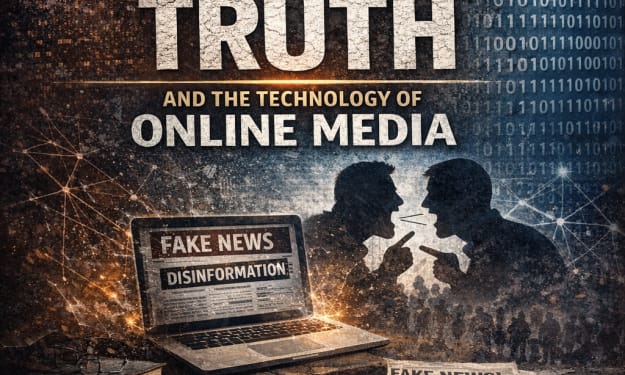
THE END OF TRUTH AND THE TECHNOLOGY OF ONLINE MEDIA
THE END OF TRUTH AND THE TECHNOLOGY OF ONLINE MEDIA Peter Ayolov Sofia University "St. Kliment Ohridski", 2019 Abstract: This article is a part of a larger study focused on the topic of the fictional media content opinions presented and perceived as truth. It will explore the abstract nature of truth in online media and its different forms. These media truths are types of fictional stories with certain effects on the public rather than a truthful presentation of the facts. Thus, the end goal of mass media today is not to tell the truth, but to create moral communities based on common experience and beliefs. Articles, opinions and news in media are seen as a narrative strategy that can be understood only through storytelling analysis. Here the focus is on the understanding of Truth and Untruth in online media as well as the connection of Internet media technology with the increase of disinformation online. The new media model creates hostile groups instead of generating consent for the nation-state, the new online media model within, Pseudo-communication, manipulation, delusion, lies, propaganda and deliberate causing of moral anger. "The end of the truth" means that the truth on the Internet is lost among the vast amount of information and the lack of regulation regarding the correctness of the published data. Instead of truth, media researchers formally talk about "post-truth," "fake news," and "alternative facts." Truth on the Internet is more like "Truthiness" or a belief that a statement is true based on the intuition or understanding of individuals, regardless of evidence, logic or facts. The subject of research is the connection between every new technology in mass media and the truth of the information and the effects on the consensus in society. Since the beginning of the 21st century, misinformation on the Internet has increased with the development of online media and social networks, and it is a problem of social peace and consent in every country.
By Peter Ayolov2 months ago in Critique
Craft Over Catharsis Challenge Winners
Craft Over Catharsis? What the hell does that even mean? The phrase came out of a curation meeting as a genuine question. We had been noticing that many challenge entries, across prompts, naturally gravitate toward trauma, grief, and personal reckoning. That makes sense. Writing is often cathartic. It's one of the ways we process what we've lived through.
By Vocal Curation Team6 days ago in Resources



Comments
There are no comments for this story
Be the first to respond and start the conversation.