Outline
Trump Ramps Up Attacks on Law Firms With Order Targeting Perkins Coie
President Trump signed an executive order on Thursday seeking to severely punish the law firm Perkins Coie by stripping its lawyers of security clearances and access to government buildings and officials — a form of payback for its legal work for Democrats during the 2016 presidential campaign.
By Md Mirajul Islam12 months ago in Critique
Is The Crypto Market a Joke?
I used to think crypto was different from traditional finance decentralised, fair, and for the people. However, trading on platforms such as Binance, FTX (prior to its collapse), Kraken, Bybit, or Bitstamp reveals the reality: these platforms are merely another Wall Street playground.Every one of these platforms uses CLOB, which might sound fair in theory, but in practice, it’s the complete opposite. Big institutions have direct market access, co-location privileges, and preferential fees, while we, the regular traders, are left with slow execution and poor order fills.
By Osty Duarteabout a year ago in Critique
How many more people will the sea swallow, and how much europe will endure? . AI-Generated.
The Mediterranean Migration Crisis: Why People Risk Everything for a Better Life Every year, thousands of people from Asia and Africa embark on perilous journeys across the Mediterranean Sea, hoping to reach Europe in search of safety, opportunity, and a better life. These journeys are fraught with danger—overcrowded boats, treacherous waters, and the constant threat of exploitation by human traffickers. Tragically, many do not survive the journey, and the Mediterranean has become one of the deadliest migration routes in the world. Yet, despite the risks, the number of people attempting this crossing continues to rise. To understand why people leave their homelands and risk everything, we must examine the complex interplay of economic, political, social, and environmental factors that drive migration.
By Banik Sojibabout a year ago in Critique
Why Do The Games in Squid Game S2 Show Real-Life Struggles
Many people have been anxiously awaiting the second season of Squid Game, the most-watched show on Netflix. To win prizes in the first season, players had to compete in several lethal kid-friendly games. The upcoming season, which is also expected to break yet another Netflix record, delves deeper into the limitations and economic background of the surrealistic games. Green light, red light. When the song starts, move forward; when it ends, freeze. It's a fairly easy game. Or is it that moving after the music has stopped carries a death sentence? It was clear from the first season that Squid Game allegorizes the horrors of capitalism through kid-friendly games. Three years later, the second season of arguably the most significant television program of our time advances its adamantly anti-capitalist theme. It accomplishes this by exposing the illusion of "choice" in a system threatening to starve the great majority. In this article, I dive deeper into the dystopian nuances of capitalism and the illusion of choice that stir up scenarios very similar to reality.
By Hridya Sharmaabout a year ago in Critique
Trump 2.0: Can Disruption Deliver a New Era?
Donald Trump, one of the most polarizing figures in modern American history, stands at the dawn of a second term, poised once again to challenge the status quo. His re-election, driven by a combination of his unapologetic style, economic promises, and the unwavering loyalty of his base, signals a renewed commitment to disrupting Washington and reshaping the global order. Yet, while his resolve has only strengthened, questions linger about how far his brand of disruption can go in an increasingly polarized political landscape.
By mureed hussainabout a year ago in Critique
Everything You Should Know on Los Angeles Container Port
Everything You Should Know on Los Angeles Container Port The Port of Los Angeles is one of the busiest and most significant ports globally. It serves as a major gateway for international trade and plays a key role in the U.S. economy. Ships from all over the world dock at the port to unload goods like electronics, clothing, and food products. But how does everything work behind the scenes? How are all those containers processed and moved through the port? In this blog, we'll dive into what the Los Angeles container port is, how it operates, and why it’s so essential for global trade.
By SuperBox Shipping Containersabout a year ago in Critique
Jackal. You are wild and timid. Are you binge-worthy?
The original Jackal is a story of the very bad guy on one side chased by a very good guy which was based not only on money commitment but on loyalty to their home country and their personal history between them. They were driven mainly by their professionalism and keen goal to achieve what they had wanted to achieve, mainly to be free. In the new version of this story, things are a little different.
By Oleksandr Matvyeyevabout a year ago in Critique
“Conspiracy Theories: Labyrinths of Shadows and the Poetry of Paranoia”
There is something profoundly human about the allure of conspiracy theories. They arise not simply as explanations for chaos, but as manifestations of our deepest anxieties and desires. They speak to a part of us that is both terrified of the unknown and irresistibly drawn to it, yearning to impose meaning on an existence that often seems incomprehensible.
By Nazia Syedabout a year ago in Critique
Trump Makes History: The First Former President Sentenced for a Felony
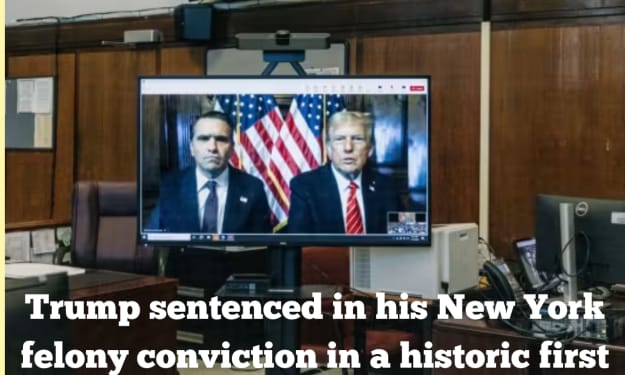
In an unprecedented moment in American history, former President Donald Trump became the first ex-president to be sentenced for a felony. The court proceedings, held on a quiet Friday morning, concluded with a sentence that left many stunned: unconditional discharge, which carries no punishment. This legal milestone underscores the unique intersection of power, privilege, and accountability in the life of one of the most polarizing figures in modern politics.
By mureed hussainabout a year ago in Critique
Democracy:Is it a right acquired by everyone, or is it power that we don't deserve...
Democracy the first thing that comes into our mind after hearing democracy is that everyone has equal rights, an unbiased attitude to every opinion thoughts, queries and all kinds of liberty, free to share and express thoughts without any constraints and to elect the ruler and government officials to form the government by common people. It is indeed a decorative term. Now the question comes should democracy be given to the common people, civilians? Somebody could analogically put this question into the category of disturbing/ silly questions like "Should the right be given to people to put their dresses on? Well, to some extent, it seems like that. We may say that Fascism (or worse) ideology contradicts democracy; hence, it is the saying of fascist leaders like Mussourie, Hitler, and Kim John Woo, who had established themselves as a dictator, so it is justified for them to say it. But what about Socrates and Aristotle, the birds of philosophy who were solely against democracy? They believed democracy is a tool too good to handle properly by common people, and they would be unable to use it rationally; high-level thinking rather than silliness and self-desire could be found there, and that's why a system should never rely upon the decisions, use of democracy by common people. Well, to some extent, we cannot deny them. Common people are those who don't want to think deeply about a broader scenario without using any intellect. Rather, they think narrowly and try to avoid new stuff and new things to progress. It's not always true that what the common people are fighting for and protesting against the government is not always true. Thousands of people protested against the US government in 2020 for wearing masks due to COVID-19. Several scholars protested after the abolition of quotas for Asians to get enrolled or admitted into a university in Europe. Most of the people on the survey have supported capital punishment and harsh animal-like attitudes towards victims, telling them they cannot be redeemed. Still, why democracy is the main key to the progress of civilisation? Democracy is not only the name of the right we deserve. It is the name of that term that gives space and liberty to establish their thoughts, philosophy, and art. It provides enough space and courage to express anything without feeling any constraint or hesitation. That's how new er ideas and concepts have been introduced and brought down upon us, and we made progress. If we abolish democracy, then we are forcing barriers and limitations upon the thoughts of a man and also taking his happiness out of him, forcing him to talk, walk, and act in a synchronized definite pattern. Yes, people make mistakes. But you cannot expect anyone to be correct all the time. Maybe that mistake was a part of upcoming progress. Common people have done the most hardworking necessary job to turn the wheel of civilisation, so they should have a say; they should have an opinion. Moreover, countries that have put pressure on press censorship and criticism of the government have faced numerous problems with modernisation. Through democracy, we have learnt to respect and accept people who at times remained ignored, ill-treatment, and misbehaved by society. Now we have learnt to accept them as an integral part of our society and to respect their values. Maybe there are fundamental flaws in democracy but there is no better substitute than it. In the field of art culture, people often feel reluctant to consume and enjoy new ideas and new content for which several artists didn't come into the limelight their whole lives, like Franz Kafka, Vincent Van Gough, and Ritwick Ghatak. So we have no other option but to modify democracy profoundly to not repeat the same mistakes. Also, one misdoing or misuse can have severe effects on the economy and development, so we have to be more sincere and more careful to become a part of civilisation.
By suvangshu Chakrabartiabout a year ago in Critique