Art
Chapter II: The Optics of the Soul
The gallery smelled of varnish and dust, a kind of hideout for creative things. Ivan Nikolayevich stood still in front of the Magritte painting, *The False Mirror*. He felt like his fingers had been unwittingly strumming some invisible instrument. The eye in the painting was huge and never blinked. The swirling blue iris seemed like the sky overhead filled with clouds and completely unsure about answering questions. Encapsulated in the glass was Ivan's whirling stream of consciousness; he couldn't help but wonder if this eye was a portal, or if just the opposite was true, another trap entangling him in another dubious reality. He cycled through the question- is it more advantageous to know a real sheeple world, or to wish it to be something else entirely? Did it really even matter? He could see his own tired, bloodshot eyes in the glass and questioned what person he was in relation to the artwork engulfed in both separate mirrors. There lay two Ivans, one searching for dream awareness and another person desperate to meet the day, the absolute vacant spirit.
By LUCCIAN LAYTH10 months ago in Critique
Fast and Dirty Editing - Pre-Prepared, Pre-Packaged Pleasure
So I thought as a last entry for the Self-Editing Epiphany Challenge, I'd partake in what I am calling "Fast and Dirty Editing". What do I mean by "Fast and Dirty Editing"? Well, rather than drill down into the dos and don'ts of writing poetry, or worry about the format (aside from any formatting rules that need to be applied) I am going to take an existing piece I wrote for the Tautogram challenge, but published it too late to be accpeted for the challenge, from a couple of years ago. I am then going to decimate it, without labouring over it too much, and go through the changes as I make them in this critique.
By Paul Stewart10 months ago in Critique
Beauty In The Mess
When I write, I usually tend to type the whole thing up on my laptop, and then make passes over the same document to edit. As a result, I am not in the habit of keeping my rough drafts. For this prompt I thought, where's something where I've left behind evidence of the process itself , both the beauty- the final product- and the mess that final product wouldn't exist without? One is not possible without the other, but it took some searching to find evidence of the latter anywhere.
By Raistlin Allen10 months ago in Critique
HERMANN HESSE : SELF- UNDERSTANDING AND ENLIGHTENMENT - ALEXIS KARPOUZOS
Hermann Hesse’s works often explore deep philosophical themes and the human quest for self-understanding and enlightenment. His writing draws heavily from Eastern philosophy, Jungian psychology, and Western existentialism, creating a rich tapestry of ideas that challenge and inspire readers. Hermann Hesse’s philosophical exploration in his works offers profound insights into the human condition, emphasizing the importance of personal experience, the integration of dualities, and the interconnectedness of all life. His writings encourage readers to embark on their own journeys of self-discovery, recognizing that enlightenment is a continuous, evolving process. Here, we’ll examine some of the key philosophical elements present in his most famous works.
By alexis karpouzos10 months ago in Critique
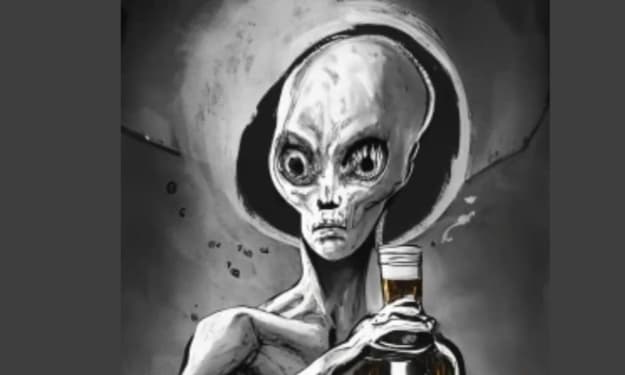
Getting Legless With Drunk Aliens - Editing A Winning Poem
For this entry into the Self-Editing Epiphany, I wanted to do something a little strange. It’s easy, in some ways, to look back at pieces we know were flawed because they didn’t get well received or didn’t place in a challenge or competition. But what about those pieces that did have success—ones that not only placed in a challenge but came first place? Could any editing, especially with time passed and experience gained since the piece was published, improve upon a winning poem?
By Paul Stewart10 months ago in Critique
The Monster. Content Warning.
The monster in my room. Have you ever woken up to find a monster in your room? I did, when I was four years old. It wasn’t your typical monster, it didn’t look like a monster but it was. It had taken over someone else. I was told by my parents to sleep in the same bed as the monster. This same monster had attacked several people. That’s what it did, it would attack one person and then that person would become the monster. Then that monster would attack someone else and then they would become the monster. Then when I was four the monster had attacked my sister and she became the monster. Then the monster attacked me. But for some reason no matter how hard the monster tried, I wouldn’t let it take over me. I would have dreams about myself becoming the monster and wake up terrified and shaking. But I didn’t want to be a monster, so I didn’t become one. And that’s when I realized that no matter what happened to the people before me, they weren’t forced to become the monster, they chose to. They were introduced to the monster and then they had to make a choice. Become the monster or defeat it, stop it from destroying everyone. The monster attacked me and it was bad but to me becoming the monster was so much worse because I would rather be hurt than hurt someone else. And that’s all it took, the way to defeat the monster was so simple and yet it had taken years for someone to stop it. All along all anyone had to do was stop being the same monster that had attacked them.
By Raine Fielder10 months ago in Critique
Flash of... Brilliance?
Flash fiction has never really been my “thing”. The type of fiction I tend to gravitate to is more extended, chapter-like fiction—gritty, lengthy stories, full of sub-context and side plots. So, flash fiction presents a challenge for me, one that I have started to tackle more frequently. I’ll be critiquing one of my most recent pieces Survival Rate. The goal was to end in a twist and subvert the reader’s expectations in some groundbreaking way. The side quest goal was to make it only five hundred words.
By Sarah Massey10 months ago in Critique
Breaking the Rules: A Bold Self-Edit of My Riskiest Writing Choice
Taking the Leap into Creative Uncertainty Every writer faces a moment of doubt when pushing the boundaries of conventional storytelling. This article is both a confession and a guide—a deep dive into my own risk-taking as a writer. I will share an excerpt that I once considered both flawed and full of potential. Then, I will analyze my editing choices, the risks I took, and how they reshaped my creative approach. If you have ever hesitated before breaking a rule in writing, this exploration might offer the encouragement you need.
By Alain SUPPINI10 months ago in Critique
A Moment On My Soapbox. Runner-Up in Self-Editing Epiphany Challenge.
Pulls out soapbox. History never repeats itself, but it loves playing a good cover. When we cease to understand, and only imitate, we doom ourselves and others into repeating the same chords, the same notes, eventually writing off a cover as a different song entirely.
By Matthew J. Fromm10 months ago in Critique
What goes through the mind of an empty envelope?
Humans! Aah, the notorious ones gospelled with the prowess of pouring their hearts onto the folds of power, of unleashing the confinement of unsaid pain through the enigmatic flair of woven syllables through the crevices of their glistening minds.
By Hridya Sharma10 months ago in Critique