


In a place once known as a beacon of opportunity, where dreams were supposed to take root and flourish, a thick shadow now lay over the city. Its tall buildings loomed like silent judges over weary citizens, and its bustling streets pulsed with an air of decay rather than hope. Here, the city had become a kingdom of corrupt demagogues and nepotism, a place where power traded hands in darkened rooms and favored the already powerful, while the common people struggled in the cracks left between.
For many, survival in the city meant navigating the maze of slums and abandoned alleys in an area known only as Deogon. Deogon was a refuge for the forgotten—those whose voices were drowned out by the clinking of glasses in penthouse suites and the shuffle of papers in high offices. For them, life was a never-ending search for scraps: scraping the bottoms of old pots, foraging through garbage bins, and scavenging in refuse-strewn streets. The streets, once the arteries of progress, were now little more than dumps, littered with the leftovers of a system that had forgotten them.
Meanwhile, the ghetto was no longer a stepping stone toward a better life; it was the city’s answer to citizenship, a neighborhood specifically for those who had nothing to give and nothing to take. There, people banded together in survival, inventing their own sense of community among the neglect. Refuse piled up alongside the streets, spreading disease and rot. It was a painful irony: while the forest outside the city thrived with health and life, the city itself had become a dead zone. Birds, insects, even stray animals avoided its lifeless streets, finding sanctuary in the greenery beyond.
Life in the village, by contrast, was simple but fulfilling. As urban dwellers clawed through trash to survive, villagers harvested their food from gardens and rich forests. The air in the countryside was fresh, filled with scents of wild herbs and trees. Their water bubbled up from natural springs, pure and refreshing. Their diet was as wholesome as it was hearty, rich in the natural vitamins and nutrients of fresh fruits, wild game, and unspoiled soil. Life may have been humbler, but it was alive, pulsating with a vibrancy that the city had lost long ago.
The more the villagers heard about the misery of the city, the more they grew grateful for their own way of life. They knew the cities were supposed to be places of dreams, but here, it seemed, was a grim paradox: in chasing the shimmer of progress, the city had lost its soul, while the village, untouched by the allure of the concrete jungle, had preserved its culture, its values, and it's way of life.
One by one, villagers who once felt the pull of the city returned, having seen with their own eyes the emptiness it offered. They brought back stories of languished souls, of glittering facades and decaying insides. The city, once seen as the destination of success, now served as a warning: that in the rush toward power and progress, the true wealth of life—nature, community, and health—could be lost. And so, they returned to the village, choosing the richness of nature over the hollow luxury of a city that had left too many lost.
Title: The Corrupt City
In the Corrupt City, where skyscrapers stretched proudly toward the sky and neon lights cast an enchanting glow over the night, the promises of progress and equality had been quietly betrayed. The government, once a symbol of protection and service for its citizens, had transformed into a machine driven by greed. Public facilities and organizations that were supposed to lift people up had become tools of exploitation, squeezing every penny from the desperate and the hopeful alike.
Schools, once the beacon of opportunity for poor children in the city, were now little more than polished facades. Scholarships meant to support the underprivileged had vanished, siphoned off by officials and administrators who cared little for the future of those who could not afford to buy their way into success. Education was now a privilege of the wealthy. Students from poor backgrounds could only dream of quality learning, while they toiled in underfunded schools with overcrowded classrooms and outdated books.
In hospitals, free healthcare—once a fundamental promise to all citizens—was no more than a legend. Public healthcare centers had been privatized or dissolved, replaced by expensive clinics that only the wealthy could afford. For the rest, illness and injury became a cycle of waiting in endless lines, often to be turned away or handed a bill they couldn’t pay. Families struggled to treat even the simplest ailments, forced to choose between food for the week or medicine for the day.
The corruption ran deep. Public funds, meant to improve roads, support small businesses, and uplift communities, were instead funneled into the pockets of civil servants who wore their power like armor. They drove sleek cars, dined in fine restaurants, and lived in guarded estates, untouched by the struggles of ordinary people. This was the new reality: a city where opportunity had become currency, and freedom came with a price tag.
And yet, for all its moral decay, the city dazzled. Its skyline glittered with modern buildings, its streets boasted luxury boutiques and towering billboards advertising dreams. To those who didn't look too closely, the city seemed like a paradise of progress and wealth, a modern marvel to aspire to. But behind the polished surface lay a hollow truth: in this city, only the wealthy and the well-connected thrived. For everyone else, life was a relentless struggle to survive in a system that viewed them as disposable.
And so, while the city’s lights shone bright, they illuminated the stark divide between privilege and poverty, ambition and corruption, progress and decay. It was a beautiful prison, a modern paradise with a soul tainted by the greed that had become its beating heart. The true beauty of the Corrupt City was nothing but a well-maintained illusion, hiding the empty promises and broken systems that lay beneath.
About the Creator
fidel ntui
Step into a realm where every word unfolds a vivid story, and each character leaves a lasting impression. I’m passionate about capturing the raw essence of life through storytelling. To explore the deeper layers of human nature and society.
Keep reading
More stories from fidel ntui and writers in Critique and other communities.
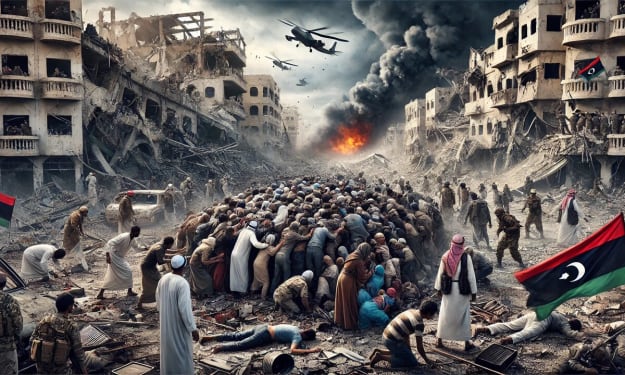
THE CHAOS AND HUMAN SHIELDS IN LIBYA
The death of Muammar Gaddafi in October 2011 marked one of the darkest chapters in Libya’s modern history. Gaddafi, who had ruled Libya for 42 years, was captured by opposition fighters, beaten, and killed in the chaos of his final stand in Sirte. His death came after months of NATO-backed uprisings against his rule. What followed his brutal end was a descent into a darkness that Libya had not known before, as a power vacuum engulfed the country.
By fidel ntuiabout a year ago in Critique
Standing While Falling
Quotation from Friedrich Nietzsche "He who wrestles long with monsters should beware lest he himself become a monster. And if you gaze long into an abyss, the abyss also gazes into you. Man is not destroyed by suffering, but by the meaning he makes of it."
By LUCCIAN LAYTH6 days ago in Critique
"Challengers" Movie Review
Challengers is a triumphantly sexy cinematic rollercoaster ride, too incredulously fun not to watch. Tashi Duncan is played by Zendaya, the exceptionally emotive young movie star. Matched against her are two gorgeously nerdy-looking young players, Mike Faist as Art Donaldson and Josh O’Conner as Patrick Zweig. All three have the blessing of great chemistry whenever they spar across screen. Alongside their star qualities are bouncing timelines, demonstrating a lifetime of flagrantly competitive choices that create a trail of wasted potential and misguided lust. Director Luca Guadagnino really knows how to make a graceful yet scandalous picture. Trent Reznor and Atticus Ross's EDM score intensifies the thrill of tennis and prideful characters up to an eleven. After watching Challengers multiple times, I am forced to argue that all sporting events should henceforth take place at a fist-pumping rave. When first hearing about this movie, I thought the entire plot had been offered up within the two-minute trailer. Two friends like a tennis star. Tennis star has a career-ending injury. Tennis star picks blonde boy, and brunette boy is angry. Audience members think they have digested the full ingredients of the film before getting their soles sticky from the theatre floor. Yet, this new-age masterpiece is anything but a simple meal.
By Spider Black5 days ago in Critique


Comments
There are no comments for this story
Be the first to respond and start the conversation.