
THE CHAOS AND HUMAN SHIELDS IN LIBYA
The Dark Age of Libya History

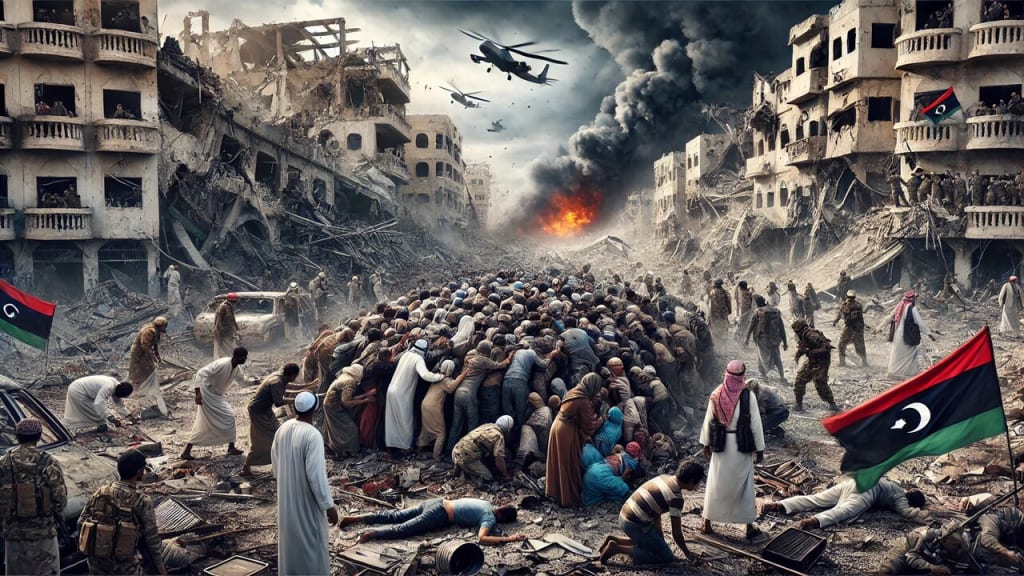
The death of Muammar Gaddafi in October 2011 marked one of the darkest chapters in Libya’s modern history. Gaddafi, who had ruled Libya for 42 years, was captured by opposition fighters, beaten, and killed in the chaos of his final stand in Sirte. His death came after months of NATO-backed uprisings against his rule. What followed his brutal end was a descent into a darkness that Libya had not known before, as a power vacuum engulfed the country.
Under Gaddafi, Libya was a complex and often contradictory nation. His regime was marked by authoritarian rule, yet it had also lifted Libyans to one of the highest standards of living in Africa. Oil wealth financed ambitious social programs, providing Libyans with access to education, healthcare, and welfare benefits. Libya stood apart as a nation with stability and economic strength—qualities that made it a magnet for migrant workers from neighboring countries. Though political dissent was suppressed, many Libyans experienced a unique form of stability under Gaddafi’s rule.
But his fall exposed the fragility beneath this stability. Libya’s tribal and regional divisions, which had been carefully managed by Gaddafi’s centralized authority, erupted into violent conflict. Armed factions, many supported by foreign interests, scrambled to fill the void left by his regime, leading to a fractured nation beset by militia control, power struggles, and lawlessness.
What Gaddafi’s death symbolized to many Libyans was not liberation but the unraveling of their nation. Hospitals, schools, and infrastructure lay in ruins, and violence surged. Libya’s oil resources, once the backbone of its prosperity, became a point of bitter contention between rival groups. People’s daily lives shifted from stability to insecurity, with families struggling to rebuild in a country now ravaged by war.
Perhaps the most tragic consequence of Gaddafi’s death has been Libya’s transformation into a hub for human trafficking and a black market for slavery. Once a land of opportunity for African migrants, Libya is now a perilous crossing point, where many are held captive, abused, and sold as commodities in a brutal underground economy. The dark shadow cast by Gaddafi’s fall lingers over the nation, a grim reminder of a broken promise—a promise of peace, stability, and progress that has been shattered, leaving Libya haunted by its unfulfilled potential.
In 2011, Libya was a land caught between hopes of stability and the ravages of war. NATO, acting under a UN mandate aimed at protecting civilians, initiated a series of air raids, targeting military assets and strategic infrastructure. However, the operation, which began with the intent of toppling the regime of Muammar Gaddafi, quickly spiraled into something far more devastating. NATO’s relentless bombardment of Libyan territory resulted in more than 10,000 air raids, leaving much of the country in ruins. Estimates of civilian casualties are staggering—some sources estimate the deaths to exceed 500,000. Civilian neighborhoods, hospitals, schools, and infrastructure lay destroyed in the aftermath, often dismissed by NATO as “collateral damage,” an unfortunate but inevitable part of war.
Before this, Libya had enjoyed a high standard of living, with a robust healthcare system, accessible education, and significant economic resources driven by oil wealth. It had a unique welfare state, offering Libyans benefits that were envied across the region. But these years of progress, stability, and development quickly faded as Libya was thrust back into a brutal power struggle. The country’s infrastructure crumbled; its cities were scarred by bomb craters, and its people were left to pick up the pieces. The once-prosperous nation was now mired in chaos and poverty, with Libyans left scrambling for survival.
Without a stable government, Libya became a dangerous frontier for criminal enterprises. Militias took over, each claiming territories, and rival factions clashed for control over the country’s fractured remains. Weapons flooded the streets, and violence became the norm, sparking a humanitarian crisis that sent shockwaves across North Africa and the Mediterranean.
One of the darkest consequences of this descent into chaos was the emergence of a new slave trade. Libya, now a failed state, turned into a major hub for human trafficking. Refugees and migrants, many of whom were Black Africans fleeing violence or poverty, found themselves stranded in Libya’s lawless borders. Desperate for safety and caught between corrupt officials, armed militias, and traffickers, many were sold into modern-day slavery, often enduring horrific abuses.
The international community watched with muted outrage, acknowledging the devastation but failing to take effective action to resolve it. The NATO intervention, initially touted as a humanitarian mission, left scars on Libya that remain unhealed. Once one of Africa’s most developed nations, Libya became an emblem of the perils of foreign intervention and the cost of failed diplomacy.
About the Creator
fidel ntui
Step into a realm where every word unfolds a vivid story, and each character leaves a lasting impression. I’m passionate about capturing the raw essence of life through storytelling. To explore the deeper layers of human nature and society.
Keep reading
More stories from fidel ntui and writers in Critique and other communities.
LOST IN THE CITY
In a place once known as a beacon of opportunity, where dreams were supposed to take root and flourish, a thick shadow now lay over the city. Its tall buildings loomed like silent judges over weary citizens, and its bustling streets pulsed with an air of decay rather than hope. Here, the city had become a kingdom of corrupt demagogues and nepotism, a place where power traded hands in darkened rooms and favored the already powerful, while the common people struggled in the cracks left between.
By fidel ntuiabout a year ago in Critique
Standing While Falling
Quotation from Friedrich Nietzsche "He who wrestles long with monsters should beware lest he himself become a monster. And if you gaze long into an abyss, the abyss also gazes into you. Man is not destroyed by suffering, but by the meaning he makes of it."
By LUCCIAN LAYTH6 days ago in Critique
Countdown to Pearl Harbor: The Twelve Days To The Attack
Countdown to Pearl Harbor: The Twelve Days To The Attack by Steve Twomey I really wasn’t expecting much of this read; I grabbed it while I was at Pearl Harbor because how could I not get a book while I was there?
By Matthew J. Fromm5 days ago in Critique


Comments
There are no comments for this story
Be the first to respond and start the conversation.