
Finally Sat Down to Watch Midsommar (2019)
A Critique

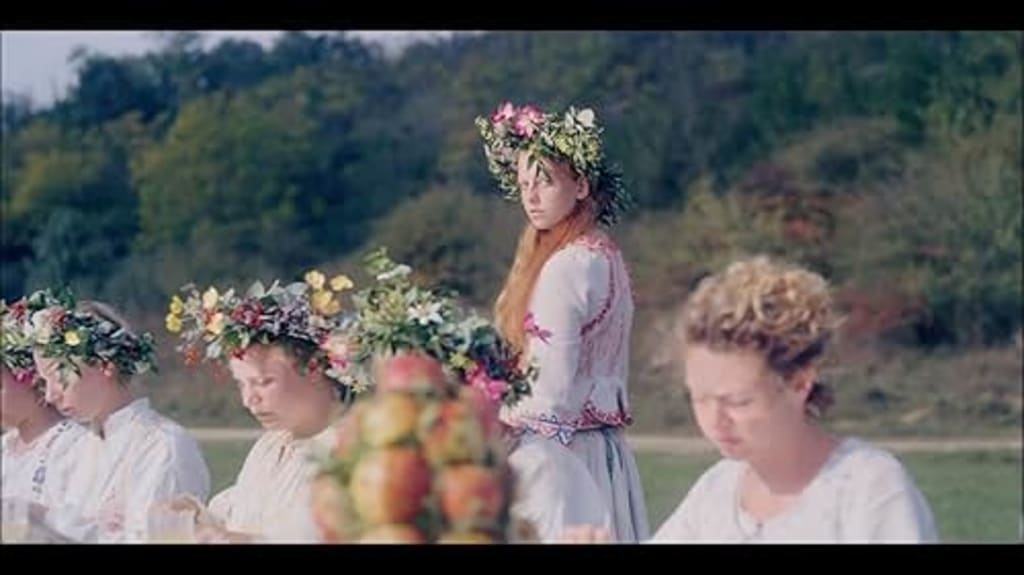
Ari Aster's 2019 film Midsommar represents an ambitious and polarizing entry in contemporary horror cinema. Following his acclaimed debut *Hereditary*, Aster crafts a folk horror experience that deliberately inverts the genre's visual conventions while exploring the dissolution of a toxic relationship against the backdrop of a Swedish pagan festival. The result is a film that is simultaneously beautiful and disturbing, meditative and visceral, earning both ardent admirers and vocal detractors.
The film's most immediately striking achievement is its visual composition. Cinematographer Pawel Pogorzelski bathes nearly the entire film in harsh, unrelenting daylight, subverting horror's traditional reliance on darkness and shadow. This choice is more than stylistic flourish—it creates a uniquely unsettling atmosphere where terror cannot hide in darkness, and the audience finds no visual respite from the unfolding nightmare.
The production design by Henrik Svensson is meticulous to the point of obsession. The Hårga commune feels simultaneously authentic and dreamlike, with its flower-adorned buildings, intricate murals, and carefully choreographed rituals. Every frame is composed with painterly precision, yet this beauty becomes weaponized against viewer comfort. We're conditioned to associate visual splendor with safety; Aster exploits this assumption ruthlessly.
The film's use of symmetry, both in framing and in the mirrored emotional arcs of its protagonist, creates a hypnotic quality. Aster frequently employs slow, creeping zooms and disorienting upside-down shots that suggest Dani's psychological unmooring while maintaining the film's deliberately measured pace.
Midsommar challenges fundamental horror conventions by setting its most disturbing moments in broad daylight, often surrounded by flowers, singing, and community celebration. The famous cliff scene occurs in full view, witnessed by a crowd that responds with ritualistic empathy rather than horror. This juxtaposition forces viewers to confront violence without the buffer of cinematic darkness or quick cuts.
However, this approach also contributes to the film's most significant weakness: emotional distance. The relentless brightness and slow pacing create a dreamlike detachment that, while thematically appropriate, can prevent genuine dread from taking root. Unlike Hereditary's suffocating atmosphere, *Midsommar* sometimes feels too aestheticized, too interested in being beautiful to fully commit to being horriffying.
At its core, Midsommar is less interested in the cult than in the death of Dani and Christian's relationship. The film opens with devastating tragedy—Dani's sister murders their parents before killing herself—and immediately establishes Christian as emotionally absent, resentful, and checked out. He's a partner in name only, staying with Dani out of obligation rather than love.
Florence Pugh delivers a raw, committed performance that anchors the film's emotional reality. Her portrayal of grief, anxiety, and eventual twisted liberation is the engine that drives the narrative forward. Dani's journey from isolated mourning to communal belonging—however horrific that community may be—forms the film's actual arc.
The genius and cruelty of Aster's script is that the Hårga cult provides Dani with something Christian never could: witnessed emotion, shared suffering, and unconditional support. When Dani breaks down after discovering Christian's betrayal, the women of the commune literally mirror her anguish, crying and wailing with her. It's disturbing, manipulative, and yet the film asks us to consider: is this really worse than Christian's cold indifference?
The theatrical cut runs 147 minutes, with a director's cut extending to 171 minutes. This sprawling runtime allows Aster to fully immerse viewers in the commune's rhythms and rituals, creating an almost anthropological experience of the nine-day festival. The slow burn approach serves the film's meditative qualities and allows dread to accumulate gradually.
Yet this is also where many viewers disengage. The middle section drags considerably, with repetitive ritual sequences that feel more like ethnographic documentation than narrative progression. Unlike The Wicker Man, which maintained propulsive mystery and investigation throughout, Midsommar often seems content to simply observe, testing audience patience in ways that don't always feel purposeful.
Midsommar positions itself within the folk horror tradition established by films like The Wicker Man (1973) and The Blood on Satan's Claw (1971). These films typically feature isolated communities with ancient practices that clash with modernity, often resulting in outsiders becoming sacrificial victims.
Aster consulted with Swedish cultural experts and based many rituals on actual folk traditions, albeit exaggerated and combined in fictional ways. However, the film has faced criticism for its approach to Scandinavian culture, particularly in how it presents Swedish paganism as inherently sinister and violent. The Hårga's practices, while fictional, draw heavily on Norse mythology and actual Swedish midsummer traditions, which some argue perpetuates negative stereotypes.
The film also raises questions about its predominantly American perspective viewing European folk culture as exotic and threatening—a dynamic with its own complicated history in horror cinema.
Beyond the horror elements, Midsommar offers a disturbing meditation on codependency and emotional abuse. Christian is not a monster in any conventional sense; he's simply checked out, passively cruel through his indifference. He forgets Dani's birthday, resents her needs, includes her in his trip only after being guilted, and considers her emotional response to trauma as burdensome.
The film suggests that Dani's greatest horror isn't the cult's violence but her own willingness to accept breadcrumbs of affection from someone who doesn't love her. When she finally chooses Christian as the final sacrifice, it's framed almost as liberation—a deeply uncomfortable catharsis that the film doesn't entirely condemn.
This moral ambiguity is either the film's greatest strength or its most troubling element, depending on your perspective. Aster doesn't offer easy answers about whether Dani's "empowerment" through joining the cult represents genuine liberation or simply a different form of manipulation and control.
Beyond cinematography, the film excels in sound design and score. Bobby Krlic's (The Haxan Cloak) soundtrack blends atonal drones with Scandinavian folk music, creating an unsettling soundscape that mirrors the film's tonal contradictions. The sound design during the mushroom trip sequences and ritual moments demonstrates meticulous attention to creating disorientation through audio.
The editing by Lucian Johnston maintains the film's deliberate pace while incorporating subtle disorienting elements—occasional frames flash by almost subliminally, and time becomes increasingly elastic as the festival progresses.
Midsommar is a film that demands much from its audience and won't work for everyone. Its glacial pacing, emotional coldness, and visual approach prioritize atmosphere and metaphor over conventional scares or narrative efficiency. When it works, it's a mesmerizing experience that lingers in the mind long after viewing. When it doesn't, it feels like a beautiful but hollow exercise in style.
The film's greatest achievement may be its genuine originality in an often formulaic genre. Love it or hate it, Midsommar looks, sounds, and feels like nothing else in contemporary horror. Aster has crafted a breakup movie as folk horror, a trauma narrative as pagan ritual, and a daylight nightmare that uses beauty as its primary weapon.
It's a film more interested in questions than answers, in atmosphere than plot, and in emotional truth than traditional horror mechanics. Whether that makes it brilliant or frustrating depends entirely on what you value in cinema—but it's undeniably a work of singular, uncompromising vision.
Rating: 7.5/10*- A visually stunning, thematically rich experience that occasionally disappears up its own aesthetic, but remains one of the most distinctive and discussable horror films of its era.
About the Creator
Parsley Rose
Just a small town girl, living in a dystopian wasteland, trying to survive the next big Feral Ghoul attack. I'm from a vault that ran questionable operations on sick and injured prewar to postnuclear apocalypse vault dwellers. I like stars.
Keep reading
More stories from Parsley Rose and writers in Critique and other communities.
The Criousity of The Finch App
An intro When I needed something to help me count and credit the days during the worst depression episodes of my life (so roughly my late twenties early thirties); Finch App was that daily boost of care. I found real succeess monitoring my Mental Health.
By Parsley Rose 5 months ago in Critique
Completed Draft
When is a piece of writing finished? It’s a question with as many different answers as writers. For me, a work is finished when it can’t be improved anymore. Almost everything I have posted here is still in drafting (not draft; they’re posted). Even when I think a work is finished, I read it again, usually finding something I can improve or tighten.
By Harper Lewis5 days ago in Critique



Comments
There are no comments for this story
Be the first to respond and start the conversation.