
A Deeper Gaze at "Her Gaze"
For Self-Editing Epiphany Challenge and my ABCommunities Challenge week ending 11/03/25



I have written a lot of pieces I believe are challenging. It's always my goal as a writer to push myself outside of my comfort zone, and in turn, hopefully to push my readers there too. For this challenge, Vocal has asked us to pick an excerpt from a piece that we consider both imperfect and brimming with potential.
The truth is, while we can all strive for perfection in writing, nothing we write will ever be perfect in the truest sense of the word. And that's fine. If we have written a piece to the best of our ability and put our heart and soul into it, there's nothing more we can do.
Initially, I was going to pick apart a piece that was not very popular and full of flaws. I may still do that for another entry. But as I revisited my work, I came across a piece I wrote for the Lipogram Challenge, titled Her Gaze. It received a Top Story, but didn't place in the challenge.
Reading it again, with months of experience under my belt and a more critical eye, I still love it. It was the best version of itself at that specific time. But I can also see its flaws. This makes it a fascinating piece to analyse, because the challenge of writing it, and the deeper meanings behind it, deserve a closer look.
Here is a link to the full story. It may help you to read it to understand my analysis.
The Challenge of the Lipogram
For anyone unfamiliar or who needs a reminder, a lipogram is a piece of writing that omits a specific letter or letters. In Vocal's Lipogram challenge, we were required to avoid the letter "I".
Never one to take the easy route, I knew from the very start that I wanted to write a first-person narrative. A seemingly impossible task, given the reliance on "I" in that perspective.
As I considered ideas for the story, I realised I could use this restriction to explore the loss of self, not just in the writing itself but in the narrative's deeper themes.
The removal of I mirrored the narrator's own identity loss, making the constraint more than just a technical writing challenge.
As I was taking on a weighty challenge, I chose a tight, focused storyline with just two characters. This meant I could experiment with sentence structure without making the challenge impossible.
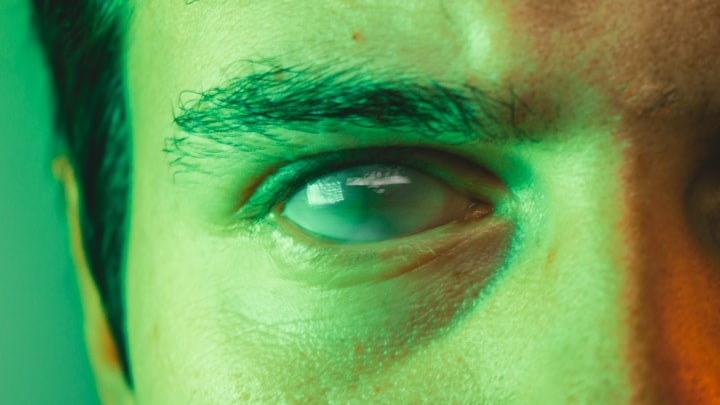
What resulted was a story that blended mystery, psychological tension, supernatural horror and romance. The narrator receives a note with the word "eyes", then meets a woman and he becomes obsessed with her gaze, the last thing he will see.
A story about entrapment that evolved into devotion, where his fear and longing became inseparable.
Interestingly, the limitation that made this a difficult piece to write helped elevate the atmosphere. The narrator's restricted voice mirrored his restricted movement, reinforcing the theme of surrender.
The Opening - Original Vs Edited
One of the most crucial sections of the story is the opening. Here's the original version -
Original Version
"Her gaze, deep yet absent, ethereal yet judgemental, was the last set of eyes my own saw before the world spun out of control. Moments became longer, and the passage of day to dusk became senseless. The four hours that preceded my encounter were a mystery. All that was brought to the forefront of my broken memory was a note pushed under my door that read "eyes". The reason for such a message was undoubtedly connected to the woman's eyes, whose wounded beauty caused an ache through my stomach. A powerful ache that held me locked where we stood bent forward before the woman who refused to tell me her name. As my eyes met her steely, deep green crystals, all the power that coursed through my body to my eyes couldn't peel them away from her gaze."
On closer reflection, I still love that I chose to begin with "her", immediately making the woman the focus of the whole story. However, some sentences feel too bloated. If I were to refine it, I might write -
Edited Version
"Her gaze, deep yet absent, ethereal yet judgement, was the last set of eyes my own saw before my world spun out of control. Mere moments became longer and the process of day to dusk, became senseless.
The four hours that preceded my encounter with her were a complete mystery. All that came to the forefront of my broken memory was a note pushed under my door. The note simply read "eyes".
The reason for such a message was clearly connected to her, the woman before me and her gaze. Whose wounded beauty caused my stomach to ache. An ache that locked me where we stood, bent before her. She refused to tell me her name. As my eyes met her steely, deep green crystal pools, all power that coursed through my body to my eyes couldn't peel them away from her gaze."
What I find interesting is that while this version is definitely tighter and more direct, it is missing some of the poetic, hypnotic quality found in the original.
That’s something I’ve discovered about editing, refining can enhance the clarity of a piece just as easily as it can strip away its essence. Great editing isn't just about cutting, it's about knowing when to cut and what to preserve.
The Turning Point - Original Vs Edited
A pivotal moment in the story is when the narrator stops resisting and starts to surrender to his fate.
Original Version
"Fear and lust overshadowed me as my head was full of her. All memory of my world was forever changed and featured her, only her. Her and her deathly, sensual gaze. Her and her shapely curves stunned and thwarted even the most powerful. Was to become her prey, my end? Hope seemed short on supply as my cerebral cortex was repurposed as a herald for her. My Empress. My Temptress. The last face my eyes gazed upon before my whole world was consumed by her."
I still love this passage for the rising tension and conflicting emotions, there's fear and devotion, terror and acceptance. However, some of the phrases could be smoother.
Edited Version
"Fear and lust overshadowed me as my head was full of her. All memory of my world was forever changed and featured her, only her. Her and her deathly, sensual gaze. Her and her shapely curves stunned and thwarted even the most powerful. Was my end to become her prey? There was a short supply of hope as my whole surrendered to her completely. My Empress. My Temptress. The last face my eyes gazed upon before my whole world was consumed by her."
In this revision, the language is tightened while retaining the sense of obsession and inevitability. The line "was to become her prey, my end?" now flows a lot better as "Was my end to become her prey?" and the awkward phrase "my cerebral cortex was repurposed as a herald for her" is replaced with a clearer and more evocative sentence.
How This Challenge Changed My Writing
Reflecting deeper on this piece and the challenge it presented, writing a first-person narrative without the letter "I" had a notable impact on my approach to writing fiction.
It showed me that constraints can be very liberating. They can actually force creativity and push us to find new ways of develop character perspectives, structuring sentences and telling stories.
First-person narratives often rely on I to create a level of intimacy, but this challenge proved that there can still be a strong personal voice even when expected tools are removed.
Would I go through this brain-mashing concept again? Perhaps not too often. But now my approach to writing is different, knowing there is flexibility with language and that sometimes, the best way to push things forward is by taking something away.
*
Thanks for reading!
Author's Notes: As fortune would have it, my ABCommunities challenge for this week was to write in the Critique community. A community I have written in before. To make things a bit interesting, I decided to combine this with an entry for the Self-Editing Ephiphany Challange that Vocal is running.
Here are some other things you might find interesting:
10/48
About the Creator
Paul Stewart
Award-Winning Writer, Poet, Scottish-Italian, Subversive.
The Accidental Poet - Poetry Collection out now!
Streams and Scratches in My Mind coming soon!
Keep reading
More stories from Paul Stewart and writers in Critique and other communities.
Cassie and Johnny
I’m the kind of dame you notice. I’m no femme fatale, but you can’t ignore me, at least not until I warn you about what’s coming, then everybody ignores me. Hell, they usually blame me afterwards and give Johnny all the credit for saving the day, but my Johnny couldn’t save a seat at the movies without my help. Sure, he’s brawny, but brainy? Not so much. Like that time I asked him to spot me five bucks, and he said he didn’t see it anywhere on me, and believe you me, he looked but good.
By Harper Lewis5 days ago in Critique
A Historic Declaration
We the People of the Husbands of the United States of America, in Order to form a more perfect Union, and I mean you...with me...establish Justice, insure domestic Tranquility, provide for the common defence, promote the general Welfare, and secure the Blessings of Liberty to ourselves, after Puberty, do ordain and establish this Declaration of Co-Dependence.
By Gerard DiLeo6 days ago in Humans

Comments (17)
Congratulations on your honorable mention, Paul! It was a pleasure to see your editing process, and I couldn't agree more that constraints can be liberating. 👏👏👏 😊
Honorable Mention 🤝 Honorable Mention
Wooohooooo congratulations on your honourable mention! 🎉💖🎊🎉💖🎊
Gotta love when fate just pulls everything together for you!! I loved the process and thought you shared with us here Paul!! Congrats on honourable mention for the self-editing challenge!! 🎉
I really appreciate the way you wrote this entry; it explains your process and thoughts.
Great job… fascinating looking inside your writing… & brain🤣✅. You’re as busy as ever 😊.
Your challenge article could also be a lesson in a Short story course teaching about writing and editing a story. Good job
I really liked how you approached this, Paul! Loved getting to see the original and edited versions side by side followed by your reflection regarding the changes! Excellent entry, friend!
This is such an interesting challenge, and I think you nailed it. I genuinely mean that. When I first saw this challenge, I had no idea what they were looking for, but I feel you just educated me. Well done, buddy. good luck.
Me, who also wrote an entry for this challenge from the first-person perspective reading all the interlocking complexity of themes: "And I just wanted to write a horror story set during the Vietnam War..." Although, interestingly enough, I also used the Lipogram restriction to my advantage. All the sentences of the journal are clipped and grammar is very much a second concern. This makes sense, because this is a soldier scrambling to record what he has seen with no confidence of how much time he'll have until the fighting starts again. Omitting the identifier "I" makes perfect sense; it's a journal, who else would be speaking? Keeps the voice consistent, too. Although, this being the first entry I've read for the Critique challenge, I find myself wishing for Track Changes, especially when it comes to sentence-level changes. Not your fault, obviously, but a reason why I was a bit leery of this challenge. Not sure Vocal's infrastructure is best set up to support this kind of introspection. Oh, and even if you hadn't trimmed the opening sentences, adding more paragraph breaks is still a marked improvement. Denser paragraphs should be used sparingly on an online platform like Vocal. I definitely change my writing style to match that approach when I write for here versus a short story intended for print I give myself license to lengthen paragraphs--to a degree, at least
I loved the insight in this - Its so odd, in the moment or just after writing something i Just can't do anything at all with it. It is as it it is and then months later i'll stumble across it and be like damn...i should have could have...i liked the honesty of you critique - although i definitely vote for keeping the hypnotic rambling but the third person really does create a surprising level of intimacy. Great as always! 💜C
I love your observations about your process and how it affected your approach to writing. Personally, I hated the Lipogram challenge and I’m glad it’s in the rear view mirror. I’m glad you are tackling this challenge, Paul, cause I could not come up with any sane way to prepare an entry for one of mine. Making literary forensics interesting is not my strong suite. Maybe after I read 3 or 4 of your entries something will click and I can do one of my own.
Sir Paul, I think you should start something like a workshop to help us improve our writing. If this doesn't place, I'd be severely disappointed!
The idea of writing a first person narrative without using "i" is fascinating. It means that you, the main character, can never be the subject but rather merely the object, never the actor but rather the one being acted upon. There is a sense of destiny without volition, of fate no matter how one approaches it. Excellent piece here, Paul. You have forced this mindless twerp to ponder, reflect & consider things. Not an easy task, I assure you.
Well done Paul. I really thought it was interesting to see you go back and review/ edit your own work with a fresh set of eyes (I’s!??) I agree - sometimes you can def over edit but there are certainly some of my stories where I can’t even bear to read them again let alone edit them. Good luck in the challenge!
I like this ✍️🌺🌺🌺
<3 Great way to combine an Official Challenge with an unOfficial one <3