
8 Mile: The Sorrow of a Raunchy Dream and a Daily Battle
When we talk about 8 Mile, it is not a movie. It is a moment, a "time" in life when hope and reality come together. It is the story of an aspiring young man, Jimmy Smith Jr., also known as B-Rabbit, who tries to leave his tough daily life behind through music.

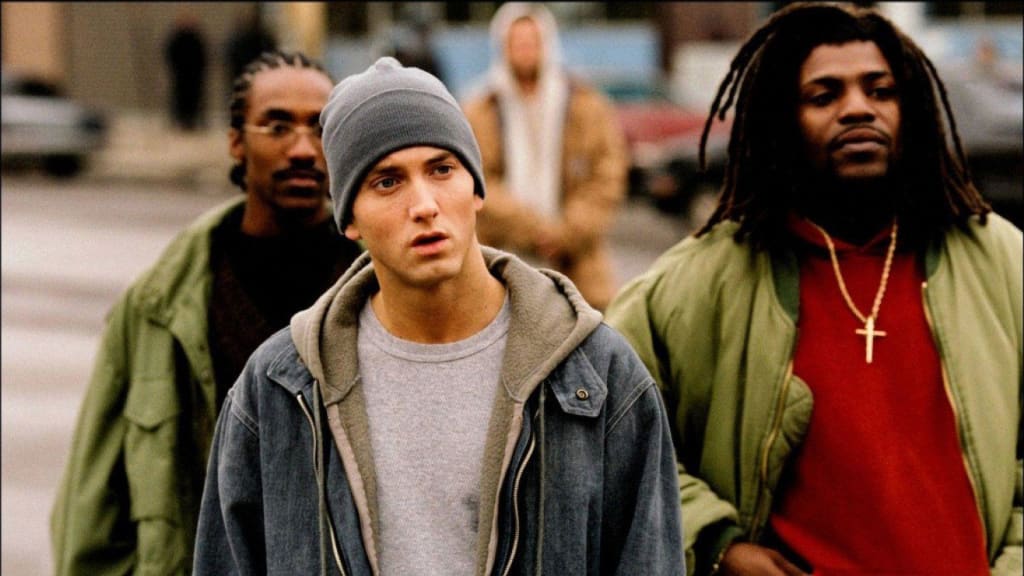
This 2002 film is not just a foray into the realm of rap ut a reflection of a man's battle within himself with his own personal demons. It is a raw and unflinching story that lingers long after the end credits.
The weight of beginnings
The opening scene of the film, where the street runs alongside 8 Mile Road, is symbolic of Detroit's richer and poorer residential areas. It is not merely a geographical divide but a cultural, social d economic one. Jimmy, who is played by Eminem, lives in Detroit, where dreams are shattered before they can even take shape. The film offers this reality untransformed and unadorned.
Behind every rhyme that he spits in battles, he tells a part of his story. It is the weight of his origin, this idea of life in which opportunities are often determined by where you're born. Jimmy is not just a rapper who desires to be famous – he is a human, a son of the city, a creation of circumstances. He must fight day in and day out, not just to remain relevant in rap, but also to survive in this life in which everything seems to be denied him.
Rap as catharsis
One of the most powerful aspects of 8 Mile is how rap is used as catharsis. Rap is not a pastime for B-Rabbit. It is a release, a lifeline, a way of expressing what words sometimes cannot. The rap battles, the focal point of the film, are actually far more than arguments. They are a way for Jimmy to process his anger, desperation and frustrations into something tangible. Each battle, he lets off steam, frees himself and most crucially, finds his voice.
The thing most amazing about 8 Mile is that the film does not glamorize rap as a shortcut to fame or riches. No, music in this film is a daily struggle, a way to prove we exist, that we matter, even if the rest of the world is opposed to us. The lyrics, often harsh, are knives thrust into the something society does not want to look at: the shattered hopes, the lives intertwined in the services of the system.
The final scene: the lion's awakening
The final scene, the final battle, is maybe one of the most thrilling experiences of cinema today. Not only is it a victory for Jimmy, but also a redemptive one. In his speech, he no longer battles his foes. He battles his demons, his frailties. By turning his frailties against him, he takes charge of his life, his destiny. It is this self-confrontation, in which he accuses his mistakes, his frailties, which is of a rare vigor. It is a movement towards liberty, a cry of victory over a world that has always considered him a loser.
The anthem "Lose Yourself" accompanying this scene is merely the icing on the cake. The lyrics are a rallying cry to take your moment, to not let the moment get away from you, even if it feels minute. This song, now an anthem to an entire generation, rings out like a battle cry against surrender.
An era, a culture
8 Mile is more than a rap movie. It is a symbol of an era. The early 2000s were the height of the rap era but also the beginning of a wild youth culture that could not be vanquished. Detroit, its abandoned factories and vacated streets, is a character in the film. It is symbolic of an era where everything seemed to be falling apart, yet where children, despite it all, fought for their dreams.
It is not merely the story of an artist's ascension to greatness. It is a tapestry of struggle. It is a study of small, small wins. And while the ultimate win appears to be a triumph, the message of the film is that victory does not always rest with external triumph, but with triumph over the self. The concept that, no matter where you begin, one can retool oneself, struggle and occasionally, emerge victorious.
Nostalgia for a lost dream?
Throughout the length of 8 Mile, we have an overarching feeling of nostalgia. It is one of dreams, of hope, of youth fighting for something more than themselves. And it's also one for a lost time, for a time when we still believed that anything was possible. The years go by and we realize that 8 Mile is more than just a rap movie. It is one about life itself. Life as it exists, with its victories and its losses, its highs and its lows.
But it is also a film about hope, of the sort that never dies, not even in the worst of times. When you watch 8 Mile, you do not merely see Eminem. You see a generation, a struggle, a search for meaning in a world that too frequently casts aside the voiceless. This film, as with the music that comes before it, is a testament to what it is to fight for your dreams, even when hope is gone. It is this that makes this film both universal and timeless.
About the Creator
Baptiste Monnet
Baptiste Monnet is a freelance author and thought leader. Focusing on social impact, he examines how personal growth and professional development drive meaningful change in today’s world.
Keep reading
More stories from Baptiste Monnet and writers in Critique and other communities.
The Man on Fire: A Story of Love, Sacrifice and Redemption
The Man on Fire, released in 2004 by Tony Scott and starring Denzel Washington, is much more than just an action film. It is a poignant dive into the twists and turns of the human soul, where violence mixes with raw emotion and redemption takes shape in the simplest gestures. But at the heart of this gripping thriller, what stands out above all is the unique relationship that develops between bodyguard Creasy and young Pita, a kidnapped girl.
By Baptiste Monnet3 months ago in Critique
Standing While Falling
Quotation from Friedrich Nietzsche "He who wrestles long with monsters should beware lest he himself become a monster. And if you gaze long into an abyss, the abyss also gazes into you. Man is not destroyed by suffering, but by the meaning he makes of it."
By LUCCIAN LAYTH5 days ago in Critique
The Tainted Cup
The Tainted Cup by Robert Jackson Bennett I made this entire series to write this review. The 2024 Hugo Winner is a Holmes and Watson style whodunnit taking place in a fantasy world that blends Area X from the Southern Reach Trilogy and The Lost World–more on the setting later.
By Matthew J. Fromm4 days ago in Critique


Comments