
The Palindrome Murders
When the Beginning Mirrors the End

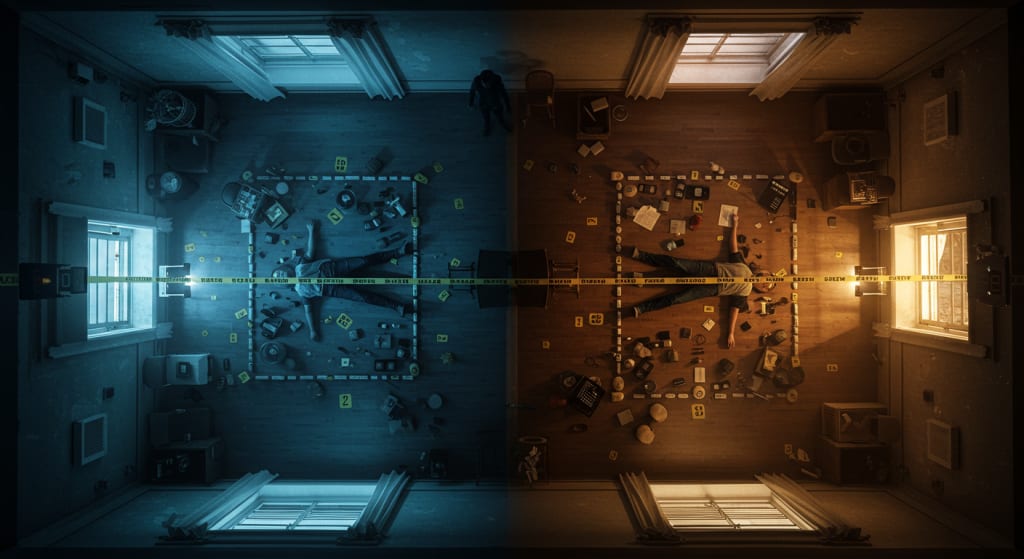
Detective Rhea Mercer had seen hundreds of crime scenes in her fifteen years with Homicide, but never one where the killer arranged the victim's possessions in perfect symmetry—until three bodies appeared across the city in one week, each staged like macabre mirror images.
The first victim was discovered on Monday morning in a downtown apartment, the body centered precisely on a white rug. Every object in the room had been meticulously arranged to create perfect bilateral symmetry—photos on the walls, books on shelves, even the victim's arms and legs positioned with mathematical precision. The medical examiner noted that the cause of death—a single puncture wound to the chest—had been delivered with surgical accuracy, directly through the sternum.
"It's like living in a damn Wes Anderson movie," Rhea muttered, photographing the scene. Nothing appeared to be missing or disturbed beyond the careful rearrangement. The victim, Martin Geller, was a 42-year-old accountant with no criminal record and no obvious enemies.
By Wednesday, when the second body appeared in an identical staging but in a completely different neighborhood, the press had caught wind of the pattern. "THE SYMMETRY SLAYER," screamed the headlines, forcing the department to call a press conference where they revealed absolutely nothing of value.
The third victim, discovered Friday in a suburban garage, broke the pattern in one significant way—the body was female, whereas the previous victims had been male. Detective Liam Rodriguez, Rhea's partner of three years, noticed something else while reviewing overhead crime scene photos back at the precinct.
"Rhea, look at this," he said, his voice tight with excitement. Liam had been diagnosed with dyslexia as a child, which he claimed gave him a different perspective on visual patterns. "The way the bodies and objects are arranged—they're forming letters."
Rhea looked over his shoulder at the three overhead shots laid side by side. "Jesus," she whispered. When viewed from above, each crime scene formed a distinct letter: R, A, and E.
"They're not random," Liam continued. "The killer is spelling something."
"RAE?" Rhea frowned. "That's not a word."
"Maybe it's not complete," Liam suggested. "Or maybe..."
"Maybe it's my name," Rhea said quietly. "Rhea. He's spelling my name."
A cold sensation settled in her stomach. Suddenly, the perfect symmetry felt like a message meant specifically for her. But why? She'd put away dozens of killers during her career—any one of them could harbor a grudge.
Captain Morris ordered protection detail for Rhea and expedited forensic analysis of all evidence. The results yielded nothing—no DNA, no fingerprints, no trace evidence that didn't belong to the victims. The only commonality between the three was that they had all lived in the city for less than a year.
It was Rhea who made the next breakthrough, after spending a sleepless night reviewing cold cases that had bothered her over the years.
"Liam, remember that case from twenty years ago? The music teacher who killed his students and arranged their instruments around them?"
Liam frowned. "Before my time."
"It was before mine too. I studied it at the academy—Eric Palliser. He killed five students before they caught him." She pulled up the old case files, her hands trembling slightly. "Look at these crime scene photos."
The images showed five separate murder scenes, each with bodies surrounded by carefully arranged musical instruments. But what struck Liam immediately was the overhead view—each scene, when photographed from above, formed a letter.
"D, A, E, R, H," Liam read aloud.
"It's a palindrome," Rhea whispered. "Read it backward."
"H, R, E, A, D... HREAD?" Liam looked confused.
"No, it's HRAED—which isn't a word either, but look." She wrote it out: HRAED.
"Reverse it," she continued, writing again: DEARH.
"Death," Liam said, the realization dawning. "He was spelling 'death,' but backward."
"Palliser was obsessed with palindromes—words and phrases that read the same forward and backward. His attorney tried to use it as evidence of mental illness, but the jury didn't buy it." Rhea flipped through more pages of the old case file. "He died in prison ten years ago."
"So we have a copycat?"
"Maybe." Rhea chewed her lip thoughtfully. "But why now? And why spell my name?"
The answer came the next morning when a fourth body was discovered, arranged to form the letter "H" from above. The victim was Daniel Weber, and unlike the others, his identity triggered immediate recognition—Weber had been the prosecutor who put Eric Palliser away twenty years ago.
"It's not a copycat," Rhea said, staring at Weber's body. "It's revenge. Someone's killing in reverse palindrome—working backward through the original case and spelling new messages."
As they dug deeper, connections emerged. The first victim, Martin Geller, had been the jury foreman at Palliser's trial. The second, Alan Schmidt, had been the lead detective. The third, Eleanor Kraft, had been the judge.
"He's killing everyone involved in Palliser's conviction," Liam realized. "But why spell your name?"
The answer was in Palliser's prison records. His cellmate for seven years had been Jeffrey Mercer—Rhea's estranged brother, whom she hadn't spoken to since he went to prison for armed robbery twelve years ago. Jeffrey had been released six months ago.
"He knows I'll figure it out," Rhea said quietly. "This is his way of connecting with me. The palindrome isn't just about revenge; it's his way of saying the past and future mirror each other."
By analyzing the pattern of Palliser's original murders and cross-referencing with everyone involved in his conviction, they identified the next potential victim—retired detective Samantha Voss, who had been first on the scene of Palliser's initial murder.
When they arrived at Voss's house, the front door stood slightly ajar. With weapons drawn, they moved through the silent house, finding nothing out of place until they reached the bedroom. There, arranged with perfect symmetry on either side of the untouched bed, were two chairs. On each chair sat folded clothes—a police uniform on one, civilian clothes on the other.
And propped against the pillows was a handwritten note:
"STEP ON NO PETS"
A perfect palindrome—reading the same backward and forward.
"He's not here," Rhea said, lowering her weapon. "He's warning us."
"But why didn't he kill Voss?" Liam asked.
The answer came in a text message to Rhea's personal phone: "MADAM IM ADAM."
Another palindrome, followed by an address—their old family home, abandoned since their parents died.
"He's not just recreating Palliser's murders in reverse," Rhea realized. "He's reversing everything—saving lives instead of taking them. The symbolism, the staging...he's creating anti-murders."
"That doesn't make sense," Liam argued. "Three people are dead."
"People who caused what he sees as an injustice," Rhea countered. "What if Palliser was innocent? What if Jeffrey discovered that during their time together?"
Records requested from the prison revealed that Jeffrey had spent years in the law library, filing appeals on Palliser's behalf even after his death. His final appeal had been denied six months before his release—just weeks before the first "palindrome murder."
When they arrived at the old Mercer house, Jeffrey was waiting on the porch, unarmed.
"You figured it out," he said simply. "I knew you would."
"Why not just tell me?" Rhea asked, keeping her gun trained on him. "Why kill those people?"
"Would you have listened?" Jeffrey's eyes were calm. "Palliser was innocent. I can prove it now—but no one would look at the evidence while those who convicted him remained in power."
The evidence Jeffrey had assembled was compelling—DNA analysis unavailable twenty years ago, witness statements that had been suppressed, timeline inconsistencies that pointed to someone else: Detective Alan Schmidt, the second victim, who had planted evidence to close the case quickly.
As Rhea placed her brother in handcuffs, he whispered one final palindrome: "A man, a plan, a canal: Panama."
"What does that mean?" Liam asked.
"It means sometimes you have to go to extreme lengths to make things right," Rhea answered, watching as her brother was placed in the back of a patrol car. "Even if the method is as twisted as the justice it seeks to correct."
Later, reviewing the case files alone in her apartment, Rhea realized the true sophistication of her brother's plan. The first letters of each victim's full name, when combined, spelled "MADAM I'M ADAM"—the palindrome that had started Eric Palliser's obsession, found scribbled in his music teaching notes twenty years ago.
The beginning had become the ending, and the ending had become a new beginning—a perfect palindrome of justice and revenge.
About the Creator
Edmund Oduro
My life has been rough. I lived in ghettos with a story to tell, a story to motivate you and inspire you. Join me in this journey. I post on Saturday evening, Tuesday evening and Thursday evening.
Keep reading
More stories from Edmund Oduro and writers in Criminal and other communities.
Whispers in White Noise
Audio forensics expert Tessa Reid made her reputation debunking "electronic voice phenomena" until the day she analyzed background noise from a ten-year-old murder scene and extracted a voice that shouldn't exist—the victim, speaking after time of death. When her findings are dismissed as technical glitches, Tessa launches her own investigation, discovering similar anomalies in five other unsolved homicides.
By Edmund Oduro9 months ago in Criminal
When Custody Becomes Commerce
Prison Blood, Political Access, and the Quiet Economy of Discretion (1960–2026) There is a moment that comes in long investigations when the facts stop behaving like isolated events and begin to line up. Not because someone is forcing them into a theory, but because they keep repeating the same shape.
By SunshineChristinaa day ago in Criminal
Ivan Raiklin and Michael Fanone Clash at Jack Smith Hearing: What Happened and Why It Matters
A heated confrontation between political activist Ivan Raiklin and former US Capitol Police officer Michael Fanone during a high-profile House Judiciary Committee hearing has drawn widespread attention in the United States. The incident occurred while former Special Counsel Jack Smith was appearing before lawmakers, turning what was already a politically charged proceeding into a moment of intense personal conflict.
By HIMANSHU GULATIabout 19 hours ago in Criminal
How, Too
Many people wonder how, too. You are not alone, and I am an expert. I will teach you how, too! First, you need to remit a small application fee and fill out an application describing the nature of your financial situation and how often payments will be made, as this will have great bearing on how well I teach you how, too.
By Harper Lewis7 days ago in Fiction



Comments
There are no comments for this story
Be the first to respond and start the conversation.