
Audio forensics expert Tessa Reid made her reputation debunking "electronic voice phenomena" until the day she analyzed background noise from a ten-year-old murder scene and extracted a voice that shouldn't exist—the victim, speaking after time of death. When her findings are dismissed as technical glitches, Tessa launches her own investigation, discovering similar anomalies in five other unsolved homicides.
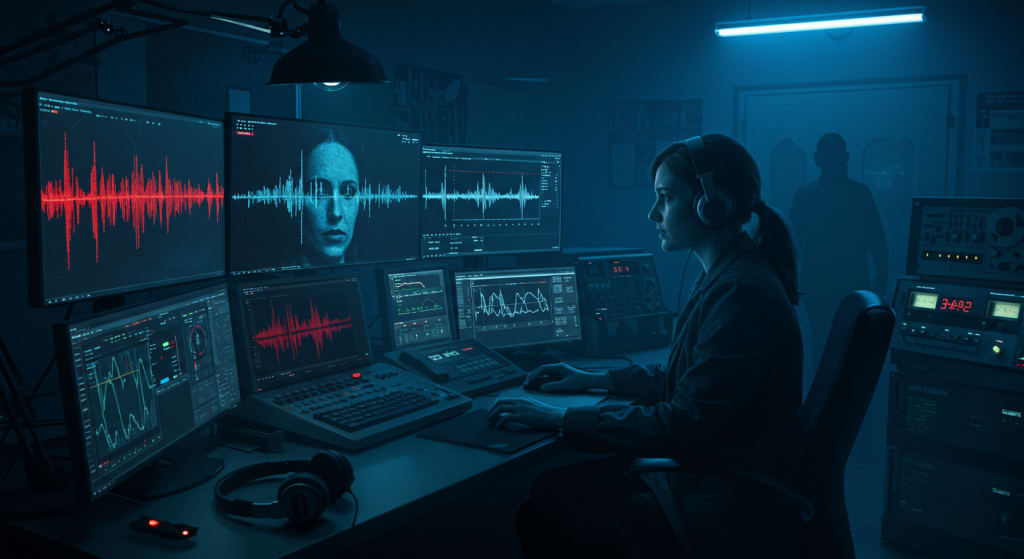
The police department's basement lab was silent except for the soft hum of equipment and the rhythmic tapping of Tessa Reid's fingernails against her coffee mug. On her monitor, sound waves rippled like water as she isolated and enhanced audio segments from a decade-old crime scene recording.
"Dr. Reid?" Detective Marcus Gaines appeared in the doorway, looking uncomfortable in the sterile environment of servers and specialized equipment. "Any progress with the Keller recording?"
Tessa sighed. "I've told you, Detective, audio forensics isn't magic. These recordings your team made ten years ago were captured on equipment that was already outdated then."
The Elizabeth Keller case had gone cold within months of her murder in 2014. Recently reassigned to Gaines, he'd been methodically reviewing all evidence, including ambient audio captured during the initial investigation—twelve hours of near-silence from the victim's apartment after the police had finished processing the scene but before it was released back to the family.
"There has to be something," Gaines insisted. "Keller's neighbor reported hearing voices arguing that night, but we never identified the second person."
"Background conversation from the hallway, television from an adjacent apartment, or simple pareidolia—hearing patterns where none exist," Tessa explained patiently. "The human brain is wired to find meaning in random noise."
"Just... keep trying," Gaines said before retreating.
Alone again, Tessa returned to the tedious process of filtering and isolating audio segments. She had built her career on scientific skepticism, earning a reputation for debunking claimed "electronic voice phenomena"—supposed ghostly voices captured in recordings—by demonstrating their mundane explanations. Her research paper, "Patterns in Noise: The Psychology and Acoustics of Perceived Paranormal Audio Phenomena," was required reading in forensic acoustics programs.
At 2:17 AM, exhausted and preparing to leave, Tessa decided to run one final algorithm—a new machine learning tool she had developed to separate overlapping vocal frequencies. She queued the program and gathered her belongings, expecting another dead end.
The lab speakers suddenly crackled to life.
"Behind the bookcase." A woman's voice—clear, distinct, and unmistakably from the recording.
Tessa froze, then rushed back to her workstation. The timestamp indicated the voice had been captured at 3:42 AM on the night of recording—five hours after Elizabeth Keller had been declared dead at the scene.
She replayed the segment, adjusting filters and scrutinizing the waveform. The voice came again: "Behind the bookcase. He put it behind the bookcase."
It was impossible. The apartment had been empty except for the victim's body, which had already been removed when this ambient recording was made. More importantly, dead women don't speak.
Tessa ran diagnostics on her equipment, checked for crossed signals or external interference, and methodically eliminated every rational explanation she could conceive. The voice remained, embedded in the white noise—a crystal-clear impossibility.
At dawn, she called Detective Gaines. "I found something, but it doesn't make sense."
Within an hour, they had obtained permission to re-examine Elizabeth Keller's apartment, now occupied by new tenants. The current residents watched curiously as Tessa and Gaines investigated the built-in bookcase along the living room wall.
"There's nothing here," Gaines said after a thorough examination.
Tessa frowned, replaying the voice in her head. "Behind the bookcase." Not inside or under, but behind. "Can we move it? Is it attached to the wall?"
The bookcase was heavy but not anchored. With the residents' permission and assistance, they carefully pulled it away from the wall, revealing a small hole in the drywall. Gaines donned gloves and reached inside, extracting a plastic bag containing a man's watch, crusted with what appeared to be dried blood.
Lab tests later confirmed the blood belonged to Elizabeth Keller, and the watch was registered to Richard Dalton, her former colleague who had never been considered a suspect. When confronted with this evidence, Dalton confessed to the murder.
Instead of celebrating, Tessa was disturbed. Her rational mind couldn't accept the source of their breakthrough—a voice that couldn't possibly exist. She told no one how she had really found the evidence, allowing Gaines to believe her audio enhancement had picked up ambient conversation from the original crime scene rather than a voice speaking hours after the victim's death.
Curiosity and scientific integrity drove her to explore further. Tessa requested access to audio recordings from other unsolved homicides, claiming to test new forensic algorithms. Over the next six months, she discovered five more instances of anomalous voices in recordings from crime scenes—always captured after the victims were dead, always providing specific details about their murders.
In the Rodriguez case, a male voice whispered coordinates leading to a boat dock where the murder weapon was recovered. In the Whitman homicide, a teenage girl's voice described her killer's distinctive tattoo. Each voice provided information only the victim could know, and in each case, Tessa found rational explanations to share with investigators while keeping the true source of her insights secret.
She became obsessed with understanding the phenomenon, converting her home office into a research lab dedicated to analyzing what she now called "residual acoustic phenomena." If these voices weren't supernatural—and her scientific training refused to accept that they could be—then some unidentified natural process must be encoding human experiences into the ambient electromagnetic field before death, to be captured later under specific conditions.
On a cool autumn evening eighteen months into her classified research, Tessa was working late at the police lab when Detective Gaines brought her a new case—a suspected homicide discovered that morning.
"No rush on this one," he said, dropping off the evidence bags containing the victim's smartphone and digital recorder. "Just preliminary scans when you have time."
Alone in the lab, Tessa began her standard protocols, downloading and backing up the audio files before enhancement. As the victim's voice recorder played through her sophisticated system, she suddenly heard something that made her blood run cold—her own voice, crystal clear against the background noise:
"He's standing behind you now. Don't turn around."
Tessa instinctively started to look over her shoulder, then froze. The time stamp on the recording was from three hours in the future.
Her hands trembling, she continued the analysis, hearing her own voice describe a man entering the lab, a sharp pain in her back, and darkness following. Her voice gave specific details: the attacker's cologne, the sound of his breathing, the exact words he would say.
Heart pounding, Tessa gathered her equipment and prepared to leave the lab, but stopped at the door. If this phenomenon was real—if these "residual acoustic phenomena" actually contained information from victims—then what she had just heard was a warning of her own impending murder. And if she could record her own death before it happened, then the entire concept of linear time was in question.
Instead of fleeing, she set up additional recording equipment throughout the lab, activated the security cameras, and placed a call to Detective Gaines.
"I need you to come to the lab immediately," she said calmly. "And I need you to bring backup."
"What's going on?" Gaines asked.
"Someone's going to try to kill me tonight," Tessa explained. "And I can prove it."
"How could you possibly know that?"
"The same way I found Elizabeth Keller's watch. The same way we solved the Rodriguez case and the others. I've been hearing voices in the recordings, Detective—voices that shouldn't be there."
There was a long silence before Gaines responded. "I'll be there in twenty minutes. Don't open the door for anyone else."
While waiting, Tessa reviewed the security protocols for the building. Access to the basement lab required keycard authorization, and the system logged all entries. She pulled up the access records for the past month and noticed a pattern—late night entries by Dr. Lawrence Merritt, a senior technician who had no active cases requiring after-hours work.
The same Dr. Merritt who had processed evidence in all six unsolved homicides where she had detected anomalous voices.
The same Dr. Merritt who had been passed over for promotion when Tessa was hired to head the audio forensics division.
The timestamp on her predicted death was approaching. Tessa locked the lab door and continued monitoring the security feeds, watching as a figure appeared in the hallway—Dr. Merritt, carrying what appeared to be a sample case.
He swiped his keycard at her door. Red light—access denied. Tessa had locked the system down. He tried again, then pulled something else from his pocket—a security override card stolen from the administrative office.
As the door mechanism beeped, accepting the override, Tessa's voice emerged from her speakers, describing the scene unfolding before her: "He's entering now. The overhead light reflects off the blade."
The recording continued as the real Dr. Merritt pushed open the door, surprise registering on his face when he saw Tessa standing calmly behind her workstation, surrounded by active recording equipment and with Detective Gaines emerging from the supply closet where he had been hiding, weapon drawn.
"Lawrence Merritt," Gaines announced, "you're under arrest for the murders of Elizabeth Keller, Martin Rodriguez, Sophia Whitman..."
As Merritt was handcuffed and led away, Tessa realized her recording had stopped—the future she had heard would not come to pass. The paradox was mind-bending: if she had prevented her own murder, how had she heard it in the first place?
In the months that followed, Tessa's research revealed the truth behind the "whispers in white noise." Merritt had been planting audio files in the evidence—sophisticated deepfakes created from victims' social media videos and voice samples, embedded within white noise frequencies that only specialized equipment could detect. His goal had been to discredit Tessa by having her report impossible findings, ultimately destroying her professional reputation.
Instead, her skepticism and methodical approach had uncovered his involvement in multiple homicides spanning a decade. The voices weren't paranormal; they were breadcrumbs deliberately left by a killer who couldn't resist showcasing his technical brilliance, even at the risk of being caught.
But one question remained unanswered: the recording of Tessa's own voice describing her murder—a murder that never occurred. She had analyzed that file thousands of times and found no evidence of tampering or deepfake technology. It was her voice, describing events that had been prevented precisely because the warning existed.
Sometimes, in the darkest hours of the night when the lab hummed with electronic life, Tessa wondered if she had discovered something beyond science—a quantum loophole where information could travel backward through time under very specific conditions.
Or perhaps, she thought as she listened to the white noise between radio stations on her drive home, perhaps the universe itself was engaged in a conversation we were only beginning to hear.
About the Creator
Edmund Oduro
My life has been rough. I lived in ghettos with a story to tell, a story to motivate you and inspire you. Join me in this journey. I post on Saturday evening, Tuesday evening and Thursday evening.
Keep reading
More stories from Edmund Oduro and writers in Criminal and other communities.
Cold Case Heat Map
When budget cuts threatened to shut down the cold case unit, analyst Sam Kovac created a controversial heat map—an algorithm tracking hundreds of unsolved cases against seemingly unrelated data points: weather patterns, economic indicators, and social media trends. The department mocked his methods until his map predicted the exact location where a forty-year-old victim's missing locket would be found.
By Edmund Oduro9 months ago in Criminal
Why Khloé Kardashian’s Ex Lamar Odom Was Arrested in Vegas
Lamar Odom, former NBA player and ex-husband of Khloé Kardashian, was arrested on Saturday morning in Las Vegas, Nevada. Lamar, who won the 2009 and 2010 championships with the Los Angeles Lakers, was previously arrested in 2013.
By Dena Falken Esq4 days ago in Criminal
Inside The Br@ tal Methods Of N@ zi Secret Police GESTAPO
They worked deep undercover with a name feared as words moved across Nazi occupied Europe. Gestapo: short form of Geheime Staatspolizel, or Secret State Police: the steel fist of Hitler and his machine of terror, entrusted with the job of tracking down foes of the Reich. However their actions behind the scenes were more terrible than many would ever imagine. In contrast to ordinary police, Gestapo never faced any supervision, did not present any warrant, and acted freely. Their methods was cruel: they could arrest a person because somebody whispered something, because a neighbour pointed an accusing finger, even because he shared a joke. Upon arrest individuals just vanished off the face of the earth with some never being heard of once again... (more)
By Live World Stories5 days ago in Criminal



Comments
There are no comments for this story
Be the first to respond and start the conversation.