
The Murder of Bob Crane: Hollywood’s Darkest Cold Case
The Star Who Lived Two Lives

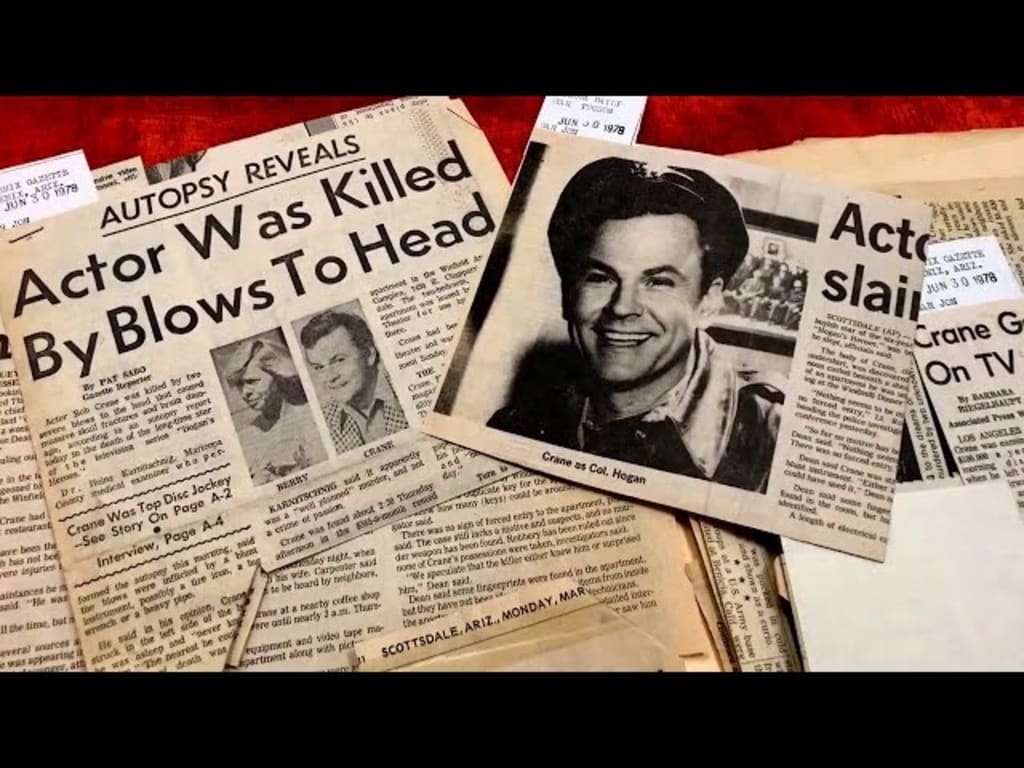
Bob Crane was the kind of guy who could light up a room. In the 1960s, he was America’s favorite wisecracking WW2 POW, Colonel Hogan, on the hit sitcom Hogan’s Heroes. Off-screen, he was just as charming—quick with a joke, always ready to sign an autograph, and never too busy for a fan. But behind the laughter, Crane was a man with secrets, and those secrets would follow him to a lonely apartment in Scottsdale, Arizona, where his life ended in violence and mystery.
June 29, 1978: The Scene of the Crime
On the morning of June 29, 1978, Bob Crane’s “Biginner’s Luck” co-star, Victoria Ann Berry, found him dead in his bed. The scene was brutal: Crane had been bludgeoned to death, the weapon likely a camera tripod, and an electrical cord was wrapped around his neck. There were no signs of forced entry. The Scottsdale police, more accustomed to dealing with snowbirds and shoplifters than Hollywood homicides, suddenly found themselves at the center of a media circus.
Crane was 49. His career had cooled since the glory days of Hogan’s Heroes, but he was still working — touring with dinner theater productions, hustling for the next gig. He was also living a double life, one that would become tabloid fodder for years to come.
Sex, Cameras, and Suspects
Bob Crane’s private life was an open secret in certain circles. He was obsessed with sex, and he documented his encounters with a camera, often with the women’s consent, sometimes not. His partner in these escapades was John Henry Carpenter, a video equipment salesman Crane had met years earlier. Carpenter helped set up Crane’s home video system and often joined him in his pursuits.
When police started digging, Carpenter’s name rose to the top of the suspect list. He’d been in Scottsdale the night of the murder, staying at a nearby motel. Blood was found in his rental car, but the technology of the time couldn’t match it to Crane. Carpenter denied any involvement, insisting he and Crane were friends, nothing more.
The Investigation: Fumbling in the Dark
The Scottsdale police were out of their depth. Evidence was mishandled, the crime scene wasn’t properly secured, and crucial leads went cold. The media, hungry for scandal, painted Crane as a fallen star undone by his own appetites. The case became a national obsession, but the investigation stalled.
For years, the murder of Bob Crane was a Hollywood ghost story — an unsolved crime that haunted everyone who touched it. Carpenter moved on with his life, but suspicion never left him. Crane’s family, especially his son Robert Crane Jr., pushed for answers, but the case grew colder with each passing year.
A Cold Case Reopened
In the early 1990s, advances in DNA technology gave investigators new hope. The blood found in Carpenter’s car was retested, but the results were inconclusive. Still, the Maricopa County Attorney’s Office decided to take a shot. In 1994, John Henry Carpenter was arrested and charged with Crane’s murder.
The trial was a media spectacle. Prosecutors argued that Carpenter, jealous over Crane’s decision to end their friendship, killed him in a fit of rage. The defense countered that the evidence was circumstantial, the investigation sloppy, and the prosecution’s case built on innuendo. After a month-long trial, the jury acquitted Carpenter. He died in 1998, still proclaiming his innocence.
Theories and Shadows
With Carpenter gone, the case faded from the headlines, but the questions never went away. Some believe Carpenter was guilty, that the evidence, though thin, pointed to him and no one else. Others think the real killer was someone from Crane’s tangled web of lovers, or perhaps a jealous husband or boyfriend. There are even those who suspect the murder was a robbery gone wrong, or that Crane’s own risky lifestyle finally caught up with him.
What’s clear is that Bob Crane’s murder was a perfect storm of bad luck, bad timing, and bad police work. The Scottsdale PD, unprepared for a case of this magnitude, made mistakes that can’t be undone. Evidence was lost, leads weren’t followed, and the window for justice closed long ago.
The Legacy of a Cold Case
Bob Crane’s story is about fame, addiction, and the dark side of celebrity. He was a man who had it all — talent, charm, success — but couldn’t outrun his own demons. His murder remains one of Hollywood’s most enduring mysteries, a case that refuses to be solved.
For true crime writers and armchair detectives, the Crane case is irresistible. It has all the elements: a beloved celebrity, a lurid double life, a prime suspect who slipped through the cracks, and a police department in over its head. Every few years, a new book or documentary promises to crack the case, but the truth remains elusive.
The Human Cost
Lost in the tabloid frenzy is the simple fact that Bob Crane was a father, a friend, and a man who deserved better than to be remembered only for the way he died. His family has spent decades searching for answers, hoping for closure that may never come. For them, the case isn’t just a story — it’s a wound that never healed.
Conclusion: The Case That Won’t Die
Nearly half a century after Bob Crane’s murder, the case is as cold as ever. The evidence is old or gone, the suspects are dead, and the answers are buried under layers of rumor and regret. But the story endures, a reminder that even in Hollywood, the land of make-believe, some mysteries are all too real.
Bob Crane’s life was a study in contradictions — public laughter, private pain, and a violent end that no one saw coming. His murder is a riddle with no solution, a Hollywood tragedy that refuses to fade to black. And as long as there are people drawn to the shadows behind the spotlight, the question will remain: Who killed Bob Crane?
If you enjoy my writing, would you consider a $1.00 tip using the Vocal Media tipping link? Thank you!
About the Creator
MJonCrime
My 30-year law enforcement career fuels my interest in true crime writing. My writing extends my investigative mindset, offers comprehensive case overviews, and invites you, my readers, to engage in pursuing truth and resolution.
She Killed Her Sister When She Gave The Teen's Virginity to Her Boyfriend
Any person who can rape and kill an innocent member of their family is truly depraved. One who later admits they enjoyed it is truly demonic. Yet, a woman who took her criminal behavior to the depths of depravity is not even behind bars.
By Criminal Matters8 days ago in Criminal



Comments
There are no comments for this story
Be the first to respond and start the conversation.