
The Final War Between India and Pakistan
The Last Stand on the Subcontinent

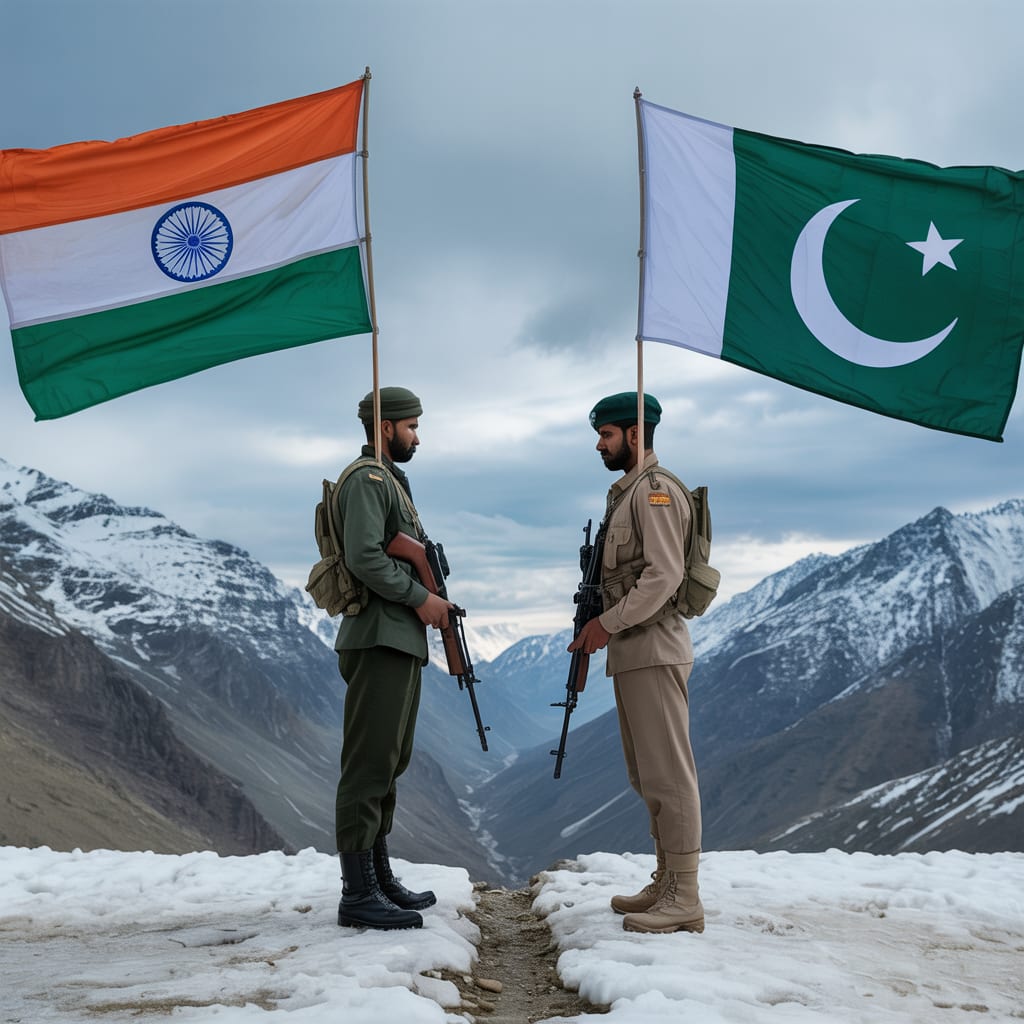
In May 2025, tensions between nuclear-armed neighbors India and Pakistan reached a perilous peak, marking the most severe military confrontation in decades. The conflict, ignited by a deadly attack in Indian-administered Kashmir, rapidly escalated into a full-scale exchange of missile strikes, air engagements, and drone warfare, with both sides accusing each other of aggression.
Retaliation and Escalation
On May 8, Pakistan launched "Operation Bunyan Ul Marsoos," targeting Indian military sites, including missile storage facilities. Both nations reported civilian casualties and infrastructure damage. In the ensuing air engagements, over 120 fighter jets clashed over the Line of Control, marking one of the largest aerial battles since the Gulf War. India lost three Rafale jets, a MiG-29, and a Su-30MKI, while Pakistan downed at least 77 Indian drones.
The Indus Waters Treaty Crisis
Compounding the conflict, India suspended the Indus Waters Treaty on April 23, 2025, citing national security concerns following the Pahalgam attack. This move allowed India to reduce the flow of water through the Chenab River, which Pakistan claims has dropped by 90%. Pakistan warned that any disruption to the river's flow could be considered an act of war, raising fears of nuclear escalation.
The international community expressed deep concern, with the United States, United Kingdom, China, and the G7 urging both nations to de-escalate and resume dialogue. Secretary of State Marco Rubio offered to mediate discussions to prevent further escalation. Despite these efforts, both countries maintained high military readiness, and civilian casualties continued to rise. In Pakistani-administered Kashmir, at least 13 civilians were killed, and over 50 injured, with widespread displacement due to shelling.
As of May 10, 2025, both India and Pakistan have indicated a conditional willingness to halt hostilities if the other reciprocates. However, deep mistrust and the absence of clear strategic objectives make a peaceful resolution increasingly difficult. Analysts warn that without third-party intervention, the situation could spiral into a broader and more devastating conflict.
The 2025 India–Pakistan conflict underscores the fragility of peace in South Asia and the catastrophic potential of nuclear-armed neighbors engaged in open warfare. The coming days will be critical in determining whether diplomacy can prevail over military escalation.
In May 2025, India and Pakistan plunged into their most dangerous confrontation since the Kargil War, following a brutal terrorist attack in Indian-administered Kashmir that left 26 Hindu pilgrims dead. India swiftly launched "Operation Sindoor," a series of precision airstrikes targeting alleged terrorist infrastructure in Pakistan-administered Kashmir. Pakistan retaliated with "Operation Bunyan Ul Marsoos," striking Indian military bases and escalating the conflict into open warfare. The skies over the Line of Control turned into a battleground, with over 120 fighter jets involved in intense dogfights. Both nations suffered losses, with India losing advanced jets and Pakistan downing dozens of Indian drones. Meanwhile, India suspended the Indus Waters Treaty, choking water flow to Pakistan and heightening fears of nuclear retaliation. Civilian areas on both sides were hit by missile strikes, forcing mass evacuations. Despite mounting international pressure, including mediation offers from the U.S. and China, both countries remained locked in a dangerous stalemate. The humanitarian toll has been severe, with dozens dead and hundreds displaced. As the threat of nuclear escalation looms, the 2025 conflict serves as a stark reminder of the volatility in South Asia and the urgent need for diplomatic resolution before irreversible damage is done.
About the Creator
Keep reading
More stories from Masood Zahid and writers in Criminal and other communities.
India–Pakistan Tensions Rise
A deadly militant attack in Indian-administered Kashmir has reignited long-standing tensions between South Asia’s two nuclear-armed neighbors, India and Pakistan. The incident, which claimed the lives of 26 individuals—mostly Hindus—has triggered a new wave of diplomatic, military, and geopolitical unease in the region.
By Masood Zahid10 months ago in Criminal
The Impossible Prison Break - Alcatraz Escape
FBI officers were stunned. This was a prison where even if a prisoner was left out in the open, escape seemed impossible. Yet somehow, right under the noses of the authorities, three inmates managed to break out. What was even more shocking was that for nearly 10 hours, the prison authorities had no idea they were missing.
By Imran Ali Shah6 days ago in Criminal
Jennifer Kesse: The Unidentified Man and the Vanished Car
The disappearance of Jennifer Kesse remains one of the most perplexing and heartbreaking unsolved missing persons cases in Florida. On January 24 2006 the 24-year-old finance manager vanished from her condominium complex in Orlando without a trace. Nearly two decades later her whereabouts are still unknown, no arrests have been made and the mystery continues to captivate true crime enthusiasts and haunt her family.Jennifer Joyce Kesse was a bright, ambitious young woman living in Orlando Florida. She worked as a finance manager at Central Florida Investments, a timeshare company in Ocoee. Having graduated with a finance degree she had built a stable life, purchasing her own condo in the gated Mosaic at Millenia community near the Mall at Millenia—a place she chose partly for its security features, including a guard. Jennifer was described by loved ones as responsible, family-oriented,and safety-conscious. She maintained close ties with her parents,Drew and Michelle Kesse and her boyfriend Rob Allen.
By Kure Garba3 days ago in Criminal




Comments
There are no comments for this story
Be the first to respond and start the conversation.