
The End of Chocolate
Having lost its innocence, chocolate joined the sordid ranks of opium, fentanyl, and cocaine.
John felt nothing as he watched with curiosity a mosquito that had landed on his arm. Its tiny proboscis, like a syringe, probed beneath his skin until it sank into a warm, pulsing capillary. As the mosquito silently sipped his blood, John thought of the millions of people worldwide who each year are infected with deadly diseases by mosquitoes just like this one. He could swat at it, but why bother? Inevitably another would find him, probably while he slept, if only he could sleep. There was no rest to be found in cell 26, and nowhere to escape. Tomorrow at sunrise, John was scheduled to be taken down the hallway, strapped to a cold metal table, fastened to a heart monitor, and injected by a hypodermic needle containing a mixture of lethal chemicals. As a condemned prisoner on death row, John's time was up. All legal appeals had proved futile, so solid was his conviction for having committed most heinous murder, not of one person, but of thousands.
Alerted by the sound of a click followed by a metal lock turning and the scraping of a door swinging open on rusty hinges, John sat up. The mosquito took to the air and, whining in flight, made its way toward the window, which was no more than a thin slit opening to a world from which John was evermore separated. All that penetrated into his cell was a sliver of light from the afternoon sun and the incessant, sweltering heat that bathed this remote, nameless outpost somewhere south of the border.
"Do you have a final request?" asked officer Carlos gruffly.
"A rich, juicy slice of chocolate cake," answered John. With the ghost of a grin, he added, "served with vanilla ice cream."
"Is that a joke?" replied Carlos, dumbfounded. "You know as well as anyone -- better than anyone -- that chocolate is illegal."
"I had imagined you would find a way. Doesn't the irony arouse your interest? After all, it was chocolate that sent me to prison."
Carlos paused, not knowing what to say. John sat quietly, poker-faced, seemingly undisturbed as another mosquito lit on his brow. Calculating and imperturbable, John had an instinct for reading others. In any other situation, he would know how to get what he wanted, but this time he had exhausted all strategies. There would be no rescue. And yet, he had noticed Carlos jotting down notes after previous visits to his cell. Carlos asked more questions than the other guards. What was his game?
Carlos spoke. "I think I do know a way to get you that chocolate, but it will cost you."
Almost amused, John replied, "Now it is you who are joking. Look at me. I've been confined to this cell for months. My bank accounts are empty. My possessions have been sold at auction. Apart from this soiled orange jump suit, all I have to offer are the drops of blood that these wretched mosquitos have already laid claim to. What on earth do you mean?"
"I want to know how you did it," replied Carlos. "You see, I have a family to support, and this security job doesn't pay well. I've always wanted to be a writer, but that doesn't pay well either. When I read about your conviction in the news, I thought, well, if I could learn the details of your criminal history, maybe I could strike a deal with a publisher and write a best-selling exposé. I could be the one to disclose your story."
"Why should I trust you to tell it?" responded John, looking rather annoyed.
"Because if you remain silent, others will write a different story. And the public will believe them. Some are saying that you are as cruel as an injured viper. Others are claiming that you are a madman whose brain has gone terribly wrong. When the hour of your execution comes, the public will have made up its mind that you are evil incarnate, a curse on humankind to be gotten rid of once and for all. That is, unless you tell me your story. I think there is more to this than we have seen in the media."
"And why do you think that?" John's voice quieted.
"Because I saw you last week in the cafeteria. You were hungry, but you gave your ration to another prisoner who was weak and demoralized. You are not the terrible man they say you are. Not deep inside. Am I right?"
John looked straight at Carlos. A gentle quality came over his eyes. His facial expression now displayed a softness that Carlos had not seen before.
"Have a seat," John gestured. Taking a deep breath, he continued, "I will tell you my story, because I trust you to hear me out. It all began 20 years ago at GeneTweak, the pharmaceutical company that hired me to research the molecular biology of cacao beans."
"That's the same as cocoa, the source of chocolate, right?"
"Correct. It is hard to imagine now, but chocolate at one time was the most popular food flavor in the world and a favorite dessert. Not only were chocolate bars eaten as snacks and cocoa added to milk and pastries, but it was safe to eat, even healthy to eat. As a scientist, I wanted to understand why people liked chocolate so much, and after that, to improve it. We had the technology to isolate and study its components, manipulate them, and create in the laboratory an enhanced version of chocolate. If chocolate was good, I determined that I could make a better chocolate, and not only in flavor."
John continued: "To begin with, I separated chocolate into its constituent chemicals and studied their effects on the brain. Among chocolate's natural ingredients are theobromine, which is a stimulant; tryptophan, which is a precursor to serotonin; phenylethylamine, which is related to amphetamine and increases the release of dopamine; and tyramine, a precursor to dopamine, which interacts with the brain's reward center."
"Whoah! Slow down. Can you simplify that?" asked Carlos, writing furiously on his notepad.
"Yes," replied John. "Essentially, chocolate enhances mood, alertness, and energy, but these effects are quite mild. By rearranging the cacao genome, inserting DNA sequences here and there, and selecting out the best of the modified forms, I created a new variety of cacao with all of these qualities amplified far beyond what anyone had imagined. The genetically modified cacao plant produced a chocolate with a taste -- how can I put it? -- to die for. Not only was it more delicious, but I engineered it so that eating it produced a state of well-being, dynamism, and euphoria. Chocolate-eaters could become more than human."
"Once GeneTweak marketed the new chocolate," continued John, "profits soared. Celebrities branded their personal flavors. Chocolate parties were all the rage. Intoxicated on the new chocolate, people forgot their troubles. Cacao farmers found that they could double their income by replacing native cacao plants with the genetically modified variety. The new plants gradually replaced native plants in every country where cacao is grown."
Still late afternoon, but with evening approaching, clouds had gathered in the sky outside. The thin ray of light reaching the cell gradually dimmed, and the shadows across John's face darkened.
"What clued you in that things were starting to go wrong?" asked Carlos.
"GeneTweak made no provision for protecting the native plants, which we later learned was a mistake. But it was too late. They are now extinct. At the same time, chocolate had become less pleasurable and more instrumental. We saw chocolate not as a gift from nature to be enjoyed, but as a commodity to exploit, and our customers' desire for it could also be exploited. I had concerns, but it was easy to look the other way because the customers were happy and our profits were increasing."
Adjusting his posture, John sat more erect. "Then the news reports came. Man mugged for chocolate bar. Bitter divorce battles over chocolate supply. Family hoarding chocolate goes bankrupt. Street gang war erupts over chocolate sales. Teens, destitute, cannot stop eating chocolate. These and other headlines saturated the news cycle. No longer was chocolate the delightful snack affordable by all. Having lost its innocence by gaining in potency, chocolate had joined the sordid ranks of opium, fentanyl, and cocaine. We had gone too far. Chocolate had become a killer drug."
"Did you express your concerns to your company?" asked Carlos.
"I did, many times. But they needed a scapegoat. Claiming ignorance of the science behind the new chocolate, and assisted by a team of lawyers, the executives pointed their fingers at my research while quietly divesting the company of chocolate research and sales. I found myself in the media crosshairs, my hands covered with evidence of chocolate. And now I am here."
"The hour is getting late and the time has come for me to go," interjected Carlos as he closed his notebook. "Thank you for sharing your story. My shift is up, and my replacement will soon arrive. But don't worry. You will have your chocolate. I promise."
John had no further visitors that night other than an occasional mosquito. No one brought chocolate cake. His stomach remained empty.
Morning came, and as scheduled, John, in handcuffs, was escorted down a narrow hallway to the procedure room. Lined with labeled drawers and electrical outlets and illuminated by hanging fluorescent lights, what the room lacked in hygiene it made up in utilitarian construction. Two guards John did not recognize restrained him on the table while a medical practitioner inserted an intravenous catheter into his right arm and checked to ensure that saline fluid was flowing.
"Where is Carlos," asked John anxiously. He was alone in showing any emotion.
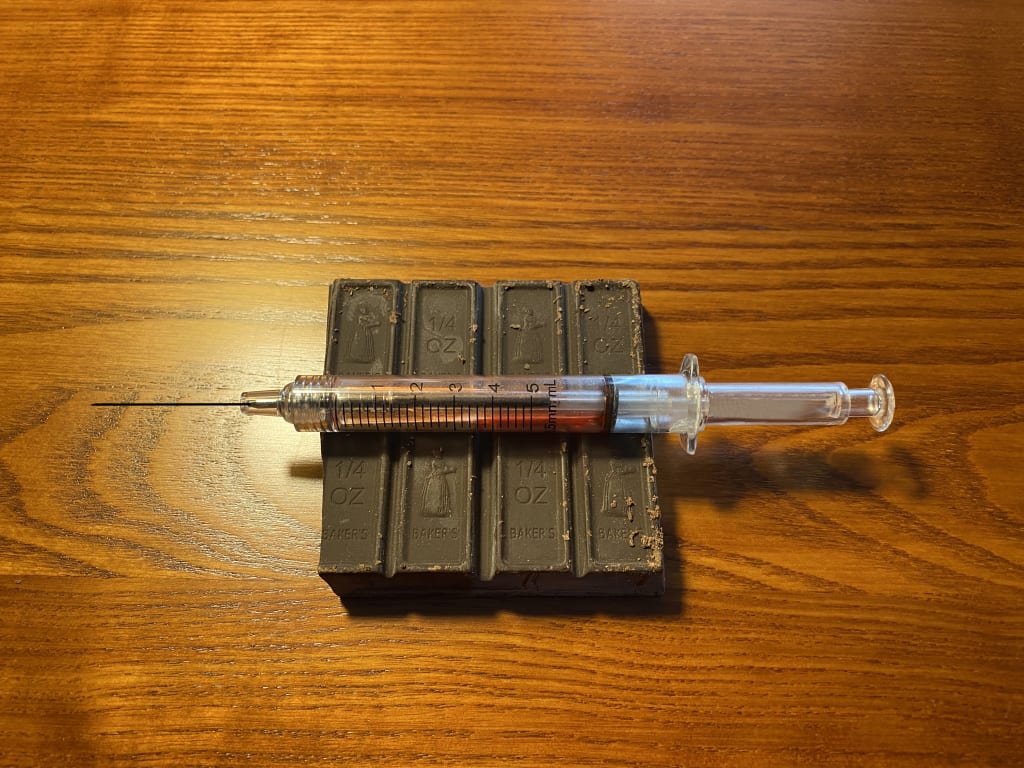
"I'm right here," said Carlos, stepping forward. In his hand was a plastic box with a bright yellow biohazard emblem on its cover. Carlos carefully set the box on the table, broke the seal, and removed a large glass syringe. Ceremoniously raising it, he flicked the bubbles loose, squirted a small amount from the tip, and inserted the needle into John's intravenous line.
"You forgot the chocolate," muttered John, his final words.
"No, I remembered," said Carlos. "In this syringe that I am injecting into your arm right now is a brown liquid containing pancuronium bromide, potassium chloride, and -- the final ingredient -- chocolate. Rest in peace."
About the Creator
William Cheshire
I am a neurologist who enjoys writing about things that matter.
Keep reading
More stories from William Cheshire and writers in Criminal and other communities.
Before Solitarius
"Ever wonder what happened to all the trees?" asked Sani. Lost in thought and neglecting her lunch, his granddaughter Haseya, who had just graduated from high school and was visiting from Maryland, gazed out his apartment window to a bleary, barren sandscape of dirt and debris stretching as far as the eye could see. Dust clouds danced at the edge of an enormous crater that marked the center of a radial array of white lines etched in the scorched ochre soil and extending out, like spokes of a wheel, for miles in all directions. The empty sky, drained of blue, invited no birds, nor were there any trees or branches on which birds might rest. Lying crooked across the forbidding wasteland was a long, white, fallen rectangular structure with a pointed end. Its crumbling stones, vaguely aligned, had long ago forgotten how to fit together.
By William Cheshire5 years ago in Futurism
The House voted separately on DHS funding
Why Thomas Massie Can Thwart Trump With Impunity A small group of House Democrats joined Republicans on Thursday to approve a funding bill for the Department of Homeland Security (DHS), defying pressure from within their party as criticism mounts over the Trump administration’s immigration enforcement policies.
By Organic Products 6 days ago in Criminal
Ponzi Schemes and Boiler Rooms in Australia: The No‑Spin Guide to Spotting, Stopping, and Surviving Them
Let’s cut to the chase… what are these things, really? Look… “Ponzi scheme” and “boiler room” sound like movie plots. But they’re not rare, and they’ve been getting slicker lately. Thing is, the bones never change.
By Dan Toombs2 days ago in Criminal



Comments
There are no comments for this story
Be the first to respond and start the conversation.