
Before Solitarius
A post-apocalyptic tale of intergenerational wordplay and revelation
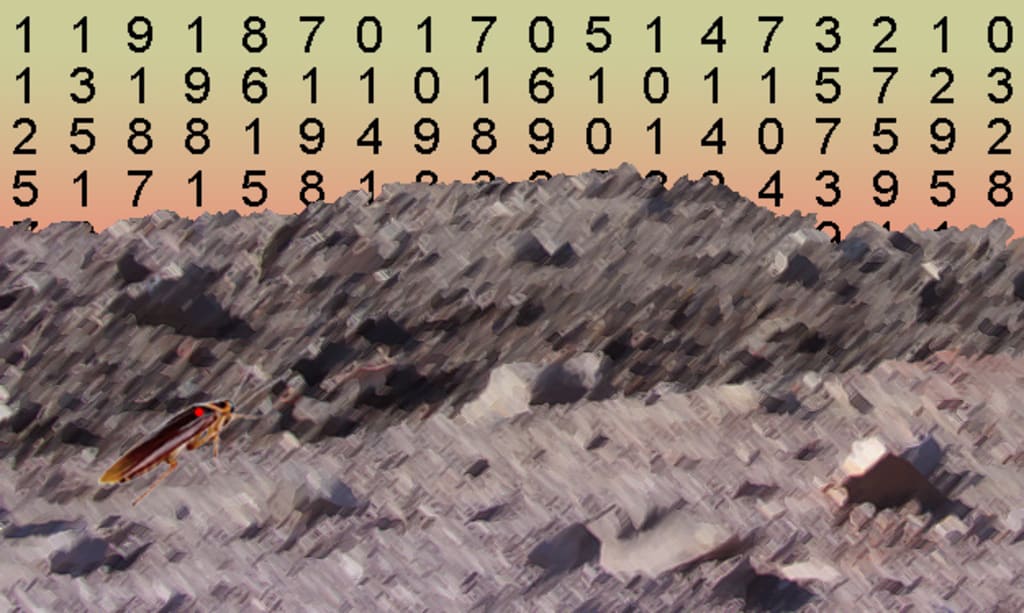
"Ever wonder what happened to all the trees?" asked Sani. Lost in thought and neglecting her lunch, his granddaughter Haseya, who had just graduated from high school and was visiting from Maryland, gazed out his apartment window to a bleary, barren sandscape of dirt and debris stretching as far as the eye could see. Dust clouds danced at the edge of an enormous crater that marked the center of a radial array of white lines etched in the scorched ochre soil and extending out, like spokes of a wheel, for miles in all directions. The empty sky, drained of blue, invited no birds, nor were there any trees or branches on which birds might rest. Lying crooked across the forbidding wasteland was a long, white, fallen rectangular structure with a pointed end. Its crumbling stones, vaguely aligned, had long ago forgotten how to fit together.
"Our ancestors called it the Washington Monument," remarked Sani, noticing where Haseya was looking. "Before it fell," he added, his eyes twinkling nostalgically, "it stood 500 feet tall." Seeing that he now had her attention, his smile widened, deepening the furrows of a weathered face that had witnessed more of the joys and disappointments of life than most have experienced. At 70 years of age, Sani, whose name in the Navajo language means "old one," was the last survivor of his generation. Many others had died in middle age of cancer, so long had they been exposed to residual radioactive fallout from the nuclear blast that devastated the city half a century ago.
"Tell me about my great-grandma I never knew," asked Haseya, her curiosity aroused as her fingers twirled the delicate chain of an ornate, heart-shaped, silver and turquoise locket that hung loosely around her neck. She asked tentatively, for the harder she tried not to imagine her great-grandmother's terrible last day, the more she felt her own heart rising in her chest. But even if the news was going to be painful, she just had to know.
"That necklace you are wearing, my dear, was hers." Sani paused and wiped his eye, feeling momentarily overcome by his mother's memory.
"I know. Please tell me about her, Grandpa."
"The first lady, she was."
"The first lady to do what?" inquired Haseya.
"No, THE First Lady, the wife of the president of the United States. We are no longer permitted to speak her name, but know this. She was a true leader. Dedicated to helping others, she worked tirelessly on behalf of the disadvantaged and always considered others' needs before her own. She was also an astute judge of human character and motives. In the intensely political climate of Washington, there were times when the president, as a public official under constant scrutiny, felt restrained from speaking decisively. But the first lady could use her intelligence and charm to influence diplomatic affairs behind the scenes, collaborating with the president's allies and, at times, alerting him early to potential threats. That was before the Great Obliteration, before Solitarius came."
"There was a time before Solitarius? They didn't teach us that in school."
Sighing, Sani sipped his tea. "Yes, life was chaotic in the intervening era, the dangerous time between the fall of the United States and our rescue by Solitarius." Sani was referring to the vast revolution that had taken place, and at the top of the new order was no human power. Solitarius was a supremely engineered artificial intelligence consisting of machine processors and calculating microcircuits that surpassed all human knowledge. Initially useful and now obligatory, Solitarius had come to manage every aspect of the country, including businesses, social groups, schools, families, even individual lives. Speaking audibly, Sani acknowledged with feigned enthusiasm, "Solitarius knows what is best for us. Praise be to Solitarius."
Winking at Haseya, Sani pointed to the wall above their table. A swarm of cockroaches had gathered, waiting for a chance to scavenge among the crumbs left after their meal. "Cockroaches," muttered Sani, scrunching his face in disgust, "have a survival advantage over other wildlife because they can tolerate ionizing radiation that kills other species. In a postnuclear age they breed and flourish, ruling the dark places where nothing else lives." He shook his arm at the assembling insects, and they scattered.
But one remained. This one was different, and the difference had not escaped Sani's notice. Squinting, he asked Haseya, "Do you see the faint red light emanating from its prethorax, just behind its head?"
Haseya looked up and answered, "Grandpa, it's just a reflection. You know your eyesight is poor."
"Look away from it. Look away, I say. Some believe these are no ordinary insects, but covert electronic impersonators. Blending in with real insects, these engineered imitators creep through cracks in our walls and peek out to monitor every corner of our society -- the invisible ears and eyes of the all-knowing Solitarius. But, of course, that is just speculation."
Speaking softly, he continued, "Back to your question. Yes, there was a time when our people lived in freedom, under a government by and for and responsible to the people. In those days, we could speak freely and openly. We could travel wherever we wanted. We could study at universities, play sports, learn to play musical instruments, craft jewelry, seek the kinds of jobs that suited our interests, and plan our own families. But we took these things for granted, and one night came when our freedoms were taken from us."
A sudden gust pounded the window, whistled furiously, then faded away. All was again silent. The lone insect remained, unmoved, as if nailed to the wall, its miniature red beacon (if that's what it was) still blinking, slowly, nearly imperceptibly. Feeling a chill, Haseya and Sani pulled their shoulders in and tightened their jackets.
"I never understood why our president did not act when he had the chance," continued Sani. When I was in government, I knew one of the Joint Chiefs …"
"Do you mean one of our Navajo chiefs smoked marijuana?" asked Haseya.
"No," laughing, "the Joint Chiefs of Staff were the most senior military leaders of the United States. My friend confided to me that a targeted nuclear strike against the anarchists hiding out somewhere in the mountains of Central America could have eliminated the threat with a minimum of civilian casualties. These anarchists hijacked a stockpile of nuclear warheads and threatened to launch them against major US cities. We had the critical intelligence. We knew their location. The president was informed in time. But he did not act. From a distance, the anarchists fired their missiles. Washington and a dozen other cities were leveled. Millions perished. The president's rivals said that his weakness as commander-in-chief at that crucial moment rendered the whole country weak in defeat. I've never understood this. The president seemed decisive in other matters. Take, for example, his opposition to Margaret Walren."
"I recognize that name!" interjected Haseya. "He was Great-grandma's trans friend, and they were planning a party."
"Where did you get that idea?" replied Sani, appearing quite puzzled. "Margaret Walren was a US senator."
"Here, I'll show you." Haseya removed the locket from around her neck, inserted her fingernail at its edge, and snapped the lid open, revealing a miniature portrait of her great-grandmother. Then, with great care, she lifted the portrait by its edge, revealing a second compartment. Sani watched in amazement as Haseya removed and unfolded a small piece of paper, on which was written in tiny letters:
Bááh nímazí in other suit pocket
Ms Walren is a gent
Punch planned, please hurry
Be careful. I love you
"My dear," said Sani, taking a deep breath, "you have stumbled onto a most intriguing, no, disturbing discovery. You see, the president would have instantly recognized the first two Navajo words, which mean "biscuit." But this was not a memo about food and drink. It was a message of utmost urgency. I wouldn't expect you to know this, but PUNCH was a military code word for a targeted nuclear strike to be deployed against extreme threats. And Ms. Walren wasn't a "gent" or gentleman. That's clearly an extra space between the letters in the word "agent." Your great-grandmother must have discovered that Walgren was a spy, and she was trying to alert her husband without saying this in the open. She must have used the locket to conceal her message where the security screeners could not find it, until she was ready to hand it to the president quietly and discretely.
"But why was the first word written in the Navajo language," asked Haseya. "That makes no sense."
"It makes perfect sense if you know what biscuit means to the US president. Only the president could authorize the launch of nuclear weapons, but before the military could act on his order, the president's identity had to be positively established using a special code written on a plastic card, which was nicknamed the "biscuit." The president carried that card in his pocket at all times. In your locket is the missing piece of the puzzle that has bothered me all these years."
"Let me see if I understand," replied Haseya. "On the fateful day when the US was attacked, the president failed to act because the card that was needed to process his order to deploy nuclear weapons had been accidentally left in the pocket of his other suit. My great-grandma learned of this and was trying to alert her husband in time. She wrote the most sensitive word, not in English, but in Navajo so that her husband, and absolutely no one else, would understand it."
"Brilliant!" exclaimed Sani. "I knew you had your great-grandmother's inquisitive brown eyes, but you have also inherited her astute mind."
"The message was still in the locket when, years later, it was passed down to me. It must have never reached the president."
At that moment, the lone insect on the wall fluttered away, its red light blinking faster than before. Flying off to some unknown location, was this unobtrusive listener an emissary to a perfectly administered benevolent new government, or a menacing informer rushing to reconnect with a sinister Solitarius? Or was it just a bug, perhaps a mutant cockroach with a firefly gene? Would they ever know?
Kissing his granddaughter goodbye, Sani whispered into her ear: "Sínízid," which means "Be careful!"
About the Creator
William Cheshire
I am a neurologist who enjoys writing about things that matter.
Keep reading
More stories from William Cheshire and writers in Futurism and other communities.
The End of Chocolate
John felt nothing as he watched with curiosity a mosquito that had landed on his arm. Its tiny proboscis, like a syringe, probed beneath his skin until it sank into a warm, pulsing capillary. As the mosquito silently sipped his blood, John thought of the millions of people worldwide who each year are infected with deadly diseases by mosquitoes just like this one. He could swat at it, but why bother? Inevitably another would find him, probably while he slept, if only he could sleep. There was no rest to be found in cell 26, and nowhere to escape. Tomorrow at sunrise, John was scheduled to be taken down the hallway, strapped to a cold metal table, fastened to a heart monitor, and injected by a hypodermic needle containing a mixture of lethal chemicals. As a condemned prisoner on death row, John's time was up. All legal appeals had proved futile, so solid was his conviction for having committed most heinous murder, not of one person, but of thousands.
By William Cheshire5 years ago in Criminal
About Binding Prometheus
I want to start actively advocating on behalf of my own work, and the most valuable part of my canon is, without a doubt, Binding Prometheus, the play I have been working on since 2019 and only finished in 2023 as part of my MA. The play itself is an amalgamation of a million different inspirations. On one end, it evokes the Ancient Greek myth-play, deriving its own title from the earliest extant work of Western drama we have, Aeschylus’s Prometheus Bound. On the other end, it borrows significantly from the sci-fi bulwarks from over the years, namely Mary Shelley’s Frankenstein and Karel Capek’s Rossum’s Universal Robots. The play could be an episode of Black Mirror, I fear. I don’t know. I’ve only ever seen one episode of Black Mirror.
By Steven Christopher McKnight29 days ago in Futurism


Comments
There are no comments for this story
Be the first to respond and start the conversation.