
Pablo Escobar: The King Who Built a Kingdom of Dust
He ruled Colombia through fear and fortune, loved his people yet destroyed his nation — the double life of the world’s most famous drug lord.
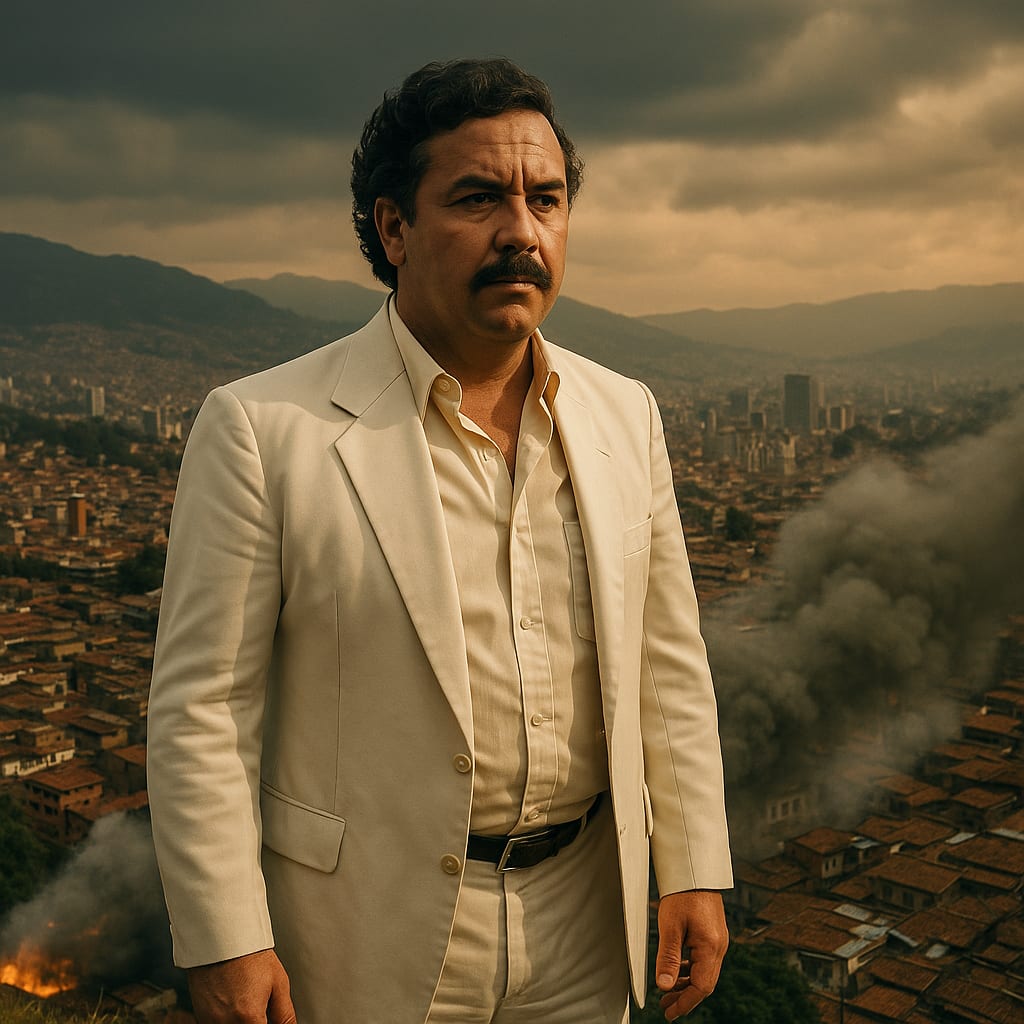
There are criminals, and then there are legends.
Few names in history echo like Pablo Emilio Escobar Gaviria — the man who built a billion-dollar cocaine empire and turned it into a political and social revolution.
In the 1980s, Escobar was not just the most powerful drug trafficker on Earth — he was a myth, a man who could build hospitals by day and bomb police stations by night. His story remains one of greed, power, and contradiction — how a poor boy from Medellín became The King of Cocaine.
The Boy from Medellín
Pablo Escobar was born in 1949, in a small Colombian town outside Medellín. His father was a farmer, and his mother a schoolteacher. From a young age, Escobar learned the importance of two things: money and respect.
As a teenager, he sold stolen tombstones and fake diplomas. But his real opportunity came in the 1970s, when the world’s appetite for cocaine exploded. Escobar saw a future others couldn’t — one where white powder would buy him castles, cars, and control.
He built relationships with smugglers, chemists, and pilots. Soon, his group — the Medellín Cartel — controlled up to 80% of the global cocaine trade. At its peak, Escobar was earning $420 million a week.
The King of Cocaine
By the 1980s, Escobar’s wealth was unmatched. Forbes Magazine listed him among the richest men in the world, with an estimated fortune of $30 billion.
He owned private jets, over 1,000 houses, and even a private zoo with elephants, hippos, and giraffes. He built entire neighborhoods for the poor in Medellín and was called “Robin Hood” by locals who saw him as a hero.
But that kindness had a cost. For every school or hospital he built, hundreds died in his war against the government and rival cartels. His motto was simple:
“Plata o plomo.” — Silver or lead.
It meant: take the bribe or take the bullet.
Police officers, judges, and politicians across Colombia fell under his power — some by fear, some by greed.
Terror as a Weapon
When Colombia’s government agreed to extradite traffickers to the United States, Escobar declared war.
He bombed airplanes, assassinated presidential candidates, and turned Medellín into a war zone. In 1989 alone, over 4,000 people were killed in cartel-related violence.
Yet despite the bloodshed, Escobar maintained his image as a man of the people. He would drive through poor neighborhoods handing out cash, building soccer fields, and promising to protect the locals. To many, he was a savior — a twisted mix of generosity and evil.
He even won a seat in the Colombian Congress in 1982, proving just how deep his influence had grown. But when journalists exposed his criminal empire, the government turned against him, and Escobar became the nation’s most wanted man.
The Prison He Built for Himself
In 1991, Escobar struck a deal with the government. He would surrender on one condition — that he would serve his sentence in a prison of his own design.
So he built La Catedral — a “prison” complete with a casino, a soccer field, and a waterfall. Inside, he lived like a king, holding parties and running his cartel by phone.
But when the government realized he was still managing cocaine shipments from inside, they moved to transfer him to a real prison. Escobar escaped — disappearing into the mountains.
He would spend the next 16 months on the run, hunted by Colombian special forces and U.S. intelligence.
The End of the Empire
On December 2, 1993, authorities finally tracked him down through a phone call he made to his son. They surrounded a small house in Medellín, where Escobar and his bodyguard tried to escape across rooftops.
In a brief gunfight, Escobar was shot and killed. He was 44 years old.
When the news broke, thousands of people filled the streets of Medellín. Some cried in grief; others celebrated. To many, he was still the man who gave them homes and jobs. To others, he was a monster who brought a nation to its knees.
The Legacy of Pablo Escobar
Even in death, Pablo Escobar’s influence endures. His name appears in music, television, and fashion — a symbol of power and rebellion.
But beneath the myth lies tragedy. His empire left Colombia scarred by violence, corruption, and addiction. The billions he made disappeared into wars that no one truly won.
Escobar’s life reminds us that power gained through fear never lasts. His dream of becoming Colombia’s savior ended in blood and ruin — a warning that even the richest man in the world can lose everything when greed replaces humanity.
As one Colombian writer put it:
“He built an empire of cocaine and gold — and died alone in the dust.”
About the Creator
shakir hamid
A passionate writer sharing well-researched true stories, real-life events, and thought-provoking content. My work focuses on clarity, depth, and storytelling that keeps readers informed and engaged.
Keep reading
More stories from shakir hamid and writers in Criminal and other communities.
Raffaele Imperiale: The Drug Lord Who Collected Van Gogh
In the strange overlap between high art and high crime, one name stands out — Raffaele Imperiale, an Italian mafia boss who treated drug trafficking and fine art with the same obsessive care. He built a billion-euro cocaine empire stretching from South America to Europe, yet behind his mansion’s walls lay a secret treasure: two stolen Vincent van Gogh paintings.
By shakir hamid3 months ago in Criminal
The Monster in the Details: How a can found in Yeadon solved a crime Ephrata missed.
The Million-Dollar Mistake Jonathan Gerlach stole over 100 human skulls. He transported bodies across county lines. He maintained a "museum" in a rowhome and a "warehouse" in a storage unit. For months, he operated with impunity right under the nose of the Ephrata Police Department.
By Sunshine Firecracker3 days ago in Criminal
Murders of Innocence
There is something to be said about childhood trauma. It somehow has a way of showing its ugly head in the life of all monsters. I know it’s only one fact that goes into the making of a monster, hear me out. I know there are other little buildings blocks associated with the “build a little monster kit” most parents don’t even realize they come equipped with in their arsenal of unloving. Yes, I know what I said.
By Cassie Moore5 days ago in Criminal



Comments
There are no comments for this story
Be the first to respond and start the conversation.