
Raffaele Imperiale: The Drug Lord Who Collected Van Gogh
Raffaele Imperiale: The Drug Lord Who Collected Van Gogh

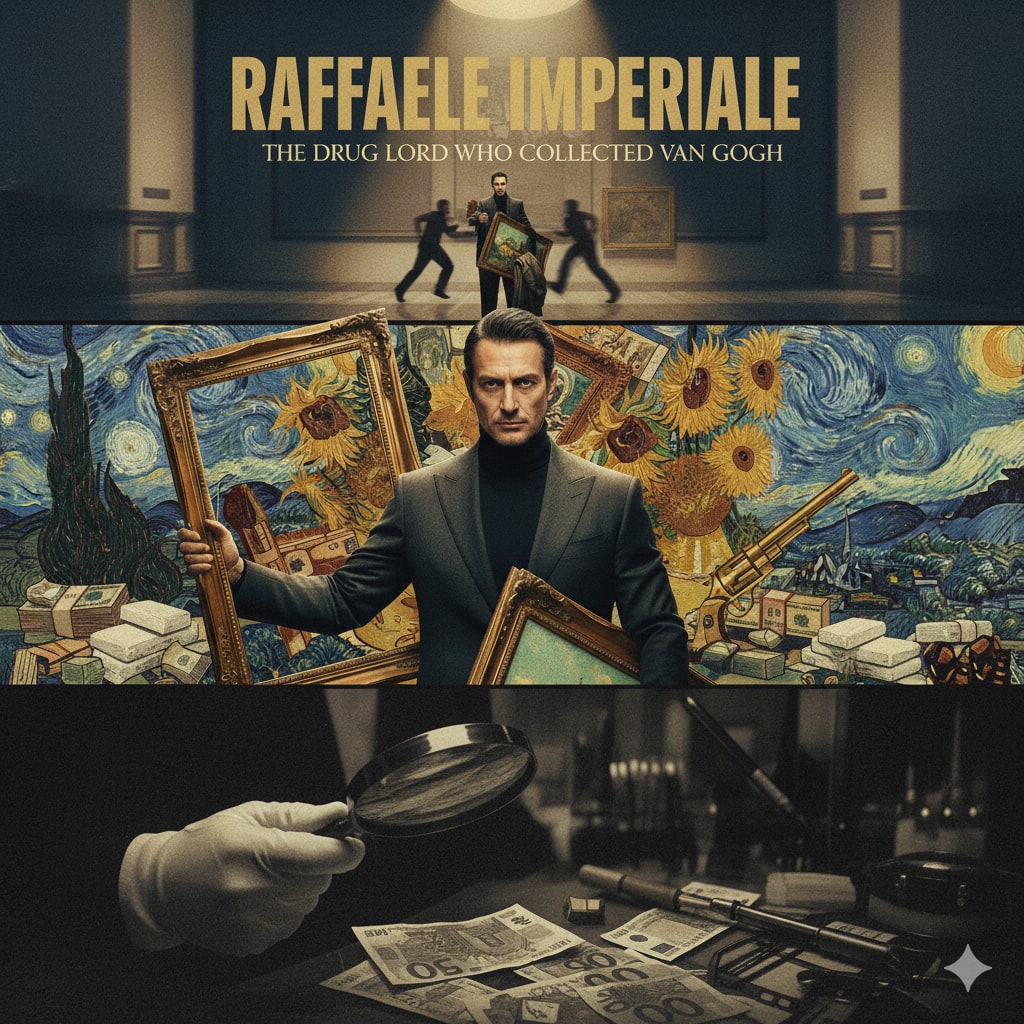
In the strange overlap between high art and high crime, one name stands out — Raffaele Imperiale, an Italian mafia boss who treated drug trafficking and fine art with the same obsessive care. He built a billion-euro cocaine empire stretching from South America to Europe, yet behind his mansion’s walls lay a secret treasure: two stolen Vincent van Gogh paintings.
It’s the story of a man who blurred the lines between beauty and corruption — a criminal who wanted not just money, but immortality.
The Rise of Raffaele Imperiale
Born in Castellammare di Stabia, near Naples, in the early 1970s, Raffaele Imperiale grew up in a region long ruled by the Camorra, the Neapolitan mafia. Unlike many young men who joined for power or revenge, Imperiale’s motivation was intelligence and ambition.
In his twenties, he entered the underworld as a negotiator and businessman rather than a street thug. He quickly became a trusted figure in the Amato-Pagano clan, one of the most powerful drug networks in Italy.
By the 2000s, Imperiale was managing cocaine shipments that arrived through major European ports — often disguised as fruit, coffee, or industrial goods. His network extended from Colombian cartels to Dutch traffickers, with warehouses spread across Amsterdam, Antwerp, and Milan.
He wasn’t the kind of mobster who flaunted guns or gold chains. Instead, he was quiet, analytical, and fascinated by art. That fascination would eventually expose him — and shock the world.
The Van Gogh Connection
In December 2002, the Van Gogh Museum in Amsterdam was hit by one of the most daring art heists in modern history. Two of the painter’s early works, “View of the Sea at Scheveningen” and “Congregation Leaving the Reformed Church in Nuenen,” vanished in the night.
For over a decade, they were considered lost — either destroyed or sold to underground collectors. Then, in 2016, Italian investigators searching one of Imperiale’s villas near Naples made a stunning discovery.
Behind a hidden wall panel, wrapped carefully in linen, were the two missing Van Gogh paintings.
The world was stunned. Why would a drug trafficker keep priceless art in his home? For Imperiale, it wasn’t about money. It was about symbolism and power. Owning stolen masterpieces was his way of saying he stood above both law and culture — a king of two worlds.
The paintings, worth over €50 million, were recovered unharmed and later returned to the museum in Amsterdam. It became one of the most extraordinary crossovers of art and organized crime in history.
The Empire of Shadows
Imperiale’s operations were sophisticated and global. He wasn’t just moving drugs; he was building an empire that combined legitimate investments, offshore accounts, and luxury properties.
He coordinated shipments through encrypted communication networks, paying off corrupt customs agents and using shell companies as fronts for his laundering operations. His personality was calm and calculating — a businessman who treated crime like corporate management.
Through partnerships with criminal organizations like the Kinahan Cartel in Ireland and the Camorra’s Amato-Pagano clan, he became a central player in Europe’s cocaine trade.
But even as he expanded his empire, police around the world were closing in.
The Fall of the Artful Don
In 2021, Raffaele Imperiale’s secret world finally collapsed. After years on the run, international authorities tracked him down in a foreign country where he’d been living under a false identity.
When he was captured, Imperiale didn’t resist. Calm as ever, he cooperated with investigators, admitting to his role in large-scale drug trafficking and even confirming that he had purchased the Van Gogh paintings on the black market years earlier.
His confession painted a picture of a man torn between crime and culture — a paradoxical figure who funded cocaine shipments with the same meticulous care he gave to protecting priceless art.
The Paradox of Beauty and Crime
Raffaele Imperiale’s story is more than just another mafia tale — it’s a study in contradictions.
He was a man who lived by greed but was drawn to beauty. A fugitive who admired timeless art while building a criminal empire that destroyed lives. He represented the evolution of the modern mafia — educated, globalized, and more dangerous than ever because it hides behind luxury, intelligence, and legitimacy.
To Imperiale, Van Gogh’s suffering, passion, and madness mirrored his own life. Both men were outsiders chasing greatness, both misunderstood, both obsessed with beauty in a brutal world.
During his interrogation, Imperiale was asked why he bought the stolen paintings. His answer was haunting:
“Because they were beautiful. And beauty doesn’t belong to anyone.”
The Legacy of Raffaele Imperiale
Today, Imperiale awaits judgment in Italy. The Van Gogh masterpieces have returned home, but their story will forever carry his name.
His empire — like the art he once hid — was built on illusion. Behind every masterpiece was blood money, betrayal, and ambition.
In the end, Raffaele Imperiale will be remembered not only as a drug lord, but as one of the strangest figures in modern crime — a man who tried to possess both the darkness of power and the light of beauty.
He remains a reminder that sometimes, the most dangerous criminals aren’t the ones who scream — but the ones who admire art in silence.
About the Creator
shakir hamid
A passionate writer sharing well-researched true stories, real-life events, and thought-provoking content. My work focuses on clarity, depth, and storytelling that keeps readers informed and engaged.
Keep reading
More stories from shakir hamid and writers in Criminal and other communities.
The Last Godfather: The Rise and Fall of Matteo Messina Denaro
For decades, the name Matteo Messina Denaro struck fear across Italy. Known as “Diabolik” — after a comic-book master criminal — he was the last great boss of the Sicilian Mafia, a man whose power came not only from violence but from silence.
By shakir hamid5 months ago in Criminal
Ken Childs and the Shadow Network Behind Celebrity Surveillance
Hollywood is no stranger to intrigue. Behind the red carpets, blockbuster premieres, and glamorous headlines lies a parallel world where privacy is fragile and information can be extremely valuable. Over the years, celebrities have faced stalkers, hackers, and fraud schemes designed to exploit their wealth and visibility. Recently, reports circulating online have drawn attention to a controversial narrative involving private investigator Ken Childs and allegations that place him near the center of a disturbing story about celebrity surveillance.
By Shane Smith7 days ago in Criminal
Murdering the love of Sarah Maguire
January 2022, it was a cold winter in Tulsa, Oklahoma, one that felt colder than most for some of us in the city. If one were to be out in the evening air of the cold, it was bone chilling to the soul. On an evening like this one who wouldn’t enjoy a good home cooked meal by someone who seemed to care about them? Right, Folks?
By Cassie Moore4 days ago in Criminal



Comments
There are no comments for this story
Be the first to respond and start the conversation.