
Inside the 2001 Scottsdale Family Murders
On April 10, 2001, a vast natural gas explosion set off by a house fire prompted Scottsdale firefighters and police to respond to the home of Robert and Mary Fisher. After extinguishing the blaze, police found the charred bodies of Mary and the couple’s two children, 13-year-old Brittney, and 10-year-old Robert Jr. The fire did not kill the three. Instead, the deliberately set fire was an attempt to cover up their murders. Mary had been shot in the back of the head while the children’s throats had been slit. Police immediately suspected Robert of the murders. The problem was, he and Mary’s car were gone. Robert’s wife and kids were found murdered in their burning home. He hasn’t been seen in the 23 years since the murder. What Happened to Robert Fisher?
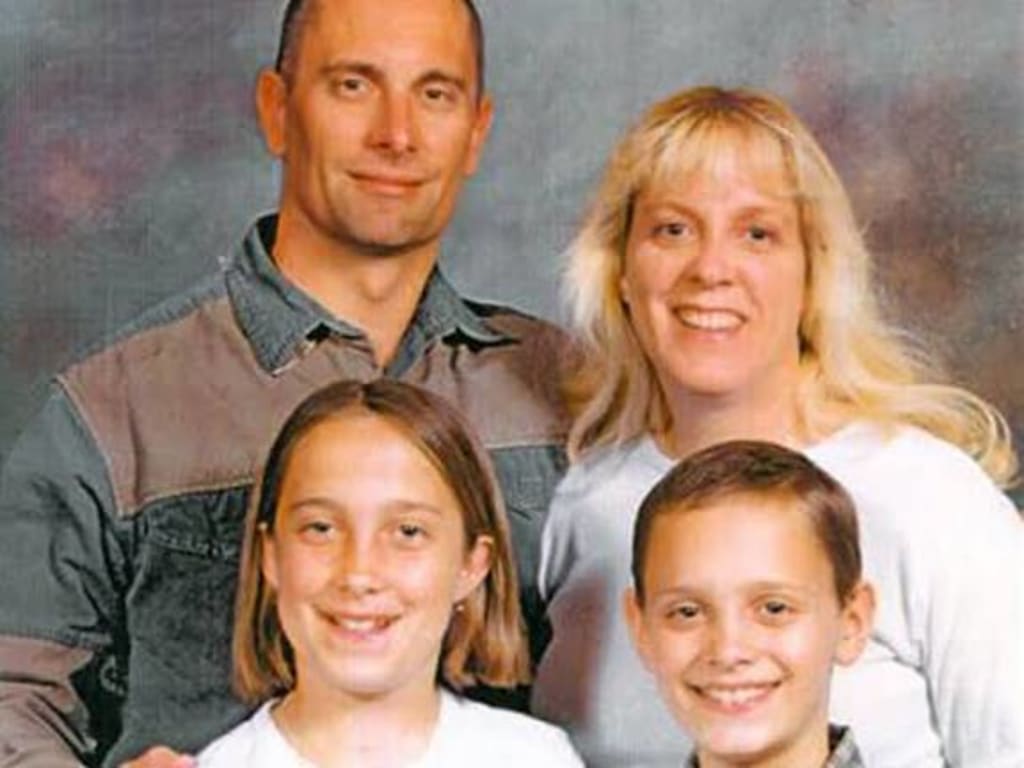
On April 10 2001 a quiet neighborhood in Scottsdale, Arizona, became the scene of one of the most disturbing family murder cases in modern American history. What initially appeared to be a tragic house fire quickly unraveled into a calculated act of violence that left three people dead and one man missing—a mystery that remains unresolved more than two decades later.In the early hours of the morning, Scottsdale firefighters and police were dispatched to the home of Robert and Mary Fisher after reports of a massive fire and explosion. The blast was later determined to have been caused by natural gas that had accumulated inside the house before ignition. Flames engulfed the structure, suggesting at first glance a devastating accident. However, once firefighters extinguished the blaze and investigators entered the home, the reality proved far more sinister.
Inside, authorities discovered the charred bodies of Mary Fisher, age 38, and the couple’s two children: 13-year-old Brittney and 10-year-old Robert Jr. While the fire had severely damaged the scene, investigators quickly determined that the fire was not the cause of death. Instead, it had been deliberately set in an apparent attempt to destroy evidence and conceal the true nature of what had happened inside the home.
The autopsies revealed horrifying details. Mary Fisher had been shot execution-style in the back of the head. Her children had their throats slit. These findings made it clear that the murders were intentional, personal, and brutal. The fire, rather than being accidental, was staged after the killings—designed to make the crime look like a tragic house fire or gas explosion.
From the outset, police focused their investigation on Robert William Fisher, Mary’s husband and the children’s father. Several facts immediately raised alarm. Robert was nowhere to be found, and Mary’s vehicle was missing from the property. There were no signs of forced entry, robbery, or an external intruder. The crime scene suggested someone familiar with the home and the victims—someone who had time and access to carry out the murders and then attempt to erase them.
As investigators dug deeper, they concluded that Robert Fisher was the primary suspect. The deliberate nature of the killings, combined with the staged fire and his sudden disappearance, painted a damning picture. Authorities believed the explosion was carefully planned, using gas to ensure the house would be destroyed and the deaths potentially misclassified.
In the days following the murders, a massive manhunt was launched. Law enforcement agencies searched surrounding areas, deserts, and wooded regions, believing Fisher may have fled on foot or used the rugged terrain to avoid capture. Despite extensive searches and nationwide alerts, Robert Fisher was never located.
Over time, the case gained national attention. The brutal murder of a wife and two children, followed by the suspect’s complete disappearance, shocked the public and left investigators grappling with unanswered questions. How did Robert Fisher escape without being seen? Did he flee the country, or did he die while on the run? Was there help from someone else, or was the disappearance entirely his own doing?
Years turned into decades, but the mystery persisted. Robert Fisher has not been seen since April 2001. He remains one of the most well-known fugitives in the United States, his name synonymous with a case defined by both horrific violence and haunting uncertainty. The loss suffered by Mary, Brittney, and Robert Jr. continues to resonate, especially given the lack of closure for extended family members and the community.
Today, more than 23 years later, the case remains open. Advances in forensic science, digital tracking, and public awareness have solved many cold cases, yet this one endures. Periodic tips and reported sightings have surfaced over the years, but none have led to a confirmed arrest or recovery.The Fisher case stands as a chilling reminder of how appearances can deceive and how some crimes leave scars that time cannot erase. A home meant to be a place of safety became the setting for unimaginable violence, and a man suspected of destroying his own family vanished without a trace. Until Robert Fisher is found—dead or alive—the questions surrounding that April morning in Scottsdale will continue to haunt investigators and the public alike.
About the Creator
Keep reading
More stories from Kure Garba and writers in Criminal and other communities.
Pedro Rodrigues Filho: Brazil’s Most Notorious Vigilante Killer
Pedro Rodrigues Filho, often referred to in the media as “Pedrinho Matador,” is one of the most infamous figures in Brazilian criminal history. His life story is frequently cited as an extreme example of how cycles of violence trauma and vigilantism can intertwine, producing a legacy that remains deeply unsettling decades later.Filho’s story begins even before his birth, in a household marked by severe domestic abuse. His father was violently abusive toward his mother throughout her pregnancy, a level of brutality that would shape the narrative of Filho’s life from the very beginning. Growing up, he was surrounded by instability, fear, and violence, conditions that would later be used by commentators and psychologists alike to explain—though not excuse—his actions.
By Kure Garba23 days ago in Criminal
Investigating Associated Building Inspections Ephrata Complaints: The Private Company with Public Power
INVESTIGATION TARGET: ASSOCIATED BUILDING INSPECTIONS, LLC (ABI) HQ LOCATION: 1248 WEST MAIN STREET, SUITE 23, EPHRATA PA 17522 ROLE: THIRD-PARTY CODE ENFORCEMENT ALLEGATION: SELECTIVE ENFORCEMENT / GROSS NEGLIGENCE KEYWORDS: #EphrataCodeEnforcement #ABI #PublicSafetyFailure
By Sunshine Firecrackerabout 15 hours ago in Criminal
Story of Larry Hoover
Larry Hoover Legacy in Reform and Pop Culture For more than half a century, the name Larry Hoover has carried a weight that echoes through Chicago’s history and American urban culture. Often discussed in connection with crime, controversy, or organized street life, Hoover’s identity became a symbol far larger than the man himself. But beyond the headlines, beyond the mythology, and beyond the notoriety, there exists a lesser‑known story: the story of a human being who evolved, reflected, transformed, and worked to redirect others from the path he once walked. It is this story — the one buried beneath decades of public narrative — that reveals the depth of Larry Hoover’s transformation.
By Organic Products a day ago in Criminal
Silver Screen Magic with Mae West
American actress and singer Mae West became a popular film actress during the Great Depression. She started entertaining in vaudeville, then performed on Broadway, and finally went to Hollywood. She signed up with Paramount Pictures and made her debut in the 1932 film “Night After Night.” She also starred in musicals, comedies, and crime dramas. The American Film Institute named her one of the best classic Hollywood actresses.
By Rasma Raisters5 days ago in Geeks


Comments
There are no comments for this story
Be the first to respond and start the conversation.