
How I Assess Intent in Handwriting
And What I Ignore on Purpose

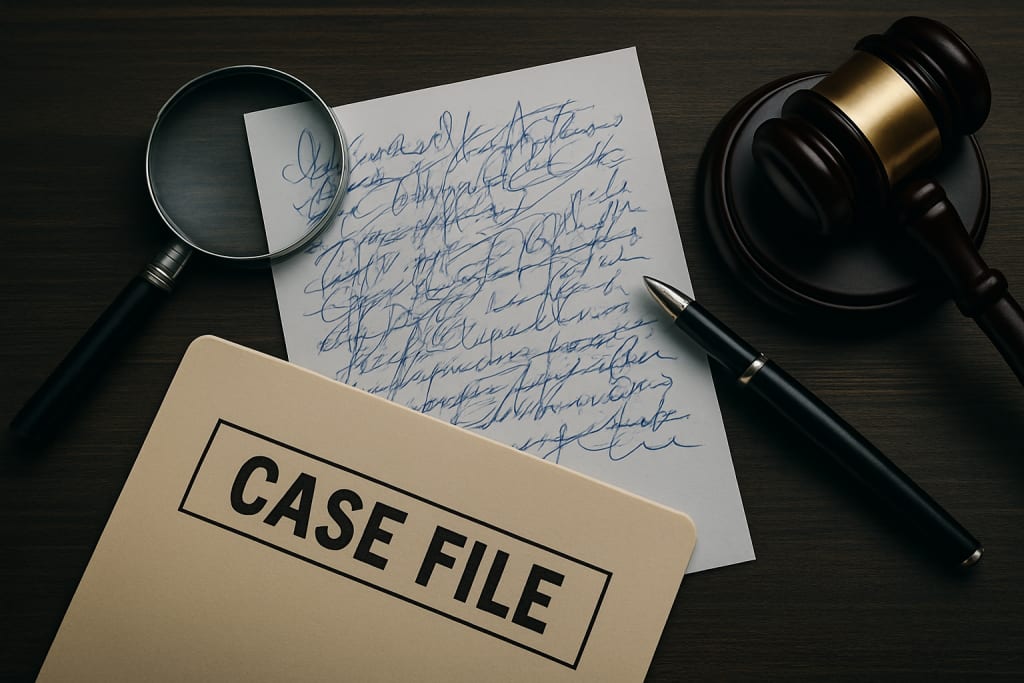
There’s a reason I do not assess “vibes.”
I assess intent.
And in forensic handwriting work, that difference isn’t just semantic—it’s the entire point.
Intent shows up in structure.
- Not energy.
- Not gut instincts.
- Not pop-psych platitudes dressed up as analysis on YouTube, Reddit, or clickbait clips.
If you’re labeling someone a liar, narcissist, manipulator, or a threat—and you have zero real life training, education, or investigative experience—you're playing a guessing game. And dragging someone’s character through it.
In addition to 14 years of higher education and decades of field work with investigative agencies, I’ve done this work quietly and carefully—no hype, no audience.
- Cold cases.
- Suicide verification.
- Homicide prep.
- Workplace violence assessments.
These aren't academic exercises. This isn't online entertainment fodder. They carry real-world consequences—and in that world, accuracy isn’t optional. It’s required.
Flashy declarations from YouTube or Reddit websleuths or parasocial investigators?
They'd be shredded under cross-examination in any legitimate courtroom. Keep that in mind when you support them—they are gatekeepers of misinformation.
What Real Forensic Handwriting Analysis Is
Let’s get this straight:
Forensic handwriting analysis is structural analysis embedded inside legal and behavioral investigations.
In casework, I’m tracking:
- Consistency and inconsistency
- Concealment patterns
- Pressure thresholds
- Pacing mismatches
- Affect regulation
- Escalation risk
- And much more
This isn’t guesswork. It’s triangulated behavioral data.
Because handwriting is movement— and movement is behavior.
Behavior isn’t random.
It’s coded.
Intent is embedded in the choices a person doesn’t even realize they’re making—until someone like me points them out.
The Three Main Forms of Intent
When I assess a handwritten statement—whether it’s from a workplace threat case or a death scene—there are three primary forms of intent I look for:
(1) Intent to Conceal
This shows up when someone’s hiding something—not necessarily lying, but hiding.
For example, I may look for:
- Overly staged letter formations.
- Altered rhythm.
- Conflicting pressure zones.
- Style imitation.
- Attempts to “clean up” their writing.
Concealment often spikes when there’s a fear of consequence or shame.
(2) Intent to Justify
Here, the structure tries to steer perception. The handwriting may reveal indicators such as:
- Excessive loops,
- Disrupted rhythm, or
- Over-managed form.
It’s not always deception—it’s narrative control.
It’s the behavioral equivalent of padding a résumé or overexplaining in an argument. They want the reader to feel something—even if they’re not consciously aware of it.
Pity. Validation. Agreement. Guilt.
I don’t need to read the words to spot it—the structure does the talking.
(3) Intent to Harm or Manipulate
This shows up when internal chaos is masked as control. It’s not about “evil” handwriting per se. It’s cognitive distortion made visible. I may find:
- Unnatural precision paired with erratic spacing,
- Disrupted pressure zones, or
- Conflicting rhythm.
This form of handwriting often looks like impulsivity pretending to be discipline. There’s usually a fight between dominance and instability—a calculated appearance that breaks under scrutiny. The structure reveals behavioral motives, such as:
- Control through confusion.
- Pressure disguised as polish.
- Emotion split from intent.
And when that gap appears, it usually signals danger.
What I Ignore on Purpose
People are often surprised by what I do not care about.
- I do not care if the writing is messy, slanted, cramped, loopy, or all over the place.
- I do not care if they skip punctuation or mix cursive with print.
Those traits might be relevant—or they might mean nothing at all.
It depends on the writer, the conditions, and the intent behind the motor patterns—not some one-size-fits-all rulebook.
- I do not flippantly diagnose.
- I do not label people narcissists or sociopaths based on ink alone.
That’s reckless, unethical, and legally indefensible.
What I do care about is structural congruence:
- Does the pressure match the rhythm?
- Does the line spacing contradict the emotional baseline?
- Does the form structure reflect the cognitive load?
If those systems are in conflict—that’s where the forensic questions begin. That's where the truth usually lives.
I do not track the “look” of the handwriting.
I track the behavior inside of it.
That's why they call me the "Ink Profiler."
A Note on Suicidal and Homicidal Letters
One of the most sensitive areas of this work is post-mortem analysis—often called a psychological autopsy.
- Was it a suicide—or staged?
- Was the threat credible—or constructed?
- What was the writer's mental state in those final moments?
I’ve reviewed dozens of death scene notes—including public cases like Kurt Cobain. Some were written moments before death. Others, days earlier. Some, by someone else entirely.
What I’ve learned many years ago is:
True suicide notes aren't always "sad."
More often, they're eerily clean. Controlled. Sometimes disturbingly so. There’s clarity in finality.
But when writing is frantic or erratic—especially when the message contradicts the motor patterns—that usually signals something else: panic, performance, interruption, or even hope.
Same goes for homicide threats.
The real ones are rarely flamboyant. They often show restraint, calculation, and tension.
And they never replace facts.
Why I’m So Careful
A single mishap can destroy a life.
That’s not theory—I’ve seen it firsthand. One reckless interpretation can derail a legal strategy, damage someone's credibility, or create irreversible harm in an already fragile situation.
That’s why I refuse to post armchair breakdowns of trending cases—or try to "tell someone's whole story" from a single handwriting snippet floating around online.
Yes, I’ll occasionally comment on structural indicators when asked, or when misinformation is spreading. But I will not speculate or perform for clout.
Because reducing someone's internal life to a social media caption?
- That's not forensics.
- That's performance.
- And I want no part of that.
What I Learned the Hard Way
It’s to my own disgust that I ever tried the YouTube route. My adult son spent years urging me to do it. I finally gave in.
It was short-lived—and deeply uncomfortable.
Yes, I shared real analysis. But it felt wrong. Like I was flattening something sacred into something consumable.
So I stopped because I knew better. And it violated everything I stand for.
What I Am—and What I’m Not
Do I have the training and experience to break down samples? Absolutely.
- I'm not a self-proclaimed analyst—I'm a credentialed, court-recognized one.
- I’m not a self-taught profiler.
- I don’t dabble in forensics—I live it.
- And I don’t perform for clicks—I profile ink for clarity.
What those influencers call “intuition” is usually projection. What they call “profiling” is frequently recycled bias or clickbait. And what gets rewarded online is boldness—not accuracy, not ethics.
- I do not want the media spin.
- I do not even want the writer's name or the context of the case.
Every international investigator I’ve worked with since 1987 knows that I work best blind—on purpose.
Because real forensic handwriting analysis isn’t about narrative.
It’s about structure.
And when you understand structure, rhythm, and deviation—you don’t need headlines. You need provable credentials and skill.
That’s why I stay in my lane. That’s why I stay quiet most of the time. Not because I lack confidence—but because I understand consequence.
In forensics, restraint isn’t weakness. It’s protection—for the case, for the people involved, and for the truth itself.
If It Feels Like a Guess, It Probably Is
The more I see online, the more grateful I am for the decades I spent doing this in real life—courtrooms, corrections, crisis response—long before the internet turned performance into a profession.
When real lives are on the line, you learn discipline fast.
So no, I won’t be chasing trends, building parasocial fanbases, or offering forensic clickbait.
I’m not here to entertain.
I’d rather stay rooted in the most authentic version of myself:
Quiet. Grounded. Outside the algorithm.
Because real casework deserves more than an audience.
It deserves ethics!
Sources That Don’t Suck:
- Cermak, T. L. (1985). Handwriting Analysis in the Assessment of Personality and Psychopathology.
- Pulver, D. J. (1997). Forensic Document Examination: Principles and Practice.
- Archer, J. (1999). Behavioral Evidence and Offender Profiling.
- American Board of Forensic Document Examiners – Ethics Guidelines
- PubMed: Suicide Letter Studies, Intent Classification, Threat Assessment Protocols
- National Center for Forensic Science: Statement Validity Analysis
- Journal of Threat Assessment and Management (APA)
- Federal Rules of Evidence (Expert Witness Testimony Standards)
- Association of Threat Assessment Professionals (ATAP) Resources
About the Creator
Dr. Mozelle Martin
Behavioral analyst and investigative writer examining how people, institutions, and narratives behave under pressure—and what remains when systems fail.
Keep reading
More stories from Dr. Mozelle Martin and writers in Criminal and other communities.
The Biggest Mistakes in Criminal Cases
When we think about criminal justice, it’s easy to focus on the courtroom drama—the judge’s gavel, the attorneys’ closing arguments, the jury’s verdict. But the truth is, some of the biggest mistakes happen far away from the bench. Outside the courtroom is where misinformation, rushed judgments, and distorted narratives quietly do the most damage. They twist the story before a trial even starts, sometimes sinking the chances of justice before a single witness testifies.
By Dr. Mozelle Martin8 months ago in Criminal
Inside the Case of Private Investigator Ken Childs, Accused of Powering One of Los Angeles’ Darkest Criminal Networks
Los Angeles has always been a city built on secrets. Behind the glamorous film premieres, multimillion-dollar mansions, and celebrity headlines lies an entire industry devoted to uncovering the truth — private investigators.
By Shane Smith4 days ago in Criminal
When Prison Becomes Home: Why Some Elderly Japanese Choose Jail Over Freedom
Japan is often seen as a land of prosperity, discipline, and social harmony. From the neon streets of Tokyo to the quiet countryside towns, the country symbolizes modern success. Yet behind this image lies a growing and troubling reality: an increasing number of elderly Japanese citizens are deliberately committing minor crimes in order to go to prison. For many, prison offers something they can no longer find in society—food, shelter, healthcare, and human connection.
By Irshad Abbasi 6 days ago in Criminal


Comments