
Circlevilles Nightmare: The Unsolved Mystery Behind the Anonymous Letters
Anonymous letters that shook a town and left a trail of fear

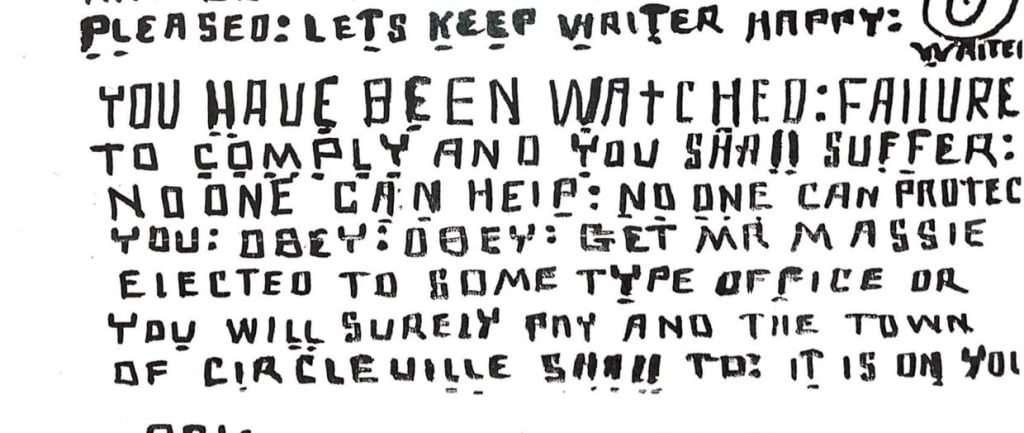
In 1976, the small town of Circleville, Ohio, became the stage for one of the most mysterious and unnerving events in American history. Residents began receiving a series of anonymous letters that contained deeply personal details about their lives, accusations of misconduct, and explicit threats. These letters were not merely the work of a malicious prankster; they led to fear, public scandal, and even a death. The case, now known as The Circleville Letters, remains unsolved, and over four decades later, questions still persist about who was behind the terror that gripped the town. This article will delve deep into the origins of the case, the people involved, and the extensive theories that have since been proposed.
The Beginnings of the Circleville Letters
Circleville, Ohio, a quiet town of about 14,000 people in the mid-1970s, had little reason to expect that it would be thrust into the spotlight of a bizarre and enduring mystery. It all began in 1976, when Mary Gillespie, a local school bus driver, received an anonymous letter accusing her of having an extramarital affair with the school superintendent, Gordon Massie. The letter threatened Mary with dire consequences if she did not stop the alleged affair and make it public to her husband, Ron Gillespie.
The anonymous writer displayed an unnerving level of knowledge about Mary’s life, providing specific details about her routine, and even claiming to be observing her every move. The letter read: “I know where you live. I’ve been watching your house, and I know you have children. This is no joke. Please take it seriously.” Naturally, Mary was alarmed but chose not to act on it, hoping the letters would stop. Unfortunately, they didn’t. Instead, the letters continued to arrive, with increasingly violent language and graphic threats.
Soon, other people in Circleville began receiving similar letters, making the situation even more complex. The letters ranged from threats and personal attacks to scandalous accusations. Yet, despite the specificity of the claims, no one could determine who was writing them. The question that haunted Circleville was: who could be behind these letters?
Ron Gillespie's Death
In August 1977, Ron Gillespie, Mary’s husband, received a phone call that seemed to contain information about the anonymous letter writer’s identity. Agitated and upset, he grabbed his gun, left his house, and drove off. Not long after, Ron was found dead in his car, having crashed into a tree. Though his gun had been fired once, there were no bullet wounds found on his body.
The Pickaway County Sheriff’s Office quickly ruled Ron’s death an accident, attributing it to drunk driving. However, his family and many locals were suspicious, especially since Ron was not known to be a heavy drinker. The fact that his gun had been discharged further fueled theories of foul play, and some believed that the mysterious letter writer might have been involved in his death. But with no concrete evidence to support these suspicions, the case remained unresolved, and Ron's death was officially declared an accident.
The Sign Threats and the Arrest of Paul Freshour
After Ron’s death, the letters continued, and soon they began to target others in the town. But the focus remained on Mary Gillespie and her alleged affair with Gordon Massie. Not only were more letters sent to Mary, but threatening signs also began appearing along her school bus route. The situation reached a breaking point in 1983 when Mary saw a sign that referenced her daughter. Angry and desperate, she attempted to remove the sign, only to discover a crude booby trap attached to it. The trap had a loaded pistol aimed at her, designed to fire upon removal of the sign.
Fortunately, the gun did not go off, and Mary was unharmed. However, this discovery intensified the investigation, and police traced the gun back to Paul Freshour, Mary’s brother-in-law. Freshour was estranged from his wife, Karen, who was Ron Gillespie’s sister. This family connection and some circumstantial evidence led authorities to believe that Paul was the Circleville letter writer. Although Freshour denied having any involvement in the letters or the booby trap, he was arrested and charged with attempted murder. In 1983, he was convicted and sentenced to 7-25 years in prison.
However, the mystery didn’t end with Freshour's imprisonment. Despite his incarceration, the letters continued to be sent to people in Circleville, including a letter to Paul Freshour himself. This raised doubts about whether the police had arrested the right person, and whether Freshour was, in fact, the letter writer. Freshour maintained his innocence throughout his trial and time in prison, insisting that he was being framed.
Was Paul Freshour Really Guilty?
The evidence against Paul Freshour was largely circumstantial. The gun used in the booby trap belonged to him, but it had been reported stolen months before the incident. The handwriting analysis used in the trial was also inconclusive; while experts claimed the handwriting in the letters matched Freshour’s, other analysts disputed this. Furthermore, the fact that the letters continued while he was in prison cast serious doubt on his guilt.
During his time in prison, Freshour petitioned for a new trial, but his requests were denied. He was eventually released from prison in 1994 after serving ten years. However, the letters stopped shortly after his release, adding another strange layer to the case.
Theories and Speculation
Several theories have been proposed to explain the Circleville Letters mystery. Some believe that Freshour was innocent and that the true letter writer was never caught. His estranged wife, Karen, was suggested by some as a possible suspect, motivated by her bitter divorce from Paul. Karen denied any involvement, but her possible connection has never been fully explored.
Another theory is that there may have been multiple letter writers. Some of the letters were written with slight differences in handwriting style and tone, leading to speculation that more than one person was involved in the campaign of harassment. It is possible that the original letter writer had help or that others, seeing the chaos caused by the letters, decided to copy the style and contribute their own threats.
Finally, there are those who believe that the Circleville Letters case involved a much larger conspiracy. Some locals have suggested that the letters were part of a cover-up for more sinister activities, perhaps even linked to Ron Gillespie’s mysterious death. However, no substantial evidence has ever been provided to support these claims.
Conclusion
The Circleville Letters remain one of the most bizarre and enduring unsolved mysteries in American history. Despite the arrest and conviction of Paul Freshour, questions about his guilt persist, as do theories about who else might have been involved. The letters, filled with threats, accusations, and intimate knowledge of the residents' lives, left a lasting mark on the town of Circleville. Decades later, the full truth behind the letters—and whether justice was ever truly served—remains an enigma.
The unsolved nature of the case, coupled with the continued harassment even after Freshour's imprisonment, suggests that there may still be pieces of the puzzle left uncovered. Whether it was the work of a single disturbed individual or a larger conspiracy, the Circleville Letters serve as a chilling reminder of how far-reaching the effects of anonymous terror can be, especially in a small town where everyone knows each other—or thinks they do.
About the Creator
Aslihan
Aspiring writer with a passion for researching diverse topics. I love sharing insights and connecting with others. Let’s embark on a journey of exploration and discover intriguing stories together
Ken Childs and the Shadow Network Behind Celebrity Surveillance
Hollywood is no stranger to intrigue. Behind the red carpets, blockbuster premieres, and glamorous headlines lies a parallel world where privacy is fragile and information can be extremely valuable. Over the years, celebrities have faced stalkers, hackers, and fraud schemes designed to exploit their wealth and visibility. Recently, reports circulating online have drawn attention to a controversial narrative involving private investigator Ken Childs and allegations that place him near the center of a disturbing story about celebrity surveillance.
By Shane Smith3 days ago in Criminal



Comments
There are no comments for this story
Be the first to respond and start the conversation.