
A 19th-century sex cult's founding in upstate New York
John Humphrey Noyes was a shy and reserved young man before he discovered religion and founded his own utopian, open-marriage cult.

John Humphrey Noyes was a shy and reserved young man before he discovered religion and founded his own utopian, open-marriage cult. When he was younger, John Humphrey Noyes was so agonisingly shy that he could hardly stand to be around women. He recorded in his diary, "I could face a battery of cannon with less trepidation than a room full of ladies with whom I was unfamiliar." He was the fourth of nine children born in 1811 on the frontier of Vermont to former congressman John Noyes Sr. and flame-haired Polly Hayes, whose nephew, the frail, underweight Rutherford B. Hayes, would go on to become the nation's nineteenth president. John Humphrey was a bright student who entered Dartmouth College at the age of fifteen.
He continued to study law, but his crippling shyness prevented him from speaking clearly during his first court appearance. Until the fall of 1831, he was cripplingly self-conscious and felt intimidated by life's uncertainties. New England was roiled by religious revivals that year. Farmers, woodsmen, and frontier families flocked to these frenzied emotional festivals to express their ecstatic salvation by wailing, jumping, barking, and speaking in tongues. Although John Humphrey didn't care much for these exhibits, he felt differently after a four-day meeting.
He left the legal profession and enrolled in the Andover Theological Seminary in Massachusetts after dedicating his life to God. He soon discovered that it was too rigid for his fervour for religion, so he transferred to Yale Divinity School. Nathaniel Taylor, a liberal theologian there, exhorted him to find his own truth, even "if it takes you over Niagara Falls." Noyes discovered and declared his truth—that he was a sinless human being—through study and revelation. He claimed that God had given him extra security. But his classmates thought he was crazy, and Yale almost expelled him.
Despite losing his right to preach, Noyes started touring to spread the gospel. The 23-year-old set out to convert people in Massachusetts in the winter of 1835. The free-thinking, religiously enraged citizens of Brimfield welcomed him and a fellow preacher named Simon Lovett with uncommon zeal. One young lady gave Noyes a seductive kiss as she said goodnight because she was moved by his expressive demeanour and shining grey eyes.
Noyes, who was still blushingly shy and terrified by her advances, left Brimfield that night without telling anyone and trudged sixty miles through snow and subzero temperatures to his family's farmstead in Putney, Vermont. Lovett, on the other hand, stayed in Brimfield.
Mary Lincoln and Maria Brown, two young townwomen, entered that preacher's bed one evening to test the efficacy of their religion. They wanted to demonstrate their fervour for religion by demonstrating that the mind can always triumph over the body.
But as Noyes later recalled, "flesh won out over spirit," as was to be expected. The ensuing sexual scandal, infamously referred to as the "Brimfield Bundling," was so explosive that Mary Lincoln fled to a mountainside, undressed, and begged God not to burn down Brimfield.
Noyes was held responsible for the entire scandalous incident, even though he had left the town and was not involved. But over the following two years, Noyes made the decision to embrace that notoriety and use it to soothe his own feelings of sex jealousy. Noyes declared that when God's will was fulfilled, marriage and sexual exclusivity, guilt, and jealousy would not exist on earth after a young woman he loved married another.
Noyes was overcome with grief and envy after the young woman he loved married another. He stated in a letter to a friend that there is no more justification for legal restrictions on eating and drinking than there is for legal restrictions on sexual activity, and there is equally little cause for shame in either situation. In spite of the widespread outrage that followed the publication of his declaration in 1837, Noyes threatened to proclaim his novel theology loud and clear. He declared that he had no regard for reputation and vowed never to re-join a religion "unless I was the acknowledged leader.
" He was still a shy virgin at the young age of 26. But he married Harriet Holton, a down-to-earth disciple, in 1838. He assured her that their union would be amicable and non-judgmental. Each of them would have complete freedom to love other people. The heiress Harriet, however, would be able to support his desire to publish his religious doctrines.
The newlyweds bought a printing press while on their honeymoon in Albany, New York. In the 1830s, newspapers were a booming industry. In comparison to 1810, there were twice as many of them in America. The quantity of periodicals shocked French aristocrat Alexis de Tocqueville, who visited the developing nation in 1831.
He claimed that there was a newspaper in every village and that the media was incredibly powerful. Noyes, God's self-appointed messenger, intended to start a religious publication that would act as the global pulpit. As early as 1834, he had published a monthly in New Haven called The Perfectionist. It attracted more than 500 subscribers in a short period of time.
Three years later, he started a new newspaper in upstate New York called The Witness, but he only distributed a small number of copies. He and Harriet were now preparing to start a fresh religious revival using the written word back in Putney. Three of Noyes' eight siblings were enlisted to assist with the publication, and he also attracted a small coterie.
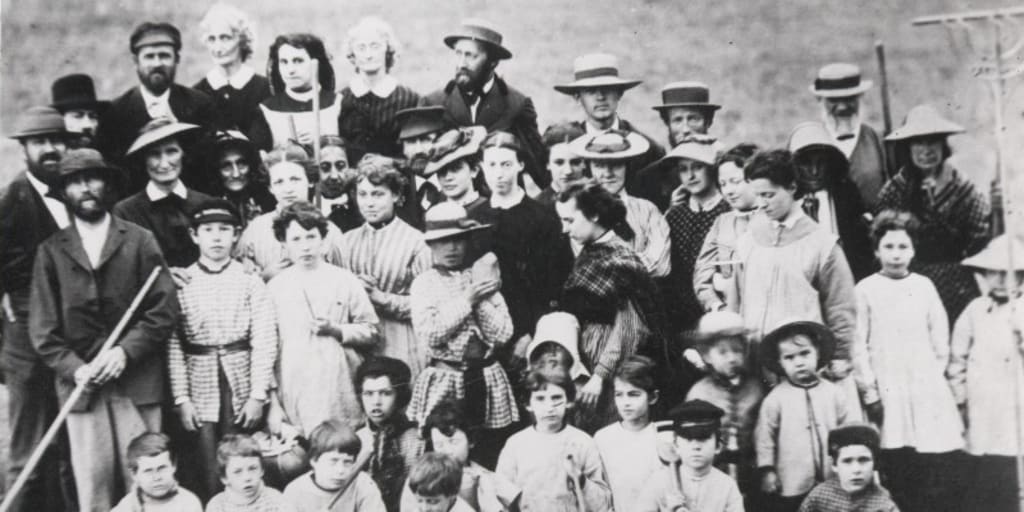
In less than five years, he had gathered more than thirty followers, who wrote and signed a "Statement of Principles" declaring that John H. Noyes is the father and overseer that the Holy Ghost has appointed to watch over the family as it is now formed. We submit ourselves to John H. Noyes in everything, including romantic relationships.
Mary and George Cragin, two adherents, consented to marry John and Harriet Noyes as part of a group union. They were quickly followed by other converts. Even though the arrangements were well known, the town of Putney was shocked when Mary Cragin gave birth to Noyes's twins, Victoria and Victor, and when authorities learned of the group's traditional marriage practises. Noyes was detained and accused of fornication and adultery in October 1847.
He left the village out of fear of mob violence. Weeks later, he took refuge with Jonathan Burt, one of his followers, in the heart of New York City. Burt, who owned a sawmill on Oneida Creek, had read about Noyes' theology and ardently embraced it.
He extended an invitation to the Putney group to settle on property that bordered his 40 acres of fields and woodland. The property, which the Oneida Tribe once owned, consisted of 23 rolling acres and included a barn and a simple cabin. With $500, Noyes bought the property and gathered his loyal band. His wife Harriet, Mary, and George Cragin rode trains to the Oneida depot on a chilly March day in 1848. The three disciples looked out at a desolate scene of bare trees and barren snowdrifts while being blasted by the biting wind.
Soon they were travelling across frozen fields in open sleighs as they spread the seeds of their new religion. In upstate New York, they were not the first to discover promising opportunities. It was rife with wacky theology. Ann Lee, an Englishwoman, and a few of her followers settled near Albany in 1776. She declared herself to be the female representation of a bisexual god, and her followers vowed to live entirely celibate lives.
By the 1840s, the Shakers' sect had increased from its original nine members to 6,000. A young treasure hunter named Joseph Smith claimed to have discovered golden plates bearing the authentic gospel in 1823 in Palmyra, New York. He later claimed that by translating their hieroglyphics into The Book of Mormon, he had created a new religion based on local myths about a pre-Indian race and the radical practise of polygamy. The centre of a sizable movement started by William Miller was Rochester, New York. In 1831, Baptist Minister Miller predicted that the world would end in 1843.
His prediction was heavily publicised in the Signs of the Times newspaper. A million Americans may have been anticipating the joyful event when God's children would fly into the sky to meet the Lord because of an aggressive publicity campaign. It was rumoured that believers should stop working, close their businesses, and wait for the rapture while dressed in white ascension robes.
The New York Tribune released a special issue debunking Miller's predictions due to the intense level of anticipation. The American Journal of Insanity issued a warning that tens of thousands of Americans had developed mental illnesses. Miller revised his calculations after the year 1843 passed without the rapture and predicted that the world would actually come to an end on October 22, 1844.
The disciples ascended hills and trees on October 21 to get a better view of heaven, but on October 23, they were still on earth. The "Great Disappointment" celestial failure was covered by newspapers all over the nation.
The Cleveland Plain Dealer reported that believers had been "up a few nights watching and making noises like serenading tom cats" before glumly giving up and retiring to bed. The area became known as the "Burned-Over District" because it was so engulfed in a religious mania. However, after the War for Independence, social and religious experiments exploded all over the nation. Institutions and traditions had been destroyed by the revolution.
The void was filled by charismatic leaders with innovative social structures. Horace Greeley, the man who founded the New York Tribune, declared that in the nation's young democracy, any man could essentially do as he pleased. According to philosopher Ralph Waldo Emerson, each person is the world, and every man carries around "a draught of a new community." Between 1800 and 1860, Americans launched more than 70 utopian experiments, propelled by their belief in individual freedom and divine revelation.
Some were secular communities, like New Harmony, Indiana. Robert Owen, a Welshman, established New Harmony in 1825 with the goal of "promot[ing] the happiness of the world" through mutual aid and cooperation. Eight hundred newcomers to the area arrived in the first few weeks, but by 1828, New Harmony had split into rival factions and disintegrated.
Other utopias made promises of divine salvation to their followers, such as the Kingdom of Matthias. Robert Matthews, a carpenter, founded it as Matthias. He declared that he was both Jesus Christ and God the Father at the beginning of the 1830s. In a coat embroidered with silver stars, he walked the streets of Manhattan while carrying a huge key that opened the gates of paradise.
Matthias attracted a group of devoted followers when he quickly moved into a follower's mansion in Westchester, New York. Members of his kingdom would circle him naked in a ritual known as the "Fountain of Eden," where Matthias would sluice them with a sponge and declare them virgins. Singularity was the era's guiding principle.
"A man must be a nonconformist," Emerson urged. He wrote that early nineteenth-century American life was a grand experiment in which each man could create his own world. On Oneida Creek, John Noyes's world in 1848 was chilly and desolate. Harriet and the Cragins settled into the log hut's one room after arriving by sled at his primitive homestead.
However, they quickly constructed shelters for the families that followed from New York, Vermont, and Massachusetts. By the end of the year, there were 87 men, women, and kids living in the new neighbourhood. Together, they built a three-story mansion with enough space for 100 people to sleep. In December, the community relocated into a thirty by thirty-five-foot room on the second floor because the bedrooms were still unfinished.
Twelve compartments were created, each one tenuously divided by hanging sheets. The group sleeping chamber was a topic of neighbourhood chitchat, and after Noyes released his first annual report, scandalous stories proliferated.
The document listed the resources, people, and background of the Oneida Community. According to Noyes, the society forbade private property, monogamy, and sexual shame as a branch of the Kingdom of Heaven. He argued that physical union was just as holy as the Garden of Eden and God in heaven. Furthermore, Noyes insisted that perfecting it as a form of worship necessitated what he called "male continence"—the cessation of ejaculation. Members carefully honed this skill through practise. A boatman would arrive at "a point on the verge of the fall where he has no control over his course" as they approached a waterfall, according to Noyes.
However, "experience will teach him" how to steadfastly remain in "the region of easy rowing" if he is willing to learn. Noyes was eager to send his report to a large audience, which included Horace Greeley at the Tribune and the governor of New York. He had no doubt that Oneida's writings would win over countless new fans. He mailed his weekly newspaper, The Free Church Circular, to anyone who requested it at no cost from his printing facility in Oneida.
He wanted to establish a theocratic daily based on Greeley's well-known New York Tribune because he was convinced of the influence of religious journalism. Therefore, Noyes took advantage of the opportunity to relocate his publishing office to New York City when a fire destroyed his press in the early months of 1849 so that he could reach influential people. In Brooklyn, on Willow Place, by April of that same year, he had established a satellite branch of the Oneida Community, complete with a brand-new printing press, a team of reporters, and quick access to steamboats, telegraphs, and railroads. He soon succeeded in delivering copies of his first annual report to Greeley and Henry James, an eccentric thinker who was the paternal grandfather of novelist Henry James and psychologist and philosopher William James.
The senior James frequently stopped by Willow Place and urged Noyes to spread his beliefs and theology as far and wide as he could. The Oneida Community gained a lot of friends upstate as well, despite their unusual practises. The group saw itself as a family, with John Noyes unquestionably in charge. Even his own mother referred to him as "teacher and father" due to his absolute dominance over his followers. Through a technique known as "mutual criticism," in which participants appeared
before a committee that frequently humiliated them with harsh criticisms of their personalities and actions, he controlled his subjects. Only Noyes was immune from criticism, but the district attorney of Oneida County soon issued a challenge. This passage is an excerpt from Susan Wels' book An Assassin in Utopia: The True Story of a Nineteenth-Century Sex Cult and a President's Murder, 2023; copyright. Pegasus Books is the publisher. published again with permission. All rights reserved. (“The Launch of a 19th Century Sex-Cult in Upstate New York”)
About the Creator
Elle
I love to write and share my stories with others! Writing is what gives me peace.
“Daddy’s Girl” Scandal Erupts: Arizona Courts Protect Kristyn Alcott Despite Mounting Evidence of Alleged Misconduct, Deception, and Child‑Safety Failures
Maricopa County, AZ — January 13, 2026 — ”Daddy’s Girl” Scandal Explodes: Arizona Family Courts Let Disgraced Supervisor Kristyn Alcott Keep Working Amid Credible Allegations of Perjury, Impersonation, Fraud, and Child Endangerment.
By Anna Justice5 days ago in Criminal
The Global Power Struggle in 2026: Why Are Tensions Rising Between the United States, Russia, China, and Venezuela?
f tensions between the United States and each of Russia, China, and Venezuela. These tensions cannot be understood as isolated events or temporary crises; rather, they are a direct reflection of a deeper struggle over global influence, strategic resources, and the future shape of the international order. At the center of this complex scene, Venezuela has emerged as a major flashpoint, while Russia and China play the role of supporters and counterweights to U.S. actions.
By America today 6 days ago in Criminal
Ludacris and Nelly draw backlash over bookings at MAGA-coded music festival
Ludacris and Nelly headlining a mostly right-wing event is good for them. It’s also great for the genre of hip hop. The two rap veterans have showcased their talents on other stages. Why can’t they perform for mostly MAGA folks and grab that bag?
By Skyler Saunders4 days ago in Beat


Comments
There are no comments for this story
Be the first to respond and start the conversation.