Science Fiction
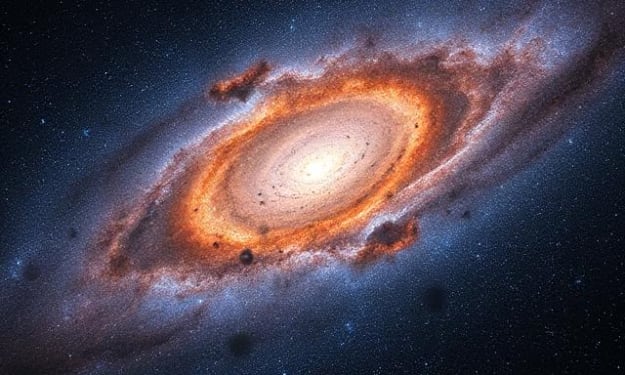
Exploring Our Universe
Our universe is vast, mysterious, and awe-inspiring—a cosmic expanse that stretches beyond what the human mind can fully comprehend. From the tiniest subatomic particles to the largest galaxies, the universe is filled with an incredible array of phenomena that challenge our understanding and fuel our curiosity. The more we learn, the more we realize how little we truly know about the cosmos, sparking a deep desire to understand the very fabric of existence.
By MD Ariful Islam10 months ago in Chapters
Shadow & Spell: A Tale of Redemption Part 2
The rain had lessened to a drizzle by the time Vaelin and Elira reached the outskirts of Duskwatch. The city’s looming walls faded behind them, replaced by dense, gnarled trees and the mist-choked roads of the Moonveil Forest. Vaelin had chosen this route deliberately—few pursued the assassin who knew the wilds better than the city streets.
By Richard Bailey10 months ago in Chapters
Harry Potter and the Chamber of Secrets: A Magical Sequel that Delivers
The magical world of J.K. Rowling's Harry Potter series made its spectacular cinematic debut in 2001, enchanting audiences around the world. However, it was the second film, Harry Potter and the Chamber of Secrets (2002), that truly elevated the franchise, building on the solid foundation laid by its predecessor and introducing darker, more intricate elements to the wizarding world. Directed by Chris Columbus, this movie not only deepens the mythology of the magical universe but also intensifies the stakes, keeping fans hooked for the thrilling journey that unfolds.
By Alexander W Carlos10 months ago in Chapters
The Dual Nature of Light
Unraveling the Quantum Mysteries of Illumination: Light and Photons For centuries, people have been interested in light, a fundamental component of our everyday lives. Light has been studied from a variety of angles, from ancient philosophers to modern scientists. Our understanding of light, on the other hand, has only become significantly more mysterious and profound over the past century. The idea of the photon—an elementary particle that is the foundation of light itself—is at the center of this comprehension. To truly appreciate the nature of light, we must explore both the concept of light and the role photons play in shaping the world around us.
By MD Ariful Islam10 months ago in Chapters
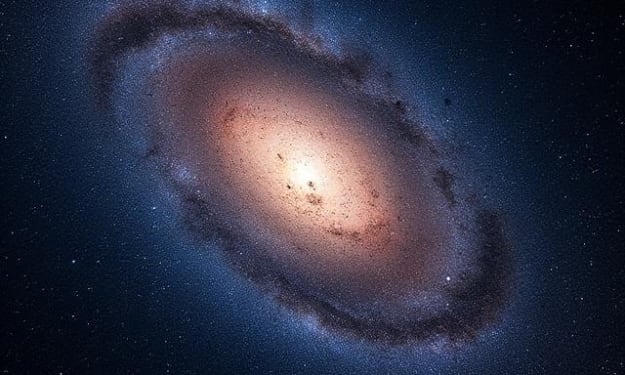
Exploring the Milky Way
The Milky Way is the galaxy that we call home. It is an enormous, whirling collection of dark matter, gas, dust, and stars that spans an unimaginable distance. The Milky Way, one of the billions of galaxies in the universe, is not just a random collection of celestial objects; rather, it is a dynamic system with intricate structures and intriguing mysteries that continue to captivate astronomers and scientists.
By MD Ariful Islam10 months ago in Chapters
Shadow & Spell: A Tale of Redemption Part 1
The rain fell in thick, unrelenting sheets, turning the streets of Duskwatch into a shimmering labyrinth of slick cobblestones and shadowy alleys. Lanterns cast flickering pools of light that did little to push back the oppressive darkness. It was a night for secrets, for those who lurked unseen. A night made for killers.
By Richard Bailey10 months ago in Chapters
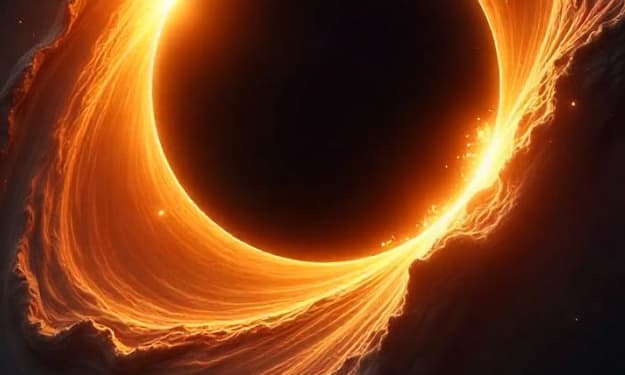
The Mysteries of Black Holes
A black hole is a type of cosmic object that contains such a vast amount of matter and energy that its gravitational force is so intense that nothing, not even light, can escape from it. John Michell, a British astronomer, first proposed the idea of a black hole in 1783. However, Albert Einstein's theory of general relativity gave it a lot of attention in the modern era. Black holes have been the subject of ongoing investigation ever since, and numerous observations and experiments have established their existence. A Black Hole's Structure and Characteristics The immense density and gravitational force of a black hole are its most fundamental characteristics. A singularity is a point at which the curvature of space-time becomes infinite and the mass or density reaches an unimaginable level at the center of a black hole. A boundary known as the "event horizon" surrounds this singularity and serves as a point of no return. Once something crosses the event horizon, it cannot escape the black hole, not even light. This is why black holes are often referred to as "cosmic voids" or "cosmic prisons" because nothing can escape from them.
By MD Ariful Islam10 months ago in Chapters