

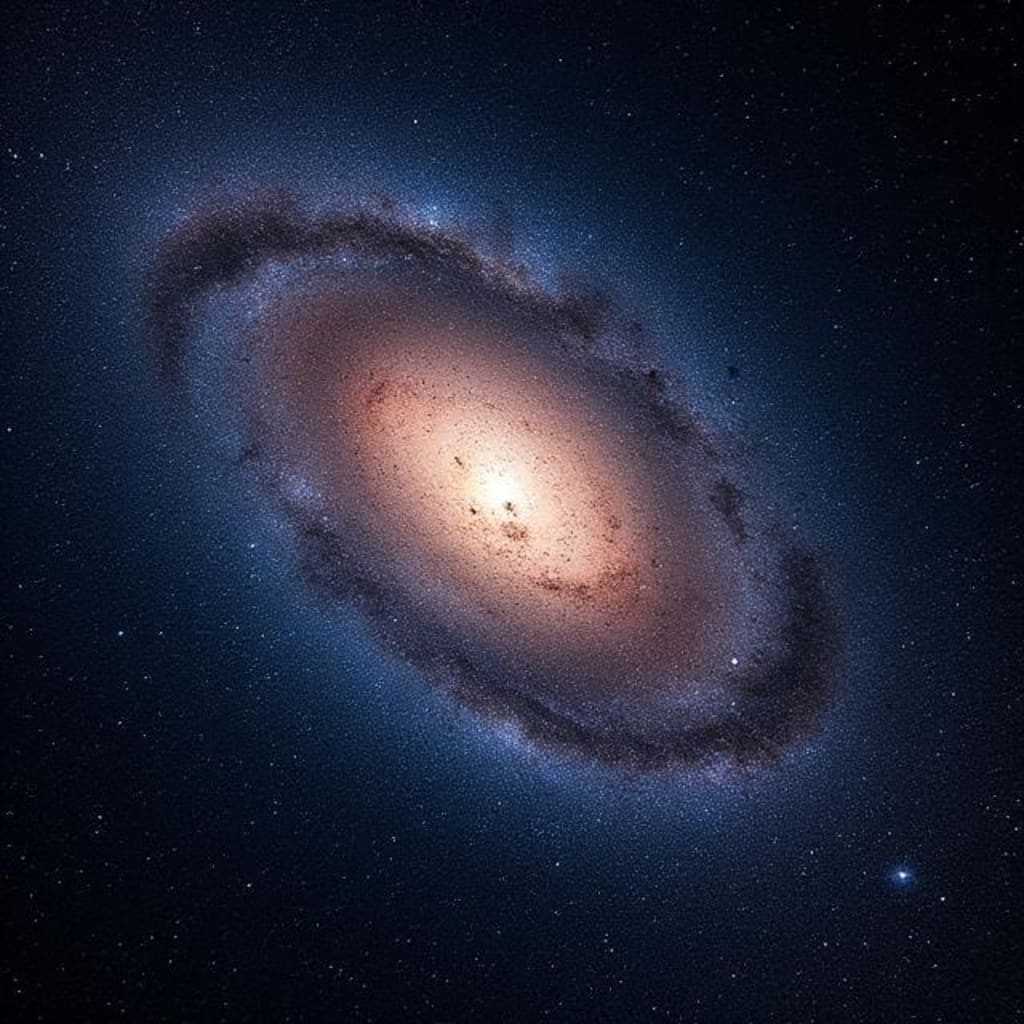
The Milky Way is the galaxy that we call home. It is an enormous, whirling collection of dark matter, gas, dust, and stars that spans an unimaginable distance. The Milky Way, one of the billions of galaxies in the universe, is not just a random collection of celestial objects; rather, it is a dynamic system with intricate structures and intriguing mysteries that continue to captivate astronomers and scientists.
### The Structure of the Milky Way
The Milky Way is a barred spiral galaxy at its core. This indicates that it has spiral arms radiating outward from a central bar-shaped structure of stars. The majority of the galaxy's stars, gas, and dust are in these arms. The Milky Way is about 100,000 light-years across and contains hundreds of billions of stars. If you were to travel at the speed of light, it would take you 100,000 years to cross it.
Globular clusters, which are spherical collections of stars that are tightly bound by gravity, form a halo around the galaxy as well. These objects, along with a vast amount of dark matter, form the outer regions of the Milky Way.
### Our Position in the Galaxy
The Orion Arm, one of the spiral arms of the Milky Way, is where the Earth is located. About 27,000 light-years from the center of the galaxy, this arm is a relatively small and obscure region. We are situated roughly halfway between the center of the galaxy and its outer edge. It takes about 225 million years for our solar system to complete a full revolution around the galactic center, which is called a cosmic year. Sagittarius A*, a supermassive black hole, can be found in the Milky Way's center. The gravitational pull exerted by this black hole has an impact on the orbits of stars and gas in its vicinity, and its mass is approximately four million times that of our Sun.
### Star Formation and Stars There are many different kinds of stars in the Milky Way, from young stars to old stars. The process of star formation occurs in vast molecular clouds, where dense pockets of gas and dust collapse under their own gravity, creating new stars. These stars are often born in clusters, and over time, they evolve and eventually die, some in spectacular supernova explosions that spread heavy elements throughout the galaxy.
The Milky Way's diverse population of stars is one of its most significant features. Young, hot stars are found in the spiral arms, while older stars reside near the galactic core. Additionally, there are numerous white dwarf remnants and red giant stars in the Milky Way. These stars, along with others, make the galaxy a dynamic and ever-evolving system.
### Unseen Forces and Dark Matter Around 85% of the Milky Way's mass is obscured. This is because it is made up of dark matter—an invisible form of matter that does not emit, absorb, or reflect light. Though we can't observe dark matter directly, scientists can infer its presence from its gravitational effects on visible matter. Dark matter plays a crucial role in preserving the structure of the galaxy by keeping the stars in orbit around the galactic center and preventing their escape into space. In addition to dark matter, the Milky Way also contains vast amounts of dark energy, an even more mysterious force believed to be responsible for the accelerated expansion of the universe.
### The Milky Way's Neighbors
The Milky Way is not alone in the universe. It is a member of the Local Group, a group of galaxies that also includes the Andromeda Galaxy, which is our closest neighbor, and several smaller galaxies like the Triangulum Galaxy. The Virgo Cluster, which is made up of thousands of galaxies, is even larger than the Local Group. Over time, the Milky Way and Andromeda are expected to collide and merge into a single, larger galaxy. This event, which is predicted to happen in about 4.5 billion years, will dramatically reshape both galaxies.
### Observing the Milky Way
From Earth, we see the Milky Way as a bright band of stars stretching across the night sky. This is the dense core of our galaxy, viewed from the inside. In many parts of the world, the Milky Way is visible to the naked eye, but light pollution in urban areas can make it difficult to see. Deserts and high mountain ranges, where there is little artificial light, are the best places to view our galaxy. Astronomers have spent decades studying the Milky Way using various tools, including radio telescopes, infrared telescopes, and space-based observatories like the Hubble Space Telescope. With the help of these instruments, researchers are able to look at various wavelengths of light and discover hidden structures and phenomena like supernova remnants, star-forming regions, and black holes. ### The Future of the Milky Way
While much has been discovered about the Milky Way, there is still much to learn. Our understanding of the galaxy's formation, the role of dark matter, and the interactions between its various components continues to evolve. With upcoming space missions, such as the James Webb Space Telescope, we will be able to explore deeper into the Milky Way than ever before, uncovering new insights into the galaxy's past, present, and future.
The Milky Way, like all galaxies, is a living entity that is constantly changing. As it evolves, so too does our understanding of the universe. We may never fully comprehend all of the mysteries hidden within its vastness, but one thing is certain: the Milky Way is a cosmic treasure trove, waiting for future generations of explorers to uncover its secrets.
### In the end
The Milky Way is not just the galaxy we live in; it is a complex, magnificent, and dynamic system that embodies the beauty and mystery of the universe. As we continue to explore and study our galaxy, we will gain deeper insights into our place in the cosmos and the forces that shape the universe around us. The journey of discovery is far from over, and with each new discovery, we get closer to comprehending space's vastness and our place in it.
About the Creator
MD Ariful Islam
Writer, thinker, and storyteller. I share fresh perspectives on [your niche or interests], sparking new ideas and conversations. Let’s connect!
Keep reading
More stories from MD Ariful Islam and writers in Chapters and other communities.
The Mysteries of Black Holes
A black hole is a type of cosmic object that contains such a vast amount of matter and energy that its gravitational force is so intense that nothing, not even light, can escape from it. John Michell, a British astronomer, first proposed the idea of a black hole in 1783. However, Albert Einstein's theory of general relativity gave it a lot of attention in the modern era. Black holes have been the subject of ongoing investigation ever since, and numerous observations and experiments have established their existence. A Black Hole's Structure and Characteristics The immense density and gravitational force of a black hole are its most fundamental characteristics. A singularity is a point at which the curvature of space-time becomes infinite and the mass or density reaches an unimaginable level at the center of a black hole. A boundary known as the "event horizon" surrounds this singularity and serves as a point of no return. Once something crosses the event horizon, it cannot escape the black hole, not even light. This is why black holes are often referred to as "cosmic voids" or "cosmic prisons" because nothing can escape from them.
By MD Ariful Islam12 months ago in Chapters
How Transparency and Honesty Drive Sustainable Financial Success
Financial success depends on more than profitability or growth metrics. It is deeply influenced by the principles guiding an organization’s decisions, communication, and long-term strategy. Transparency and honesty are not simply ethical ideals; they are strategic drivers of sustainable performance that strengthen stakeholder trust, reduce risk, and improve organizational resilience.
By Michael Christopher Venturino6 days ago in Chapters
Hottest in the Office
Dear Rafi, You’re very distracting to work around. For the first second I saw you the other day, I thought you were some type of executive. It took a moment to realize no, you were just the new guy, dressed up for the job he wants. Be still, my heart.
By Gabriel Shames4 days ago in Pride



Comments (1)
I love the Milky Way! Amazing work! Good job