
The Dual Nature of Light
Exploring the Role of Photons in Quantum Mechanics and Technology

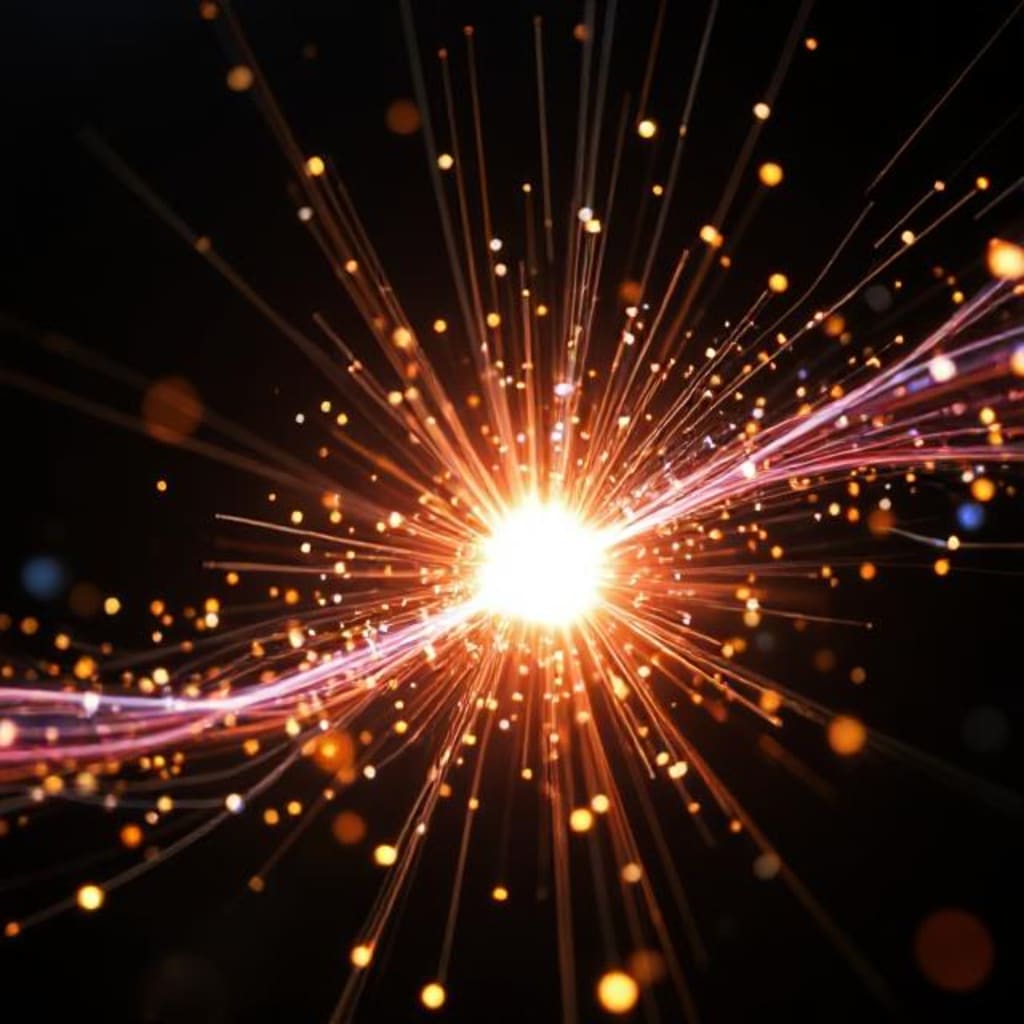
Unraveling the Quantum Mysteries of Illumination: Light and Photons For centuries, people have been interested in light, a fundamental component of our everyday lives. Light has been studied from a variety of angles, from ancient philosophers to modern scientists. Our understanding of light, on the other hand, has only become significantly more mysterious and profound over the past century. The idea of the photon—an elementary particle that is the foundation of light itself—is at the center of this comprehension. To truly appreciate the nature of light, we must explore both the concept of light and the role photons play in shaping the world around us.
### What is Light?
Light is a form of electromagnetic radiation that travels in waves. It includes a spectrum of wavelengths that our eyes can perceive (visible light), as well as wavelengths beyond our sight, such as ultraviolet (UV) and infrared (IR) radiation. Light waves are made up of oscillating electric and magnetic fields that propagate through space. But light is more than just a wave; it also has properties like particles, which is how photons came to be. ### The Photon: A Light Particle The fundamental particle of light is a photon. Photons don't have mass like many other particles in the universe, but they do carry energy and momentum. They are unique in the field of quantum mechanics because of this. Photons actually embody the principles of quantum theory, which governs the behavior of particles at extremely small scales, and as a result, they are referred to as "quantum" particles. The wavelength (or frequency) of a photon is what defines it, and it moves through space at the speed of light—roughly 299,792 kilometers per second (186,282 miles per second). The energy of a photon is directly related to its frequency: higher-frequency photons (like those in ultraviolet light) carry more energy than lower-frequency photons (like those in infrared light). The equation provides a description of this energy relationship: \[
E = h \cdot f
\]
Where:
The photon's energy is denoted by "(E)," - \(h\) is Planck’s constant (a fundamental physical constant),
- The photon's frequency is "(f)." ### The Secret to Understanding Light: Duality of Waves and Particles One of the most remarkable features of light—and photons—is their ability to behave both as waves and particles. This duality is a cornerstone of quantum mechanics. Phenomena like interference and diffraction, in which light waves combine and spread out as they pass through slits or obstacles, demonstrate the wave nature of light. However, when it interacts with matter, particularly in processes like the photoelectric effect, light also behaves like a stream of particles. In the photoelectric effect, light shining on a metal surface causes the emission of electrons. Albert Einstein famously explained this phenomenon in 1905, suggesting that light is composed of particles—photons—which transfer their energy to electrons, causing them to be ejected from the metal. This particle-like behavior of light could not be explained by the wave theory alone, and it earned Einstein the Nobel Prize in Physics.
Quantum mechanics, which revolutionized our understanding of the microscopic world, was inspired by the idea that light possesses wave and particle characteristics. ### The Photon's Quantum Nature In the quantum world, photons don’t just behave like little packets of light—they exhibit unique characteristics that defy classical physics. For example, photons can exist in a state of superposition, meaning they can be in multiple places or states at once until measured or observed. This is best illustrated by the famous *double-slit experiment*.
Light is passed through two slits in this experiment, and the pattern on the screen behind the slits is an interference pattern typical of waves. However, when photons are sent one at a time, they still create an interference pattern, implying that each individual photon behaves like a wave that passes through both slits simultaneously. The wave-like superposition collapses into a definite state when a photon is observed and "decides" which slit to pass through. This paradoxical behavior of photons—acting as both particles and waves—has fascinated scientists and led to debates over the nature of reality itself.
### Photons in Action: Practical Applications
Photons are more than just abstract concepts; they also have practical applications that have an effect on our day-to-day lives. Technology uses photons and light in a variety of ways, including the following: 1. Data Transmission and Communication Fiber-optic communication relies heavily on photons. In this system, light (often in the form of infrared photons) is transmitted through long strands of glass or plastic fiber, allowing for the rapid transfer of data over vast distances. This technology forms the backbone of global internet networks and telecommunications.
2. **Lasers**
- A laser (Light Amplification by Stimulated Emission of Radiation) produces a coherent beam of photons, all traveling in the same direction and phase. Lasers have numerous applications, from medical procedures like laser eye surgery to barcode scanning, data storage, and even military applications.
3. **Solar Energy** - Solar panels rely on the photoelectric effect, the process Einstein described in 1905, to convert sunlight into electricity. When photons from the sun hit the surface of solar cells, they release electrons and produce an electrical current. This technology is at the heart of the growing renewable energy movement.
4. **Imaging and Medicine**
Photons are used in X-ray imaging and PET (Positron Emission Tomography) scans for medical imaging. These technologies rely on photons to penetrate the body and provide detailed internal images that help diagnose and treat diseases.
### The Role of Photons in the Universe
Photons also provide us with information about the universe. The light emitted by distant stars and galaxies carries critical data about their composition, temperature, and motion. In fact, the study of photons is one of the primary ways astronomers learn about the cosmos. Telescopes like the Hubble Space Telescope capture photons from distant objects, enabling scientists to observe the farthest reaches of space and gain insight into the history and evolution of the universe.
In addition, a type of photon that covers the entire universe is the Cosmic Microwave Background Radiation (CMB), which is a remnant of the Big Bang. Studying the CMB has provided evidence for the origins of the universe and is a key piece of the puzzle in understanding cosmology.
### Conclusion: The Quantum Wonder of Light and Photons
Light and photons represent one of the most captivating phenomena in both science and nature. Their dual nature, as both particles and waves, challenges our classical understanding of the world and opens the door to the strange and often counterintuitive realm of quantum mechanics. From powering our homes with solar energy to unlocking the mysteries of the cosmos, photons are an essential part of the universe's fabric.
The more we learn about light and photons, the more we realize that they are not only the key to understanding how the universe works, but they are also the driving force behind a lot of our technological advancement. As science continues to explore the quantum world, the mysteries of light and its elusive particle, the photon, will undoubtedly lead to even more revolutionary discoveries.
About the Creator
MD Ariful Islam
Writer, thinker, and storyteller. I share fresh perspectives on [your niche or interests], sparking new ideas and conversations. Let’s connect!
Keep reading
More stories from MD Ariful Islam and writers in Chapters and other communities.
Exploring the Milky Way
The Milky Way is the galaxy that we call home. It is an enormous, whirling collection of dark matter, gas, dust, and stars that spans an unimaginable distance. The Milky Way, one of the billions of galaxies in the universe, is not just a random collection of celestial objects; rather, it is a dynamic system with intricate structures and intriguing mysteries that continue to captivate astronomers and scientists.
By MD Ariful Islam10 months ago in Chapters
Fair Exchange, No Robberies
Dark Memoirs - Index There are at least two kinds of people in the world: those who write this half-arsed kind of intro to a story that looks to separate the rare and the norm, and those who realise it's an overused framing device and don't.
By Paul Stewart12 days ago in Chapters
ThunderCats Fanfiction Project (Ch 4 Episode 4)
Deep within the flagship’s wounded core, Tygra and Panthro descend into the dark to revive the ship’s failing heartline. As they navigate smoke‑filled shafts and failing conduits, the crew above clings to breath and hope. The first lights flicker back to life — but the silence of the void still surrounds them, and the cost of survival has only begun to reveal itself.
By Marcellus Grey5 days ago in Chapters



Comments
There are no comments for this story
Be the first to respond and start the conversation.