
The Mysteries of Black Holes
Understanding the Cosmic Giants

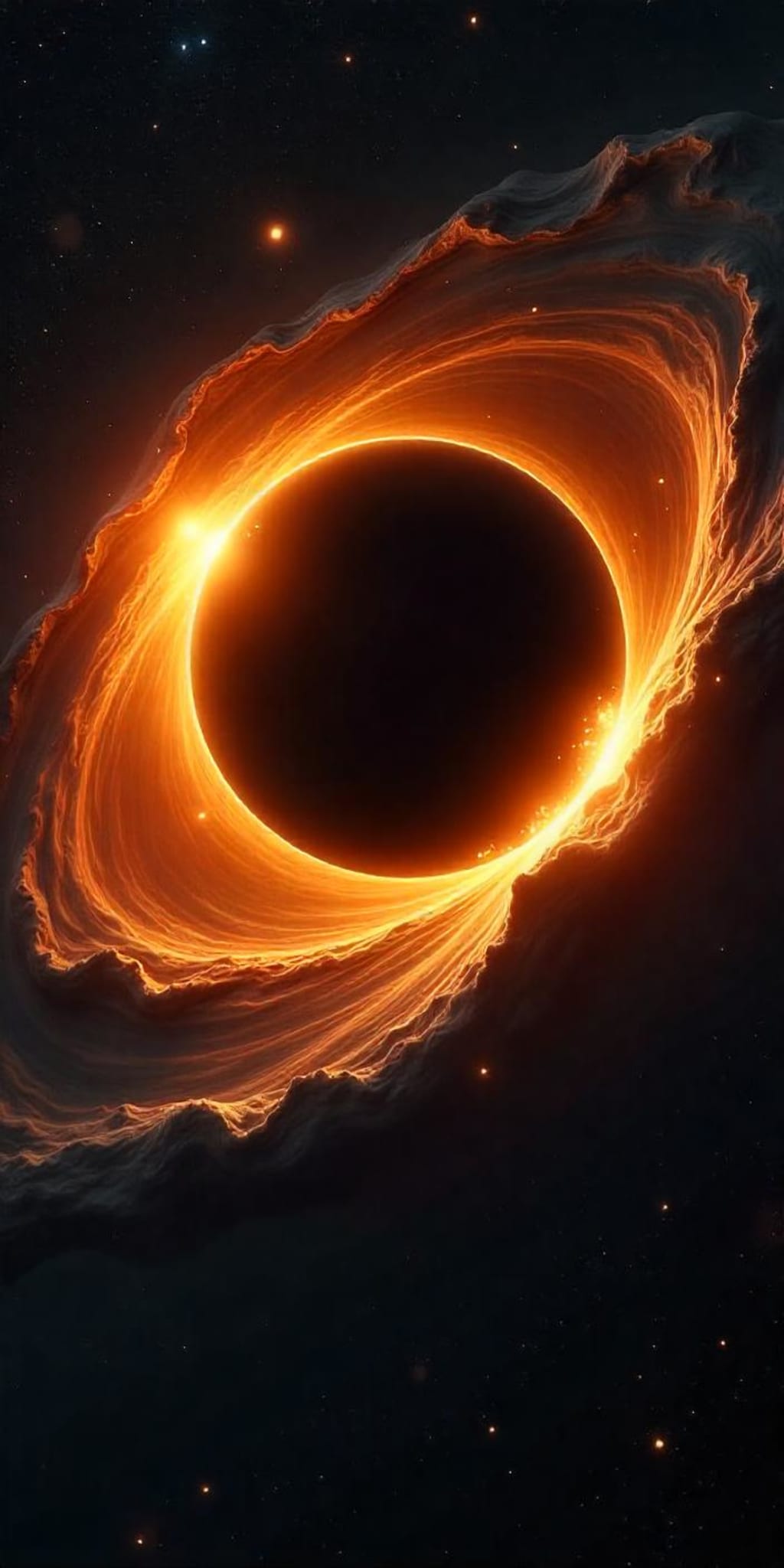
A black hole is a type of cosmic object that contains such a vast amount of matter and energy that its gravitational force is so intense that nothing, not even light, can escape from it. John Michell, a British astronomer, first proposed the idea of a black hole in 1783. However, Albert Einstein's theory of general relativity gave it a lot of attention in the modern era. Black holes have been the subject of ongoing investigation ever since, and numerous observations and experiments have established their existence. A Black Hole's Structure and Characteristics The immense density and gravitational force of a black hole are its most fundamental characteristics. A singularity is a point at which the curvature of space-time becomes infinite and the mass or density reaches an unimaginable level at the center of a black hole. A boundary known as the "event horizon" surrounds this singularity and serves as a point of no return. Once something crosses the event horizon, it cannot escape the black hole, not even light. This is why black holes are often referred to as "cosmic voids" or "cosmic prisons" because nothing can escape from them.
Inside the black hole, the singularity is so dense and powerful that any matter or energy gets crushed into an infinitesimally small point. Space-time is profoundly warped as a result. Scientists frequently refer to black holes as the "dark heart" of the universe because of their extreme depth. However, the exact nature of the interior of a black hole remains theoretical, as our current knowledge is limited.
Varieties of Black Holes Black holes are generally categorized into three types:
Stellar Black Holes: These black holes are formed when a massive star undergoes a supernova explosion and its core collapses under the force of gravity. Starry black holes typically have masses between three and one hundred times that of the Sun. Supermassive Black Holes: These black holes are typically found at the centers of galaxies. They can have masses that are millions to billions of times larger than the Sun. Scientists believe that nearly every large galaxy has a supermassive black hole at its core, playing a significant role in the galaxy's structure and dynamics.
Intermediate Black Holes: These black holes typically have masses between 100 and 10,000 times that of the Sun, putting them in between supermassive and stellar black holes. Their existence is still not fully confirmed, but some observational evidence suggests that they might exist.
Formation and Scientific Theory of Black Holes
The theory of general relativity developed by Albert Einstein is where the idea of black holes got its start. According to Einstein's theory, gravity is a curvature of space-time caused by the presence of mass and energy rather than a force acting between masses in the traditional sense. When an object or star has a sufficiently large mass and its size is compressed to a certain point, the curvature of space-time becomes so steep that not even light can escape it, and thus a black hole is formed.
Scientists like Karl Schwarzschild and Roger Penrose, whose work laid the groundwork for comprehending the singularity at the center of a black hole, further developed this theory. Their contributions provided the theoretical basis for understanding how black holes form and behave in the context of space-time geometry.
Detecting Black Holes
The existence of black holes has been confirmed through several scientific methods. One of the key ways to detect black holes is by observing the behavior of nearby objects. For instance, if a star passes too close to an invisible object, its motion will change in ways that indicate the presence of a black hole. The gravitational influence exerted by the black hole alters the trajectory of the star, making it possible to detect the black hole's presence.
In 2015, researchers discovered gravitational waves caused by a collision between two black holes, making their discovery one of the most significant achievements in the field of black hole research. The Laser Interferometer Gravitational-Wave Observatory (LIGO) made this discovery, which established a new era in black hole research and confirmed the existence of black holes. Space and the Black Holes Black holes are not just bizarre objects; rather, they are an essential component of the cosmos. They play a crucial role in the formation and evolution of galaxies. The immense gravitational force of black holes can influence the life cycles of stars and gas clouds within galaxies. The behavior of matter throughout the universe can be influenced by the energy released by black holes, particularly by the material that enters them. Some scientists believe that black holes are important for understanding fundamental processes in the universe, such as the nature of time, gravity, and quantum mechanics. The study of black holes provides insights into the most extreme conditions in nature, where the laws of physics as we know them break down.
Conclusion
Black holes are fascinating and enigmatic objects that challenge our understanding of space, time, and gravity. While much about black holes remains theoretical, ongoing research and observations continue to shed light on their mysterious nature. Their existence not only deepens our knowledge of the universe but also offers a glimpse into the extreme and unknown realms of space-time. Black holes are more than just cosmic curiosities; they are central to the understanding of the fundamental laws of physics and the evolution of the cosmos.
About the Creator
MD Ariful Islam
Writer, thinker, and storyteller. I share fresh perspectives on [your niche or interests], sparking new ideas and conversations. Let’s connect!
Keep reading
More stories from MD Ariful Islam and writers in Chapters and other communities.
The Mystery of Gravity
Gravity is a force that we all experience on a daily basis. It keeps our feet on the ground, controls how planets move, and keeps galaxies together. Gravity, despite its fundamental role in shaping the universe, remains one of physics' greatest mysteries. From Isaac Newton’s classical laws to Albert Einstein’s groundbreaking theory of relativity, scientists have made remarkable progress in understanding gravity. However, deep questions remain unanswered: Why does gravity exist? Why is it so much weaker than the other fundamental forces? Where does it fit into the quantum mechanics world? Could there be undiscovered aspects of gravity that might lead to new physics?
By MD Ariful Islam12 months ago in Chapters


Comments (1)
I love black holes! Good work