Memoir
Dare to Ask
The lessons I learned about keeping my wishes and desires to myself started early and repeated often. ~ I broke my mother’s cheese plate when I was about 8 years old. It was white, with a built-in lip around the edge, and a round raised spot on which the uncut cheese sat. A small dullish knife with a white handle completed the set.
By Judey Kalchik 2 years ago in Chapters
Serve Others as a Silent Voice
“Serve others as a silent voice”. All the different nuances of this, so far, so close. On suffering, on what is and has been this eternal seek-ness (yes, sickness) of my being. “Wait, stay here, do not look up, just with you here, in deep silence.” I’m right now in a state of total float-ness, feather-ness (As light as a feather.) Yes, that’s right. What is all this? I’m a being that is. «Ich bin was ich bin» Noch einmal ich. And yet, something has changed – the connections are there, the little dots are right there, can I put them together?
By Laura Rodben2 years ago in Chapters
Maya civilisation . Content Warning.
The city of Kakm stood as the preeminent city-state in the Maya lands, with unrivaled influence achieved through shrewd diplomacy and a well-organized military apparatus. Kakm had successfully contained its main rival, Tial, while new powers were emerging in both the West and East, and new dynasties were taking root. The late Classic era represents the pinnacle of Classic Maya culture, and during this time, many of the most renowned buildings, monuments, and works of art were crafted. We have a lot to cover, so let's begin. It's time to explore one of the most famous Maya cities during its heyday, one you're probably familiar with—Pelen. we saw it evolve into a regional power during the fourth and fifth centuries. Unfortunately, it found itself in the crosshairs of Kakm in 599 and 611, which couldn't have come at a worse time. The Pelen dynasty seemed to be in crisis. To understand this, we must rewind the clock to the early 6th century, at the end of the rule of Akal Monab I. Although future records give him unusual prominence, Akal Monab I's reign in the city was relatively uneventful. However, when he passed away in 524, there was a puzzling five-year gap before his successor, Kaan Hoy Chatam I, took the throne. Kaan Hoy Chatam I reigned for 36 years but was followed by a series of disappointingly short rulers. His immediate successor, Akal Monab II, who may have been the grandson of Akal Monab I, ruled for just five years before his brother or half-brother, Kaan Bahlam I, ascended and reigned for another 11 years. Kaan Bahlam I, however, left no viable male heir upon his death, leading Pelen to install its first queen, Lady Yol. In 583, she took the throne, possibly as the sister or daughter of Kaan Bahlam I. Her reign saw Kakm's attack in 599, and the inscriptions recount this event by stating that Pelen's trio of patron gods was dethroned. Whether this was a metaphorical or literal desecration remains uncertain. Lady Yol IAL passed away in 604, and her likely son, Aen Yol Mat, succeeded her. While he managed to exert control over Pelen's smaller neighbors, he couldn't prevent Kakm's second devastating attack in 611. Although Aen Yol Mat survived the onslaught, he died the following year, leaving Pelen in disarray. With no apparent heir, the Pen Dynasty plunged into chaos. In 613, a poignant lament is recorded in an inscription, expressing the loss of the Divine Lady and Divine Lord, noting the omission of certain crucial rituals. The ruler at this time was identified as A Muan Mat, a name with intriguing significance, as it is the same as the ancestral deity and founder of Pelen's trio of patron gods. This might represent an unconventional reign or an interim rule. Regardless, it was short-lived, as a new king, Kenich Khab Pakal, was crowned in 615. Kenich Khab Pakal was the 12-year-old son of Lady Sak Kauk, and there's speculation that Lady Sak Kauk might have been A Muan Mat, although this ruler's gender is considered male by most scholars, making that scenario unlikely. A striking tablet depicts Pakal's inauguration, with his mother presenting him with a crown since he wasn't immediately recognized as a Lord.It is likely that Lady Sak Kuk acted as Regent for her young son during the early years of his reign. We wonder if Pakal's rise to power was due to desperation or if the elites saw promise in him. Although things looked bleak in Palen, doubters of Kenich Kanab Pakal were proven wrong. Despite initial setbacks, Pakal became a pivotal ruler in Palen. In 628, the King of Pedris Negras attacked Palen, capturing a high-ranking noble. Pal's response was to rebuild Palen's prestige. Pedris Negras turned its attention to other cities under Katnich Yal AK I's rule, giving Pakal time to indulge his passion for building. Notable constructions included expanding the Olvidado, the main palace, and the iconic Temple of the Inscriptions. Between 659 and 663, Palen launched campaigns against neighboring cities, with the captives depicted on palace walls. Nunu'l Chak from Santa Elena, a former Palen vassal, was one noteworthy captive. Although some gains were temporary, they showcased Palen's resurgence. Pakal ruled for an astonishing 68 years, known for preserving Palen's independence. His tomb was discovered in 1949, containing famous works of Maya art, including his death mask. His reign was a triumph, leaving behind a restored city and a capable heir, Katnich Kaan Bahlam II. Katnich Kaan Bahlam II, Pakal's son, continued Palen's building spree, creating the Cross Group, including the Temple of the Cross, Temple of the Sun, and Temple of the Foliated Cross. He also engaged in conflicts with neighboring cities. In the wider Western Maya world, Palen's revival was significant. The region saw intense rivalries and conflicts. Tonina emerged as a rival to Palen. Pedris Negras.One figure celebrated Tal's new success, immortalizing the victory. Hasa Chang Kil delved into Tal's early history, drawing upon its ancient connection with the city of Teoton. By this time, Teoton had diminished significantly from its former imperial glory, but its role in Tal's history remained ingrained in memory. The commemorative date inscribed on that lentil marked precisely 256 years after the death of Spear Thrower Owl, showcasing the people of Tal's strong connection with their past. In his own depictions, Kasa Chang Kawi presented himself as a Teotiano warrior, following in the footsteps of his ancestors, inaugurating a new era of success for Tal. Despite Tal's rising fortunes, further advances were slow to materialize, as Kaki-M had worked diligently to establish alliances to counter Tal's power. Even though these alliances were beginning to weaken, they still held significant sway. Motou de San Jose and possibly Nashun, Tal was unable to penetrate the cities of Nanho, El Peru, and Dospelis to the East and South. However, these challenges did not deter Hasa Chang Kail, who embarked on a monumental construction effort, constructing several pyramids and complexes during his reign, rejuvenating Tal in a new light. The civic pride inspired by these new structures was palpable. When he passed away around 730, Tal had once again become a great power, though still in the process of finding its footing. The responsibility of continuing Tal's restoration now fell to his heir. On December 8, 734, Kasa Chang Kail's son, Yakin Chan Kail, ascended to the Tal throne. Yakin Chan Kail proved to be up for the challenge. Under his rule, Tal not only threw off the Kakm yoke, but also rekindled its imperial ambitions, settling old scores with Kakm. Celebrating a victory against Kakm in the early years of his reign, Yakin Chan Kail took an unfortunate Kakm captive, although the noble's identity remains obscured.
By Chabane Mustapha2 years ago in Chapters
Bangkok the City of Angels
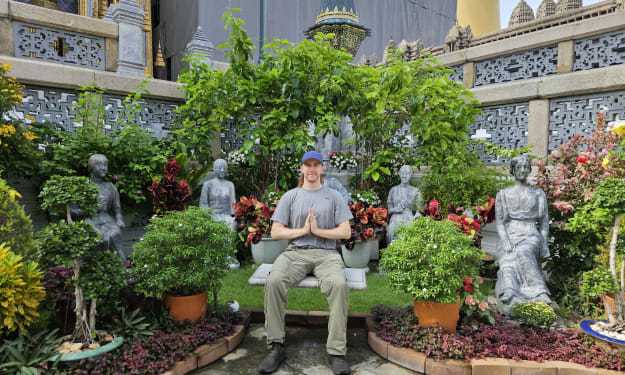
Coming from the quiet and serene Japan, Thailand felt like a good contrast of life. The busy and noisy streets except in the morning when you can see the bhuddist monks walk. Whether it was dancing to a club or live music until 4am or staring out at a rooftop bar at midnight, Bangkok truly stole my heart.
By Matthew Mccahey2 years ago in Chapters
Apple Macaroon Cake
In 1946, a young and ambitious man named William Greenberg, fueled by his poker winnings from his army days, decided to open a bakery on the bustling streets of Manhattan's East 95th Street. Little did he know that this modest endeavor would grow into a beloved institution on the Upper East Side. Over the next 25 years, Greenberg expanded his bakery operation to encompass four locations, but it was his mouthwatering Apple Macaroon Cake that truly stole the show.
By Muhammad Mohsin2 years ago in Chapters
Chaotic woman
"A chaotic life is the result of chaotic choices" -Alafia This quote shot an abrupt woah moment when I read it for the first time through a self given reading with my oracle cards. First couple of reads, the quote was disagreeable because there was no belief of my life holding space for chaos until the definition was seen with clarity. Chaos is a state of utter confusion. That landed me exactly where I've been dwelling in, a reality of confusion. A reality of discomfort through poor choices constantly chosen.
By Azrie'l Johnson2 years ago in Chapters
What Can I Use To Remind Me?
My morning rituals are attached to the refrigerator as a reminder note. Does it work? I never look at it. I go to the fridge to get something out of it. I will occasionally check to see when a graduation or baby shower is scheduled. Because it’s a morning ritual I shouldn’t be forgetting but I do!
By Denise E Lindquist2 years ago in Chapters