

The city of Kakm stood as the preeminent city-state in the Maya lands, with unrivaled influence achieved through shrewd diplomacy and a well-organized military apparatus. Kakm had successfully contained its main rival, Tial, while new powers were emerging in both the West and East, and new dynasties were taking root. The late Classic era represents the pinnacle of Classic Maya culture, and during this time, many of the most renowned buildings, monuments, and works of art were crafted. We have a lot to cover, so let's begin. It's time to explore one of the most famous Maya cities during its heyday, one you're probably familiar with—Pelen. we saw it evolve into a regional power during the fourth and fifth centuries. Unfortunately, it found itself in the crosshairs of Kakm in 599 and 611, which couldn't have come at a worse time. The Pelen dynasty seemed to be in crisis. To understand this, we must rewind the clock to the early 6th century, at the end of the rule of Akal Monab I. Although future records give him unusual prominence, Akal Monab I's reign in the city was relatively uneventful. However, when he passed away in 524, there was a puzzling five-year gap before his successor, Kaan Hoy Chatam I, took the throne. Kaan Hoy Chatam I reigned for 36 years but was followed by a series of disappointingly short rulers. His immediate successor, Akal Monab II, who may have been the grandson of Akal Monab I, ruled for just five years before his brother or half-brother, Kaan Bahlam I, ascended and reigned for another 11 years. Kaan Bahlam I, however, left no viable male heir upon his death, leading Pelen to install its first queen, Lady Yol. In 583, she took the throne, possibly as the sister or daughter of Kaan Bahlam I. Her reign saw Kakm's attack in 599, and the inscriptions recount this event by stating that Pelen's trio of patron gods was dethroned. Whether this was a metaphorical or literal desecration remains uncertain. Lady Yol IAL passed away in 604, and her likely son, Aen Yol Mat, succeeded her. While he managed to exert control over Pelen's smaller neighbors, he couldn't prevent Kakm's second devastating attack in 611. Although Aen Yol Mat survived the onslaught, he died the following year, leaving Pelen in disarray. With no apparent heir, the Pen Dynasty plunged into chaos. In 613, a poignant lament is recorded in an inscription, expressing the loss of the Divine Lady and Divine Lord, noting the omission of certain crucial rituals. The ruler at this time was identified as A Muan Mat, a name with intriguing significance, as it is the same as the ancestral deity and founder of Pelen's trio of patron gods. This might represent an unconventional reign or an interim rule. Regardless, it was short-lived, as a new king, Kenich Khab Pakal, was crowned in 615. Kenich Khab Pakal was the 12-year-old son of Lady Sak Kauk, and there's speculation that Lady Sak Kauk might have been A Muan Mat, although this ruler's gender is considered male by most scholars, making that scenario unlikely. A striking tablet depicts Pakal's inauguration, with his mother presenting him with a crown since he wasn't immediately recognized as a Lord.It is likely that Lady Sak Kuk acted as Regent for her young son during the early years of his reign. We wonder if Pakal's rise to power was due to desperation or if the elites saw promise in him. Although things looked bleak in Palen, doubters of Kenich Kanab Pakal were proven wrong. Despite initial setbacks, Pakal became a pivotal ruler in Palen. In 628, the King of Pedris Negras attacked Palen, capturing a high-ranking noble. Pal's response was to rebuild Palen's prestige. Pedris Negras turned its attention to other cities under Katnich Yal AK I's rule, giving Pakal time to indulge his passion for building. Notable constructions included expanding the Olvidado, the main palace, and the iconic Temple of the Inscriptions. Between 659 and 663, Palen launched campaigns against neighboring cities, with the captives depicted on palace walls. Nunu'l Chak from Santa Elena, a former Palen vassal, was one noteworthy captive. Although some gains were temporary, they showcased Palen's resurgence. Pakal ruled for an astonishing 68 years, known for preserving Palen's independence. His tomb was discovered in 1949, containing famous works of Maya art, including his death mask. His reign was a triumph, leaving behind a restored city and a capable heir, Katnich Kaan Bahlam II. Katnich Kaan Bahlam II, Pakal's son, continued Palen's building spree, creating the Cross Group, including the Temple of the Cross, Temple of the Sun, and Temple of the Foliated Cross. He also engaged in conflicts with neighboring cities. In the wider Western Maya world, Palen's revival was significant. The region saw intense rivalries and conflicts. Tonina emerged as a rival to Palen. Pedris Negras.One figure celebrated Tal's new success, immortalizing the victory. Hasa Chang Kil delved into Tal's early history, drawing upon its ancient connection with the city of Teoton. By this time, Teoton had diminished significantly from its former imperial glory, but its role in Tal's history remained ingrained in memory. The commemorative date inscribed on that lentil marked precisely 256 years after the death of Spear Thrower Owl, showcasing the people of Tal's strong connection with their past. In his own depictions, Kasa Chang Kawi presented himself as a Teotiano warrior, following in the footsteps of his ancestors, inaugurating a new era of success for Tal. Despite Tal's rising fortunes, further advances were slow to materialize, as Kaki-M had worked diligently to establish alliances to counter Tal's power. Even though these alliances were beginning to weaken, they still held significant sway. Motou de San Jose and possibly Nashun, Tal was unable to penetrate the cities of Nanho, El Peru, and Dospelis to the East and South. However, these challenges did not deter Hasa Chang Kail, who embarked on a monumental construction effort, constructing several pyramids and complexes during his reign, rejuvenating Tal in a new light. The civic pride inspired by these new structures was palpable. When he passed away around 730, Tal had once again become a great power, though still in the process of finding its footing. The responsibility of continuing Tal's restoration now fell to his heir. On December 8, 734, Kasa Chang Kail's son, Yakin Chan Kail, ascended to the Tal throne. Yakin Chan Kail proved to be up for the challenge. Under his rule, Tal not only threw off the Kakm yoke, but also rekindled its imperial ambitions, settling old scores with Kakm. Celebrating a victory against Kakm in the early years of his reign, Yakin Chan Kail took an unfortunate Kakm captive, although the noble's identity remains obscured.
Yakin Chan Kail's ambitious campaigns extended to the city that eluded Hasa Chang Kail during his reign. Records from Temple 4 Chronicle marked a series of impressive victories in 743 and 744, including the capture of El Peru's patron god and the king of Nanho. It is probable that the king of Nanho was brought back to Tal and executed, sealing Tal's dominance over its rivals. These victories helped break the encirclement around Tal and shattered Kakm's anti-Tal block. In the wake of these triumphs, Yakin Chan Kail initiated a massive building program, possibly aided by the influx of spoils and foreign labor. Temple 4, one of the tallest Maya buildings on record, was constructed during his reign. While the exact date of Yakin Chan Kail's death remains uncertain, his legacy as Tal's greatest military leader and builder was firmly established. There is even speculation that his tomb, marked by surprising modesty, might still be hidden within the magnificent Temple 4, awaiting discovery. Tal's dominance continued during the reign of its next two rulers, Ruler 28 and Yasha II, before a period of decline set in. Meanwhile, Kakm, which had previously retaliated fiercely against Tal's successes, remained relatively inactive during Yakin's campaigns. The absence of Kakm intervention during this time raises questions about Kakm's internal state and its priorities. Returning to Ichak Kaak, historical records suggest that he managed to maintain Kakm's hegemony, with his defeat by Tal being the only significant blemish on his record. Ichak Kaak likely passed away before 700 and was succeeded by Yuk Nom Tok Kael. While monuments from various cities indicate that Kakm had close relationships with El Peru, Nanho, and Dospelis during Ichak Kaak's reign, the next rulers were unable to prevent Tal's resurgence. Despite the persistent erection of monuments at Kakm for another century, the city's name appeared less frequently in inscriptions from other cities, signifying a decline in its foreign influence. Kakm's interference in foreign affairs would experience one final resurgence, as discussed later. As for Dospelis, a city that emerged as a rival to Tal during Hasa Chang Kail's reign, it remained busy consolidating and expanding its kingdom. Under the leadership of Itam N Kail, Dospelis managed to capture the city of Seal and its king, Ichak Bahlam. His successor, Ruler 3, engaged in warfare with neighboring cities, possibly as a defensive measure. The wars may have arisen due to disputes over Dospelis' authority, as other cities contested its power. In 761,Dospelis experienced a complete collapse, with C Wheel Chan Kenich disappearing from historical records. While the exact circumstances of Dospelis' downfall remain obscure, it is reasonable to assume that the weakening of Kakm left the city vulnerable, ultimately resulting in the loss of its fragile authority.
About the Creator
Keep reading
More stories from Chabane Mustapha and writers in Chapters and other communities.
Massive river beneath the Black Sea was found by scientists.
Let's play a little guessing game, shall we? Can you name the sixth largest river on Earth in terms of volume, which refers to the amount of water that flows through it? The first couple of rivers are easy to list. Number one, of course, is the Amazon River in South America. Then we have the Congo in Africa and the Ganges in India. Feel free to list all the rivers on the planet, but you won't get any closer to the answer. Why? Because this river is not on the surface but underneath the waves of the Black Sea. In 2010, a team of scientists discovered this river while studying the Bosphorus Strait in Turkey. Sonar scanning revealed a channel at the bottom of the Black Sea with water flowing through it. It turned out that, in places, it's 115 feet deep, which is three times as tall as an average telephone pole. This flowing water acts like a real river, complete with rapids and waterfalls, and its volume is 350 times greater than that of the River Thames in London. Talk about a strong undercurrent. If it were a surface river, it would be in the top ten. Bad news for the Madeira River in Bolivia and Brazil, which presently holds the sixth position. But how did this underwater river form? The answer lies in the amazing features of the Black Sea. It gets its water from two main sources. The first source is the rivers that flow into it, like the Danube, Dniester, and Dniester. A lot of "D" rivers there. But more importantly, they are all freshwater waterways. On the other side, quite literally, is the Mediterranean, and it's salty. When this saltwater enters the Black Sea, it sinks straight to the bottom. You see, freshwater is lighter than saltwater, and this creates stratification, a fancy term meaning that the two types of water don't mix. Saltwater, being denser, drops to the bottom. If you want to see how this works, you can do an experiment at home. Pour mineral water into one cup and saltwater into another. Table salt will do. Then put a grape in each cup. You'll see how it immediately sinks to the bottom of the cup filled with freshwater. The grape will stay afloat in the cup filled with saltwater. The same thing is happening inside the Black Sea. But there's another side to this phenomenon. The upper layer of water is rich in oxygen, meaning it can support life. The bottom layer, however, is anoxic, which means there's no oxygen at the bottom. But this isn't a bad thing. Because of this trait of the Black Sea, shipwrecks are able to survive for centuries. Oxygen decomposes wood, and what material did ancient people use to make their ships? That's right, timber. Recently, in 2018, scientists discovered the oldest Greek shipwreck on Earth. The merchant ship lies more than a mile deep at the bottom of the sea, and experts estimate that the vessel is 2,400 years old. The wreck was valuable for historians to study all the elements of ancient ship construction, from the mast to the rowing benches. It's all intact. The wreck lies some 50 miles off the coast of Bulgaria, but no one has seen it in person. Explorers sent a deep-sea remotely operated vehicle (ROV) to film the wreckage. It was impossible for a diver to go down. But the Black Sea doesn't look that huge on a map. Could it be that deep? Oh yes, it's way deeper than people think. You could stack six Empire State Buildings at the deepest point of the Black Sea, around 7,257 feet. This inland sea isn't the only place on Earth where researchers have discovered shipwrecks and underwater rivers. One of the largest channels running along the ocean floor lies off the coast of South America. It runs from the mouth of the mighty Amazon and into the Atlantic Ocean. Studying underwater rivers isn't an easy task. The depth and strong currents make it impossible to send in divers. Even the equipment for underwater research has to be sturdy, otherwise the current will wash it away. That's why the underwater river in the Black Sea was ideal for scientists to explore. Earth's oceans and seas are powerful, but luckily for us, there are places where divers can admire underwater rivers. Have you ever heard of a cenote? Sounds Spanish, doesn't it? Well, that's because it is. Cenotes are underground caves that form after the limestone above collapses, revealing the groundwater beneath. The term "cenote" is associated with the Yucatan Peninsula in Mexico. Ancient Mayans used them as water sources. In the Mayan language, the word "cenote" meant sacred well. Researchers estimate there are around 10,000 cenotes spread across the Yucatan Peninsula. You can also find them in other places like Cuba and Australia. Beauty is in the eye of the beholder, but unofficially, the most beautiful cenote is located just south of the town of Tulum in Mexico. Its name reflects the cave's divine beauty, Cenote Angelita. But people don't visit the cenote to go swimming. What's more interesting is its bottom. A scuba tank is all you need to finally admire an underwater river firsthand. The waters are dark and foggy, so divers use powerful flashlights. After a 100-foot dive, a marvelous sight appears: an underwater river with trees along its banks. Some of them even have green leaves, just like any other water flow on dry land. But it's not really a river. Here comes the fascinating part. Remember how saltwater and freshwater don't mix well? The "river" the divers see is actually a thick layer of fog between the two types of water. Three feet of hydrogen sulfates, to be exact. This is the compound that water processing plants use to remove chlorine from drinking water. The substance is so heavy that the fog it produces moves independently from the surrounding water, creating the illusion of a river flowing underwater. But there are other real rivers that play tricks on you. Take, for example, the Mystery River in Indiana. It's the longest underground river in the United States. Explorers discovered the river and its cave system, Blue Spring Caverns, in the 19th century. Nearly three miles of the river are navigable. Isn't that impressive? You can book a boat tour on a river that you can't even see. But the most mysterious river on the planet is the Saraswati River in India. The coolest part about it is that it doesn't exist. It was an alleged river only mentioned in ancient literature. For centuries, people thought it was just a myth. Then satellite images showed that it might be real. Ancient texts spoke of a major confluence of three mighty rivers: the Ganges, Yamuna, and Saraswati. The first two are visible today, but where's the third one? That's what scientists decided to find out. Images from an American satellite showed the presence of underground water in the area. Until then, researchers thought these were paleo-channels, meaning that water flowed through them a long time ago. But to their surprise, it appeared that there was still water inside these channels.
By Chabane Mustapha2 years ago in Education
The Cave Part 6
If you have ever heard a tale about yourself that you cannot remember and doubtless think is made up, you will know how I felt when Tharkin related all that the eagle had seen of me before my memories were scattered. Of far distances and traveling companions that I did not recall, camping out under the stars and making our way to the mountains with deliberate purpose. The great bird had lost contact with my party once we entered the forests, and the seven other members were not seen again by him or his brethren since.
By Jamye Sharp13 days ago in Chapters
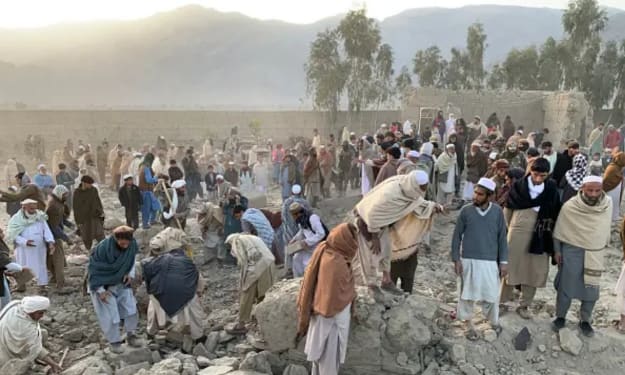
Pakistan Bombs Afghanistan: Nangarhar and Paktika Airstrikes Kill Civilians, Taliban Condemns Attack
Provincial officials in eastern Afghanistan’s Nangarhar province told the BBC that a house belonging to a man named Shahabuddin was targeted in the Gardai Kach area of Behsud district, killing and injuring around 20 people, including women and children.
By Real content7 days ago in Chapters



Comments
There are no comments for this story
Be the first to respond and start the conversation.