
Imran Ahmed Khan Niazi’s Government: A Distinct Chapter in Pakistan’s 74-Year Political History
The Rise, Challenges, Public Welfare, and a Comparative Performance Analysis

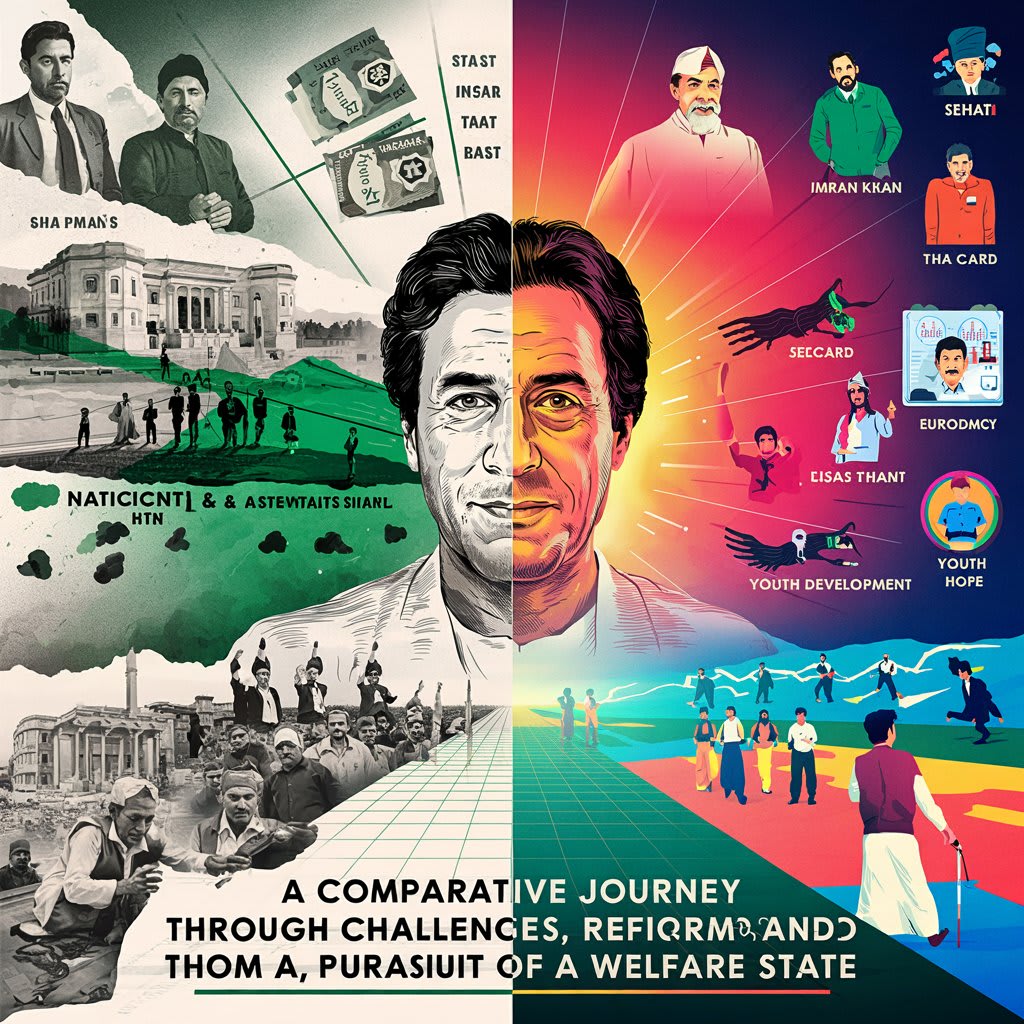
Introduction
Since gaining independence in 1947, Pakistan has witnessed a variety of leadership styles, political ideologies, and governance structures. Among the many political leaders who held the office of Prime Minister, Imran Ahmed Khan Niazi stands out not only for his cricketing fame but also for his ambitious and reformist approach to governance. Leading the Pakistan Tehreek-e-Insaf (PTI), Imran Khan assumed office on August 18, 2018, and served until April 10, 2022 — a period of approximately 3 years and 8 months. His tenure, though short of the full five-year term, left a significant impact on Pakistan’s political, economic, and social landscape. This article explores the beginning of his government, the challenges he faced, the initiatives he introduced for the welfare of the common man, and how his overall performance compares to the governance of Pakistan over the past 74 years and 9 months.
---
The Beginning of Imran Khan’s Government
Imran Khan’s political journey began in 1996 with the formation of PTI. For over a decade, the party remained on the fringes of Pakistani politics. However, Khan’s charismatic leadership, persistent campaigning against corruption, and the promise of a "Naya Pakistan" gradually gained public attention. By the 2018 general elections, PTI had become a formidable political force, securing enough seats to form a government at the federal level.
His election victory was seen as a reflection of public frustration with traditional political parties like the Pakistan Muslim League-Nawaz (PML-N) and Pakistan Peoples Party (PPP), both of which had been marred by allegations of corruption, nepotism, and inefficiency. Imran Khan promised to bring accountability, transparency, and a new era of justice and welfare-oriented governance.
---
Challenges Faced by His Government
Imran Khan inherited a country riddled with deep-rooted economic, political, and administrative issues. From day one, his government had to deal with:
1. Economic Crisis:
Pakistan was facing a severe balance-of-payments crisis with depleting foreign reserves. The government had to seek a bailout from the International Monetary Fund (IMF) to stabilize the economy, which brought its own set of conditions and austerity measures.
2. High Debt and Deficit:
Khan’s government had to deal with a massive debt burden and a persistent fiscal deficit. Managing public finances without curtailing development or social programs was a major hurdle.
3. Opposition Pressure:
Unlike some past governments, Imran Khan faced strong opposition from day one. Multiple parties joined forces against him, accusing him of being brought into power by the military establishment.
4. COVID-19 Pandemic:
The global pandemic hit during his tenure, forcing a delicate balancing act between saving lives and saving livelihoods. Pakistan’s healthcare infrastructure was under immense pressure.
5. Civil-Military Relations:
Though initially considered close to the military, cracks began to appear towards the end of his tenure, ultimately contributing to his removal through a vote of no-confidence.
---
Welfare and Thoughtfulness for the Poor
Despite economic and political challenges, Imran Khan’s government undertook several significant initiatives for the welfare of the underprivileged:
1. Ehsaas Program:
Launched in 2019, it became Pakistan’s largest-ever social safety net. It included cash transfers, nutrition programs, interest-free loans, scholarships, and shelter homes for the homeless. During COVID-19, the Ehsaas Emergency Cash Program was internationally praised for delivering aid to over 15 million families.
2. Panagahs (Shelter Homes):
To provide dignity and shelter to the homeless and daily wage laborers, panagahs were established in major cities where people could sleep safely and get free meals.
3. Sehat Sahulat Card:
A landmark health insurance initiative that allowed citizens to avail free medical treatment at both public and private hospitals. It was initially introduced in KP and later expanded to Punjab and other regions.
4. Low-Cost Housing:
Under the Naya Pakistan Housing Program, the government aimed to provide affordable housing to low and middle-income families.
5. Kamyab Jawan Program:
Aimed at empowering youth through skills development and small business loans.
6. Digital Pakistan Initiative:
To modernize Pakistan’s digital infrastructure and promote innovation among youth and entrepreneurs.
---
Comparative Analysis: Imran Khan vs. 74 Years of Governance
To fairly compare Imran Khan’s government to the rest of Pakistan’s 74 years and 9 months of governance, we can analyze across a few key dimensions:
1. Anti-Corruption Narrative
Unlike many past leaders, Imran Khan consistently maintained a hardline stance against corruption. He established the Asset Recovery Unit, supported NAB’s actions (though critics claimed it was politically motivated), and highlighted money laundering and offshore accounts. In contrast, past governments often protected corrupt elements within their parties and failed to institute strong accountability mechanisms.
2. Focus on Welfare State
While welfare programs have existed before (like Benazir Income Support Program), Imran Khan’s Ehsaas was more extensive in scope and implementation. He emphasized the Islamic concept of Riyasat-e-Madina, drawing inspiration from the early welfare state model of Prophet Muhammad (PBUH).
3. Economic Management
This is a mixed bag. Under Khan, inflation remained high, especially in food prices, and the Pakistani Rupee depreciated significantly. Critics argue this hurt the middle and lower classes. However, structural reforms, current account improvements, and the rise in exports and remittances were notable achievements. Earlier governments often relied heavily on unsustainable debt and subsidies to mask economic problems.
4. Foreign Policy
Khan adopted an independent foreign policy posture. He spoke against Islamophobia at the UN, maintained neutrality in Middle East tensions, and prioritized relations with China, Turkey, and Malaysia. His stance on India, especially after the revocation of Article 370 in Kashmir, was firm and vocal. In contrast, previous governments often adopted a more cautious, traditional diplomatic approach.
5. Media and Free Speech
Imran Khan's government was criticized for curbing media freedom and using state machinery to suppress dissent. Journalists faced pressure, and digital censorship increased — a trend that unfortunately has existed under previous governments too.
---
Legacy and Public Perception
Imran Khan's removal from office through a no-confidence vote was a dramatic end to a polarizing tenure. However, his popularity among the masses, especially the youth, remains high. His messaging of sovereignty, anti-elitism, and public empowerment continues to resonate.
His supporters see him as an honest leader who tried to change a corrupt system but was obstructed by the "status quo" forces. His critics argue he lacked experience and team strength to deliver on his promises.
---
Conclusion
Imran Ahmed Khan Niazi’s time in office may have been short compared to Pakistan’s long and complex political history, but it was certainly impactful. His focus on public welfare, digital transformation, and international standing marked a shift in governance. Despite economic challenges and political instability, his tenure introduced initiatives and debates that continue to shape the national discourse.
In a country where leadership is often measured in missed opportunities, Imran Khan’s government represents both the promise of reform and the reality of entrenched resistance. When viewed against the backdrop of Pakistan’s 74 years and 9 months of governance, his chapter stands as a bold — albeit incomplete — attempt at redefining the country's future.
The end……….
About the Creator
Umair Ali Shah
Writer exploring life, truth, and human nature through words. I craft stories, essays, and reflections that aim to inspire, challenge, and connect. Every piece is a step on a shared journey of thought and emotion.
Keep reading
More stories from Umair Ali Shah and writers in Chapters and other communities.
Every Day Is Theirs: A Heart’s Tribute to Our Parents Beyond One Day
✍️ By: Umair Ali Shah Yousafzai --- 🌸 Introduction: The Problem with “One Day” In an age where love has been reduced to emojis and celebrations are confined to trending hashtags, it’s become common to see people dedicate just one day a year to their parents — usually in the form of a well-edited photo, a generic social media caption, or a short video clip. "Happy Parents’ Day!" they declare, and with that, consider their duty fulfilled. But can one day capture the essence of lifelong sacrifice? Can a Facebook status outweigh a mother’s sleepless nights? Can an Instagram reel compensate for a father’s decades of toil? The answer — spoken by the heart — is a resounding no. Parents are not a seasonal celebration. They are the soul of our lives. They do not deserve a day; they deserve our every day, our every breath, our every success, our every prayer. --- 🕊️ A Love Beyond Comprehension Parental love is not poetic — it is prophetic. The mother’s womb becomes a sanctuary before we even open our eyes. Her body breaks to give us life. Her nights shatter so our dreams can form. Her meals go cold so ours stay warm. She becomes our shadow, our comfort, our shield. And the father? He becomes the silent mountain who absorbs the storm before it reaches us. He ages behind the curtain so we can grow on stage. His shoes wear thin so ours stay new. His pockets empty so our dreams can fill. His hands become rough while ours remain soft. Such love cannot be compared. It cannot be counted, priced, or postponed. It is as eternal as the sky — silent but all-encompassing. --- 🏠 From Cradle to Grave: They Gave Us Everything The truth is simple and painful: the very people who gave us everything, we give them the least. They carried us when we were weak. They taught us to walk, to speak, to eat. They encouraged our smallest achievements and bore our greatest failures. They forgave our rebellion, our rudeness, our rejection. They kept loving even when we didn’t love back. And what did they ask for in return? Nothing — except a little time. A little respect. A little remembrance. And yet, many of us fail even in that. --- 📅 One Day is Not Enough — It’s Almost Insulting Designating one day for parents is, in many ways, an insult wrapped in sentimentality. It suggests that gratitude can be scheduled, that love can be timed, that sacrifice can be acknowledged only when it's convenient. Do parents love only once a year? Do they support us only on Sundays? Do they pray for us only during exam season? No. Their love is relentless, their loyalty unconditional, their prayers eternal. Then how dare we give them just a day? --- 🕯️ Real-Life Reflections: Forgotten Candles of Our Lives Visit an old age home and you will see forgotten candles flickering dimly, waiting for someone to relight their flames. Mothers who once carried their children now carry loneliness. Fathers who once stood tall now sit silently by windows, hoping someone might knock on the door. "I gave him everything," says one mother, staring into her fading memories. "And now he sends money, but not himself." What do we owe them? Not riches. Not luxury. We owe them presence. We owe them honor. We owe them time. And if we fail to pay that debt in life, we will spend the rest of our lives repaying it in guilt. --- 🌙 The Islamic Perspective: A Duty, Not a Favor In Islam, honoring one's parents is not optional. It is second only to worshipping Allah. The Qur’an places “being good to parents” immediately after “worship none but Allah” (Surah Al-Isra, 17:23). > “And lower to them the wing of humility out of mercy and say: ‘My Lord, have mercy upon them as they brought me up [when I was] small.’” — (Qur’an 17:24)
By Umair Ali Shah 7 months ago in Chapters
Fair Exchange, No Robberies
Dark Memoirs - Index There are at least two kinds of people in the world: those who write this half-arsed kind of intro to a story that looks to separate the rare and the norm, and those who realise it's an overused framing device and don't.
By Paul Stewart14 days ago in Chapters
Sacrifices For The Balance Chapter 8: The Investigations Get Serious
Lady Astor parked her electric SUV just outside the dog rescue. She had decided to start with Maddy Tennyson; even if she couldn't get her to commit to her cause, she could be useful in gauging the political environment. She had decided to go with the jeans and boots look; she was as ready to work as she was to talk.
By Jamais Jochim2 days ago in Chapters
Silver Screen Magic with Mae West
American actress and singer Mae West became a popular film actress during the Great Depression. She started entertaining in vaudeville, then performed on Broadway, and finally went to Hollywood. She signed up with Paramount Pictures and made her debut in the 1932 film “Night After Night.” She also starred in musicals, comedies, and crime dramas. The American Film Institute named her one of the best classic Hollywood actresses.
By Rasma Raisters6 days ago in Geeks


Comments
There are no comments for this story
Be the first to respond and start the conversation.