
"Ever wondered how many moons Jupiter has and what makes them so fascinating?"
Discovering Jupiter's Moons: Total Count, Names, and Fascinating Facts
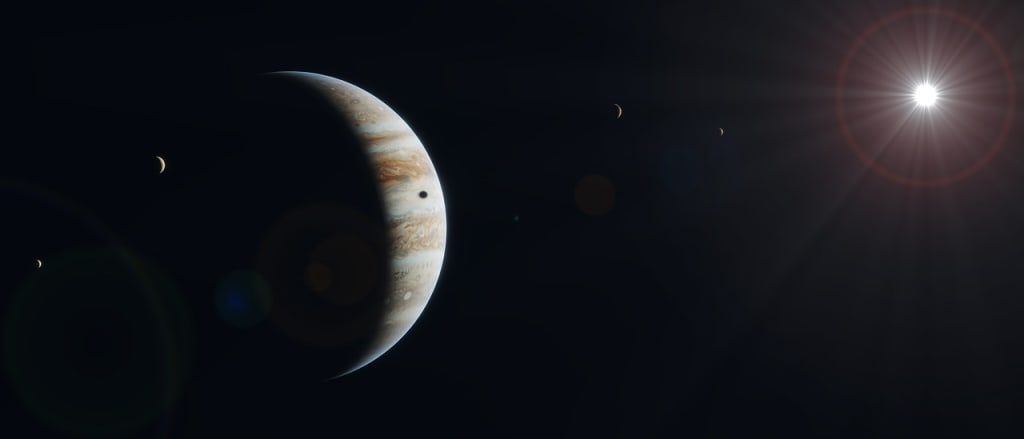
Jupiter, the largest planet in our solar system, boasts an impressive collection of moons, with 95 officially recognized moons as of early 2025. These moons form a complex satellite system known as the Jovian system, which also includes rings and numerous small objects. This article explores the fascinating diversity of Jupiter's moons, their discovery, and their unique characteristics.
The Discovery of Jupiter's Moons:
The story of Jupiter's moons begins in 1610, when Italian astronomer Galileo Galilei first observed four large celestial bodies orbiting Jupiter using a telescope. These moons—Io, Europa, Ganymede, and Callisto—are now known as the Galilean satellites. They were the first objects discovered to orbit a celestial body other than Earth or the Sun, revolutionizing our understanding of the cosmos. German astronomer Simon Marius also observed these moons around the same time and proposed their mythological names, which are still used today.
The Galilean Moons: Giants of the Jovian System:
The Galilean satellites are by far the largest and most massive of Jupiter's moons, dominating its satellite system. Each of these moons is unique:
- Ganymede: The largest moon in the solar system, Ganymede is even bigger than Mercury. It has a magnetic field and a surface marked by water ice and geological features.
- Callisto: Known for its heavily cratered surface, Callisto is the second-largest moon of Jupiter and one of the oldest landscapes in the solar system.
- Io: The most volcanically active world in the solar system, Io's surface is covered with sulfur and lava flows due to intense tidal heating from Jupiter's gravity.
- Europa: Europa is an icy moon with a subsurface ocean beneath its frozen crust. This ocean makes Europa one of the most promising places to search for extraterrestrial life in our solar system.
These moons are not only massive but also scientifically significant due to their unique geologies and potential for harboring life.
The Smaller Moons: A Diverse Collection:
Beyond the Galilean moons, Jupiter has dozens of smaller moons that vary widely in size and characteristics:
- Inner Moons: These include Metis, Adrastea, Amalthea, and Thebe, which are located close to Jupiter and help maintain its faint ring system. Amalthea is particularly notable for its reddish hue and irregular shape.
- Irregular Moons: Most of Jupiter's smaller moons are irregularly shaped objects believed to be captured asteroids or remnants from collisions. Many orbit at great distances from Jupiter and follow retrograde orbits (opposite to Jupiter's rotation).
The vast majority of these smaller moons are less than 10 kilometers in diameter, making them difficult to observe without advanced telescopes.
Recent Discoveries and Expanding Moon Count:
In recent decades, advances in telescope technology have led to a surge in discoveries of Jupiter's smaller moons. Since 1999, more than 70 new Jovian moons have been identified. As of early 2025, there are 95 confirmed moons, but this number could increase as astronomers continue to detect additional small objects orbiting Jupiter.
Interestingly, many of these newly discovered moons remain unnamed. The International Astronomical Union (IAU) has decided that only scientifically significant small moons will receive mythological names moving forward.
Scientific Significance:
Jupiter's moon system offers valuable insights into planetary formation and evolution. The Galilean satellites provide clues about geological activity, tidal heating, and subsurface oceans. For instance:
- Europa’s subsurface ocean has made it a key target for astrobiology missions like NASA’s upcoming Europa Clipper, set to launch in 2024.
- Io’s volcanic activity helps scientists understand tidal heating mechanisms that could occur on exoplanets orbiting close to their stars.
- Ganymede’s magnetic field raises questions about its internal structure and potential habitability.
The smaller irregular moons also contribute to our understanding of asteroid capture processes and orbital dynamics.
Observing Jupiter’s Moons:
The Galilean moons are visible even with small telescopes or binoculars. They appear as bright dots aligned near Jupiter’s equator. Observing these moons provides amateur astronomers with a glimpse into the dynamic Jovian system.
Conclusion:
Jupiter’s 95 known moons represent one of the most diverse and intriguing satellite systems in our solar system. From the massive Galilean satellites to the tiny irregular objects on distant orbits, each moon offers unique scientific opportunities. As technology advances, future discoveries will likely expand our understanding of this remarkable planetary system.
About the Creator
Rachel Reviews: The Spiral Archive by Pieter Hendrik
It's difficult for me to know where to start with a review of this book as it was, for me, an entirely unique experience and one that I'll probably never have again. I don't want that to be interpreted as unenjoyable but it has left me scratching my head a little and ruminating on its content, its themes and its characters.
By Rachel Deeming7 days ago in BookClub
The Doctrine of Obedience
Understanding Iran’s power requires looking beyond missiles, sanctions, or nuclear negotiations. The real engine of influence lies in how Iran recruits, conditions, and binds individuals into long-term obedience. Its system is not accidental or reactive. It is deliberate, ideological, and designed to endure.
By Albert Hadi 3 days ago in BookClub



Comments (1)
Júpiter moons are cool! Good work