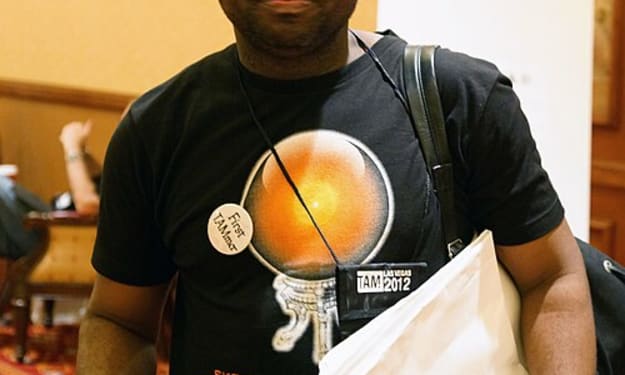
Scott Douglas Jacobsen
Bio
Scott Douglas Jacobsen is the publisher of In-Sight Publishing (ISBN: 978-1-0692343) and Editor-in-Chief of In-Sight: Interviews (ISSN: 2369-6885). He is a member in good standing of numerous media organizations.
Stories (140)
Filter by community
Quo Vadis, Humanity?
On December 19, a powerful and deeply moving conference was held in Sarajevo, dedicated to the protection of children and to shedding light on the fate of missing babies in the territory of the former Yugoslavia. The organizers – the Association of Missing Babies of Vojvodina and the Christian Alliance of Croatia – gathered mothers, families, activists, experts, and people of conscience from across the region in a packed hall at Collegium Artisticum in Skenderija, united by the same pain and the same question that has gone unanswered for decades.
By Scott Douglas Jacobsen2 months ago in History
Dr. Leo Igwe Speaks on Ending Witchcraft Allegations in the 21st Century
Dr. Leo Igwe spoke to the Ethical Humanist Society of Chicago about how unexamined superstition and dogma produce tangible harm. Using today’s African witchcraft accusations, he drew parallels to Europe’s early modern witch panics and argued the phenomenon is transnational, not “African culture.” Because witchcraft lacks evidentiary basis, accusations operate like criminal charges yet deny presumption of innocence and can spark violence against vulnerable people. Religious entrepreneurs exploit exorcism narratives for status and money. Igwe urged accountability—policing, prosecutions, and institutional reform—plus prevention through early critical-thinking education, international solidarity, and a humanist commitment to evidence and rights, unfinished global human-rights work.
By Scott Douglas Jacobsen2 months ago in Education
James Wahls’ Revolve Fund: Recoverable Grants and Equitable Capital
James Wahls, founder of the Revolve Fund, explains how recoverable grants expand capital access for marginalized entrepreneurs. Unlike loans or equity, they set impact or revenue milestones; repayment occurs only when goals are reached, with no penalties if funds were used as intended. Revolve pairs flexible dollars with wraparound supports—communications support, business acumen, access to different networks, etc.—to help navigate banks, CDFIs, and venture funds. Impact is measured as "strategic influence": co-investment, follow-on capital, and referral-driven wins. While based in Baltimore, Revolve works with grantees around the country including an expanded focus in Detroit, Wahls’s hometown of origin. Detroit grantee partners include Black Tech Saturdays, Invest Detroit Ventures, Black Leaders Detroit, College & Beyond and more. In this and other markets, Wahls advocates for thoughtful risk tolerance, cautions against exploitative capital, and emphasizes the contextual leadership of local philanthropy.
By Scott Douglas Jacobsen3 months ago in Trader
Claus D. Volko, M.D. on Symbiont Conversion Theory and Bacterial Reprogramming
Claus D. Volko, M.D. (born 1983) is an Austrian software engineer and medical scientist in Vienna. He holds degrees in medicine (M.D.), medical informatics (B.Sc.) and computational intelligence (M.Sc.). In the demoscene he is known as “Adok” and served as main editor of the electronic magazine Hugi. Volko formulated Symbiont Conversion Theory in 2018. He founded and leads the Prudentia High IQ Society, and joined Mensa in 2002. In 2018 he published “Volko Personality Patterns,” a Jungian-inspired extension of MBTI typology. In 2025 he posted “Reprogramming Bacteria for Symbiont Conversion: A Review” on Prudentia’s blog, and maintains Prudentia’s journal and blog.
By Scott Douglas Jacobsen3 months ago in Interview
Green Dome Islamic School: Faith-Based Education and Public Partnership in Calgary
Malik Ashraf is Vice Chairman of the Al-Madinah Calgary Islamic Assembly (Green Dome Mosque) in Calgary and a founding volunteer who has served the community for over 20 years. He helps lead the organization's education work, including Green Dome Islamic School, a Prairie Land School Division partner school that combines Alberta's curriculum with Islamic studies and community-based supports. In conversation, Ashraf describes education as guidance—moral, intellectual, and spiritual—anchored in the Qur'an's call to read and learn. He advocates for equitable public policy, sustainable funding, and community-built institutions that protect children and strengthen families. He documents progress publicly and invites dialogue.
By Scott Douglas Jacobsen3 months ago in Humans
Christopher Pommerening on Human-Centered Learning, Learner Autonomy, and the Future of Education
Christopher Pommerening is a German entrepreneur, investor, and education innovator who has dedicated his career to reimagining learning for the 21st century. Based in Barcelona, he is the founder of Learnlife, a global movement of “learning hubs” designed to replace outdated, standardized models of education with personal, co-created, and autonomous approaches. Drawing on his 27 years in the technology and startup sector, Pommerening combines entrepreneurial vision with a deep commitment to human-centred learning. His work emphasizes relationships, lifelong learning, and learner agency, aiming to inspire ecosystems of change that help individuals flourish in diverse cultural contexts worldwide.
By Scott Douglas Jacobsen3 months ago in Education
Gáspár Békés, European Secularist Network: Secular Policy in Hungary
Gáspár Békés is Secretary and a Founding Member of the Hungarian Atheist Association and a persecuted secular journalist. Here we talk in-depth about secularism, Humanism, youth rights, and religion in Hungary.
By Scott Douglas Jacobsen3 months ago in Interview
Dr. Marcus Anthony Hunter, Dayvon Love, Nkechi Taifa: California AB 7, Reparations, and Truth and Repair
Dr. Marcus Anthony Hunter is a professor at UCLA holding the Scott Waugh Endowed Chair in the Social Sciences, with appointments in Sociology and African American Studies. He served as the inaugural chair of UCLA's African American Studies department and previously was President of the Association of Black Sociologists. Hunter is a co-author of Chocolate Cities: The Black Map of American Life, which examines Black urban formation and the geographies of power, and author of Radical Reparations: Healing the Soul of a Nation.
By Scott Douglas Jacobsen3 months ago in History
Kelowna Harvest Fellowship and Harvest Ministries International: Child Sex Abuse Allegations, Civil Suits, and Evangelical Accountability in British Columbia
This article examines recent abuse-related cases in British Columbia’s evangelical landscape. It outlines criminal charges against Pastor Edwin Alvarez of an unnamed Metro Vancouver church for alleged sexual interference and assault against children between 2017 and 2021. It then reviews two active civil lawsuits against Pastor Art Lucier and Kelowna Harvest Fellowship, where plaintiffs allege long-term grooming and sexual abuse beginning in childhood, alongside institutional negligence. The article contrasts these ongoing actions with a separate Kelowna case in which a former youth pastor, anonymized as “CM,” received an 18-month custodial sentence after pleading guilty to child sex offences.
By Scott Douglas Jacobsen3 months ago in Criminal
Northside Foursquare Church and Cloverdale Christian Fellowship Church Abuse Allegation Cases
Langley, with its dense Evangelical presence, has seen serious abuse allegations within local churches. One civil case involves Pastor Barry Buzza of Northside Foursquare Church, accused of grooming and sexually abusing a teenage congregant who sought pastoral guidance, with claims the church ignored warning signs. Another case centers on Pastor Samuel Emerson of Cloverdale Christian Fellowship Church, who faced multiple charges related to sexual misconduct involving youth; he was ultimately convicted on one count of sexual assault, with other charges and those against his wife dismissed. These cases highlight patterns of spiritual authority, impunity, and inadequate safeguarding in regional Evangelical institutions.
By Scott Douglas Jacobsen3 months ago in Criminal
Feminist Afghan Media: Afghanistan Women’s News Agency (AWNA), Nimrokh Media, Rukhshana Media, Radio Begum, Begum TV, and Zan Times
Afghanistan is facing an extreme human-rights emergency, with Taliban policies shutting girls out of secondary and university education and denying 2.2 million girls schooling beyond the primary level. Women are barred from most work, public life, and basic freedoms, while forced and child marriage has surged. In this crisis, feminist media outlets—AWNA, Nimrokh, Rukhshana, Radio Begum, Begum TV, and Zan Times—have emerged in Afghanistan and in exile, documenting abuses and defending women’s voices despite escalating repression.
By Scott Douglas Jacobsen3 months ago in Humans
Fumfer Physics 34: P vs NP, Gödel, Chaitin, and Computational Limits
In this exchange, Scott Douglas Jacobsen and Rick Rosner explore the P vs NP problem and its philosophical echoes. Rosner leans toward the mainstream view that P likely does not equal NP, drawing a parallel to Gödel’s incompleteness theorems. Jacobsen expands the discussion with Tarski’s meta-language framework and Chaitin’s arguments about irreducible complexity, connecting them to both biological systems and modern AI. The conversation emphasizes that mathematical uncertainty does not endanger reality; instead, it reveals intrinsic limits on what computation can achieve. The pair illustrate this with the traveling salesman problem, an archetype of explosive combinatorial complexity in the real world.
By Scott Douglas Jacobsen3 months ago in Interview