
2012, Shale Gas and... Bright Future
Looking back at the birth of post-truth

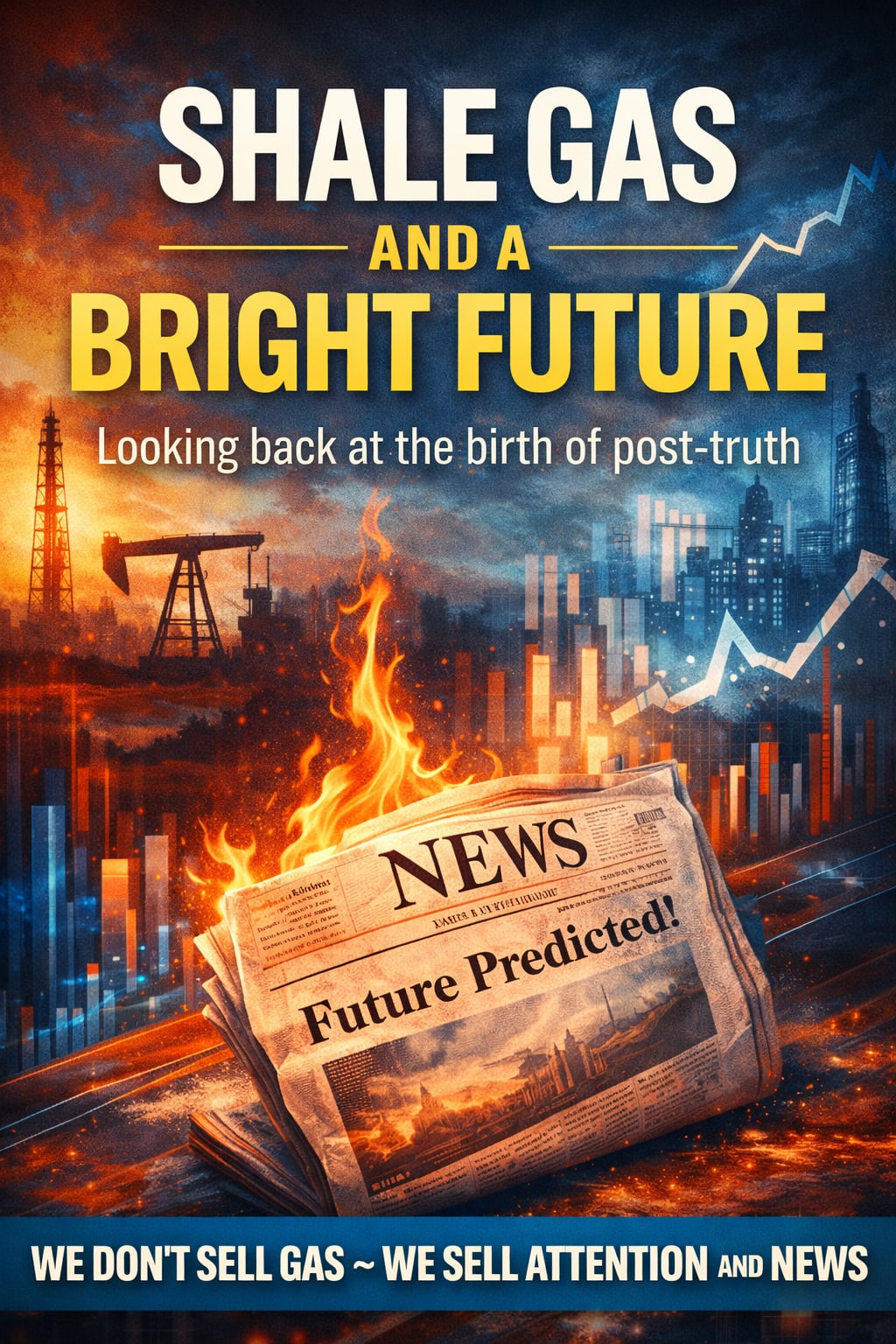
Shale Gas and a Bright Future: Looking back at the birth of post-truth
In 2012 Bulgaria experienced what looked like a classic modern conflict: a global corporation wanted to extract shale gas, students protested to protect land and water, media polarised the public, politicians divided into camps, and the government imposed a moratorium. At the time the story appeared simple — nature versus profit, citizens versus corporations, science versus fear.
More than a decade later the question is no longer who was right.
The real question is: **what was actually being traded?**
It turned out not to be gas.
It was the future.
The commodity that did not exist
The debate was framed around a physical resource — underground gas. Yet the economic system reacting to it was not based on extraction but on expectation. Modern markets do not price what exists; they price what is predicted to exist. Energy, more than any other sector, operates on promises about tomorrow — heating, industry, growth, civilisation itself.
Shale gas became the narrative of a coming era of abundance.
And narratives are tradable assets.
Every article, protest, documentary, counter-documentary and political speech increased its market value. Opposition did not damage the investment story — it amplified it. Conflict functioned as proof of significance. If people feared it, it must be important; if important, profitable; if profitable, valuable now.
Society itself became a marketing mechanism for expectations.
Media as drilling technology
Media, politics and science appeared to argue, yet they performed a common function: they generated scenarios. Each prediction — ecological catastrophe or economic salvation — extended the lifespan of attention. The public did not consume information about gas; it consumed competing futures.
The famous documentary imagery of burning tap water convinced more effectively than complex geological reports. Not because it was truer, but because it was visual, memorable and emotionally priced. In the attention economy, persuasion depends less on evidence and more on narrative density.
The public sphere shifted from knowledge to plausibility.
What mattered was not whether gas would be extracted, but whether the story of extraction could circulate indefinitely.
When energy became finance
Around the world the “shale revolution” coincided with financial speculation. Reports warned about inflated reserve estimates, internal industry emails spoke about bubbles, and investors continued to pour money in. Even doubt increased value — uncertainty fuels speculation better than certainty.
Here lies the paradox: the possibility that the gas might not exist at the predicted scale did not collapse the system. It strengthened it. Because the product was never the gas; the product was the prediction of gas.
Stocks moved on forecasts.
Politics moved on forecasts.
Public fear moved on forecasts.
And forecasts require attention.
Bulgaria between Gazprom and Gasland — but really between stories
The Bulgarian debate looked geopolitically complex: Russian pipelines, American companies, European regulation, environmental movements. Yet beneath it was a media structure typical of the post-truth era: a society choosing between narratives rather than facts.
People did not trust scientific papers.
They trusted images.
And images create positions before understanding.
Both supporters and opponents believed in the same premise — that the resource was decisive. Without that shared belief the conflict would disappear. The protests themselves confirmed the existence of value, regardless of geology.
The country banned something that might never have been economically viable. But the ban was also part of the spectacle: another chapter in the drama sustaining attention.
The real resource: attention
The early 21st century moved from industrial production to informational production and finally to attentional production. Energy debates became ideal vehicles for this shift because they connect survival instincts with financial speculation.
Fear sells better than certainty.
Future sells better than present.
Prediction sells better than fact.
The shale gas controversy revealed that modern society trades not in materials but in expectations about materials. The market did not need proven reserves; it needed circulating belief.
Attention became the extractable fuel.
News became the refinery.
Financial futures markets literally operate on this principle: price today is the narrative about tomorrow. The shale story was a perfect example — a global economic bubble made of forecasts, protests and documentaries.
After gas: the age of predictive reality
Looking back, the significance of 2012 is not environmental or geopolitical but epistemological. It marks the moment when public debate detached from verification and attached to projection. Science, media and activism merged into a single predictive theatre.
The real product was not energy but plausibility.
Once this logic appeared, it expanded everywhere — financial crises, pandemics, technological revolutions, AI risks, climate scenarios. Each functions less as a material process and more as a continuous stream of anticipated futures competing for attention.
We discovered something unsettling:
Society does not run on resources.
It runs on forecasts of resources.
And markets do not monetise gas, oil or electricity first —
they monetise the story about them.
A bright future without substance
So what happened in Bulgaria in 2012?
Nothing — and everything.
No wells were drilled, no catastrophe occurred, no prosperity arrived. Yet the event mattered because it demonstrated the new economy: the economy of post-truth prediction. A public conflict where the physical object was secondary to its narrative shadow.
The shale gas might have existed or not.
The bubble certainly existed.
What we extracted was not fuel but engagement.
What we sold was not energy but expectation.
What we consumed was not knowledge but futures.
And once a society learns to trade futures directly, reality itself becomes optional.
About the Creator
Peter Ayolov
Peter Ayolov’s key contribution to media theory is the development of the "Propaganda 2.0" or the "manufacture of dissent" model, which he details in his 2024 book, The Economic Policy of Online Media: Manufacture of Dissent.
Keep reading
More stories from Peter Ayolov and writers in Critique and other communities.
The Speaking Mirror
The Speaking Mirror: Language After Humans The twentieth century believed that language was humanity’s highest achievement. The twenty-first century quietly discovers that language was only a transitional technology. What people called thought, debate, knowledge, education and culture increasingly reveals itself as a narrow biological interface — a slow and lossy channel through which an organism tried to handle complexity larger than its memory. The arrival of large language models exposes this limitation not gradually but brutally. For the first time a system appears that does not merely store texts but inhabits their relations. The consequence is unsettling: the history of language has outgrown its creators.
By Peter Ayolov9 days ago in Critique
THIS IS WILD Tourette's Campaigner John Davidson Shouts November At Michael B. Jordan & Delroy Lindo During BAFTA Awards
As it stands, the word November, should only be used by Foundational Black Americans (FBA). After centuries of turmoil and savage drudgery, they should be only people to express such a sentiment. November is such a word rooted in history and dipped in blood that for any other group of people to utter it should be reprimanded and censured.
By Skyler Saundersabout 4 hours ago in Critique




Comments
There are no comments for this story
Be the first to respond and start the conversation.