Jhon smith
Bio
Welcome to my little corner of the internet, where words come alive
Stories (65)
Filter by community
Three Knocks Beneath the Sea
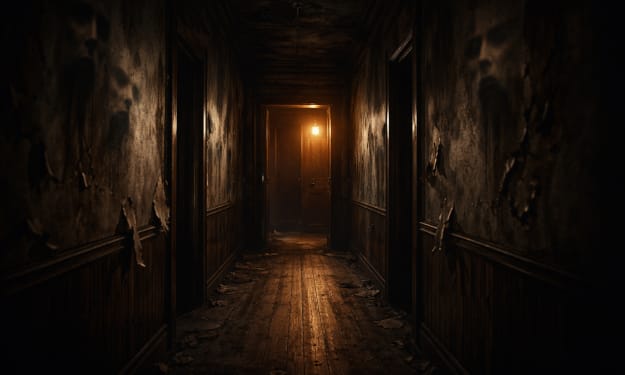
Silence has a texture under the sea. It isn’t empty—it breathes. It hums against the steel, curls into the corners, whispers in your skull until you start to hear your own blood. We were two miles beneath the surface when I heard it. Three knocks. Measured. Solid. Familiar. It reminded me of the way my grandpa used to knock on my door after making the long drive to see me. I sat up in my bunk, heart pounding so hard I felt it in my teeth. No one should have been awake except Reyes on night watch. The rest of the crew slept in their metal coffins, their breath feeding the recycled air system. The clock read 02:46. Three more knocks. Louder now. On my door. I stared at it—the trembling hinge, the echo traveling through the walls—and said, “Who’s there?” Nothing. Of course it was nothing. The embarrassment came fast, hot. Calling out to nothing. Just the deep, eternal hum of the Odyssey and the distant groan of the hull flexing against pressure that could crush us in a heartbeat. I stood, bare feet against cold metal, and opened the door. The corridor glowed dull red under the night lights. The air tasted of oil and salt. No one. Only three small wet circles on the door—like fingertips. I touched one. It was freezing. Reyes jumped when I entered the control room. “Jesus, Harper,” he said, clutching his chest. “What are you doing up?” “Someone knocked on my door.” He frowned. “No one’s moving around. Everyone’s accounted for.” “Then what did I hear?” He hesitated, then tapped the sonar display. “I’ve been getting something weird. A return echo—small. Moving along the hull.” The pulse slid across the screen. It wasn’t static. It shifted. “Could be current,” he said. “At two miles down?” He didn’t answer. A flicker. Then nothing. “I’m checking the observation chamber,” I said. “Harper—” But I was already walking. The chamber buzzed softly. The external camera showed nothing but blackness—endless, patient black. I leaned closer. My reflection hovered over the void, pale and unreal. Then something moved. A distortion. Like heat shimmering in air. I flicked on the floodlights. The hull burst into view, silver-gray and sweating condensation. Near the edge of the frame—there. A handprint. Pressed into the metal. I froze. And through the steel, unmistakable, I heard it. Knock. Knock. Knock. “Reyes!” He arrived breathless. “Listen,” I whispered. Three soft blows echoed through the ship, settling deep in my bones. “That’s impossible,” he said. “We’re two miles under.” The Captain woke everyone. Ten of us gathered in the mess, whispering theories—pressure shifts, hull expansion, sonar ghosts. No one mentioned the fact that we had all heard it. Porter squinted at the monitor. “Zoom in.” The feed magnified. Something shimmered against the hull, pulsing faintly. “It’s moving,” he said. The Captain ordered more light. The shimmer vanished. Then a dragging sound scraped across the steel. Knock. Knock. Knock. I had never seen fear spread so fast. These were people who had faced death without flinching. That night, none of us slept. At 6:00 a.m., I found Porter shivering in the mess. “You look like hell,” I said. He raised his hand. Three red circles marked his palm. “It knocked back,” he whispered. “From inside the pipes.” My stomach twisted. “Inside?” He nodded. “It’s in the sub.” I laughed. I don’t know why. A stupid, brittle sound—like this was all a prank. The look on his face snapped me back. “Maybe it was your echo,” I said. “Maybe.” Neither of us believed it. Two men disappeared the next night. No alarms. No breach. Just gone. Bunks empty. Boots still by the door. Reyes found a puddle of saltwater near the aft chamber. No leak above it. Three shallow finger dents pressed into the floor. “We’re surfacing,” the Captain said. The engines failed. Lights dimmed. Emergency red flooded the halls. Knock. Knock. Knock. Porter’s scanner pinged. “Something’s in the wall.” The steel bulged outward, slow as a breath. Then it split. No water came. Black vapor spilled out—alive, veined with faint light. A face pressed through it. Almost human. It raised a hand. Three knocks. Then laughter. My laughter. The bulkhead sealed. Silence returned. Later, the intercom crackled. “Harper,” Porter whispered. “It says you shouldn’t have turned on the lights.” The line went dead. We found him floating, eyes open, a shadow behind him shaped like a man. By morning, half the crew was gone. As we ascended, Reyes stared at the sonar. “It’s following us.” Two blips. Perfectly aligned. The knocks grew louder. Closer. Then the whisper came through every vent, every thought: Don’t open the door. I did. Blue light flooded in. Beautiful. Warm. Familiar. Like home. Like my grandpa’s knock. I laughed as the water filled my lungs. I laughed as the light faded. I laughed as I knocked three times on the outside of the submarine.
By Jhon smith19 days ago in Horror
When Snow Teaches Time to Slow Down
The first true snowfall arrives without asking permission. Large white flakes drift downward in an unhurried rhythm, as if the sky itself has learned patience. I sit safely inside my home, wrapped in warmth, watching the world soften beyond the wide front window. The edges blur. The noise fades. Time loosens its grip and slows to match the gentle descent of snow.
By Jhon smith21 days ago in Motivation
The Falcon Who Left the Cliffs
There was once a young peregrine falcon who believed the elders spoke too often and listened too little. They told her stories of the cliffs where they nested—how those gray stone walls had stood for thousands of years, shaped by wind and sea, yet strong enough to carry generation after generation of falcons. They spoke with reverence, as if the cliffs themselves were living elders. But the young falcon felt only discomfort.
By Jhon smith21 days ago in Fiction
I Was Productive Successful and Quietly Miserable
I built a life that looked finished before it was ever lived. My days were stacked with achievements like trophies placed carefully on a shelf. I woke early not because I wanted to but because discipline had replaced desire. I answered emails before sunrise and told myself this was ambition. I measured my worth in deadlines met and tasks completed. I was productive in ways that impressed everyone except me.
By Jhon smith22 days ago in Psyche
Whispers of the Old Woods
The villagers said the forest had a memory. Not the memory of men, who forgot quickly and argued loudly, but a patient, listening memory, older than the river, older than the hills, older than the stones lining the village square. It hummed quietly at night, a sound like wind brushing against the trees, or perhaps the echo of old voices. No one ventured deep into the woods after dusk—not without reason. And those who did often returned changed, carrying the strange weight of stories they had not told themselves. Elara was not like the others. She had grown up on the edges of the forest, her window facing the trees that seemed to sway even without wind. Her grandmother would warn her, “The forest listens, child. It remembers your footsteps. Speak carefully, or it will answer in ways you cannot understand.” But Elara had a hunger for stories, a thirst for the unseen. One autumn evening, when the sunset painted the sky in molten gold, Elara walked along the familiar path into the forest. She carried nothing but a small lantern and her notebook. She wanted to hear what the forest had to tell her. The air smelled of wet leaves and moss. Shadows stretched long, reaching for her feet like dark fingers. And then, just as she reached the oldest oak in the heart of the woods, she heard it—a voice, soft and melodic, like someone humming an ancient lullaby. She froze, her breath forming tiny clouds in the cool air. “You come for stories,” the voice said. It seemed to drift from the bark of the tree itself. “But stories have their price.” Elara swallowed her fear and nodded. “I will pay it.” From the darkness, shapes began to appear—figures that were neither fully human nor entirely shadows. They danced slowly, circling the oak, their movements silent but precise. Elara realized they were the forest’s memory made flesh: the ones who had been lost to time but remembered still. “Long ago,” the tallest shape whispered, its voice like the rustle of dry leaves, “a child like you wandered here, seeking tales of courage and folly. She spoke, she laughed, she cried. And in return, the forest kept her, just as it will keep you, if you are not careful.” Elara’s hand gripped her notebook. “I seek only the stories,” she said, “not to be taken by them.” The figures paused, their eyes glimmering like starlight. Then one stepped forward, extending a hand made of woven branches. “Very well,” it said. “Listen closely.” And Elara listened. They told her of the fox spirit who outwitted the hunters, leaving only riddles behind. They spoke of the river maiden, who wept pearls into the stream and taught mortals the language of water. They whispered of the old king of the forest, whose crown of leaves had turned to ash, leaving only the wind to carry his commands. Each story twisted in her mind, strange yet familiar, like remembering a dream she had almost forgotten. Hours—or perhaps minutes, for time had little meaning here—passed. When she finally looked up, the figures were gone, and the oak stood silent, ancient as ever. But in her notebook, the stories were written, as if her pen had moved on its own. She returned to the village at dawn, carrying the forest’s memory with her. When she shared the tales, the villagers listened with wide eyes. Some laughed, some wept, some shook their heads and muttered about imagination. But Elara knew the truth: the forest had spoken, and she had heard it. Years later, when her own children grew old enough to walk among the trees, she would tell them to listen carefully. “The forest remembers everything,” she would say, “the good, the bad, and the forgotten. It speaks to those willing to hear—and sometimes, it answers in ways you cannot foresee.” And at night, when the wind rustled through the leaves, she would hear it: faint whispers, like the echo of a hundred old voices, singing stories meant for those who dared to walk beyond the edge of the known. In the forest, stories never die. They only wait, patient as stone, ready to find a listener willing to remember.
By Jhon smith23 days ago in Poets
The Hole in the Ice That Rewired My Mind
Four years ago, if you had told me that one day I would willingly cut a hole in a frozen lake and submerge myself in it, I would have laughed—politely at first, then with concern for your mental health. If you had added that I would grow so attached to this winter ritual that I’d crave it, depend on it, even shape my days around it, I might have checked whether you were joking. Or hallucinating.
By Jhon smith24 days ago in Motivation
The Day I Tried to Cook Like a YouTube Chef
I’ve never been good in the kitchen. I mean really bad. I can barely boil water without feeling like I’m performing some kind of dangerous science experiment. But one Sunday morning, after scrolling through hours of YouTube cooking videos, I had an epiphany: maybe I just needed the right tutorial.
By Jhon smith27 days ago in Humor
The Letters That Survived a War
In 1942, in a small town in northern France, life felt impossibly fragile. The war had already changed everything. Streets that once carried children laughing were now filled with silence or the distant thrum of military vehicles. The air carried a tension that had no scent, a weight you could feel pressing on your chest whenever you stepped outside.
By Jhon smith27 days ago in History
The Bug That Refused To Be Found
I still remember the first time my code worked exactly the way I wanted it to. It was a small program and nothing impressive by any professional standard, but watching it run without errors felt like magic. The screen responded the way I expected it to, and for a brief moment, the world made sense. That moment pulled me toward technology. The idea that logic could become something useful fascinated me, and I wanted to understand how problems could be solved not by guesswork but by patience and structured thought.
By Jhon smith27 days ago in Geeks