
It Didn’t Creak at Night—It Spoke
The moment a place knows your name, it owns you
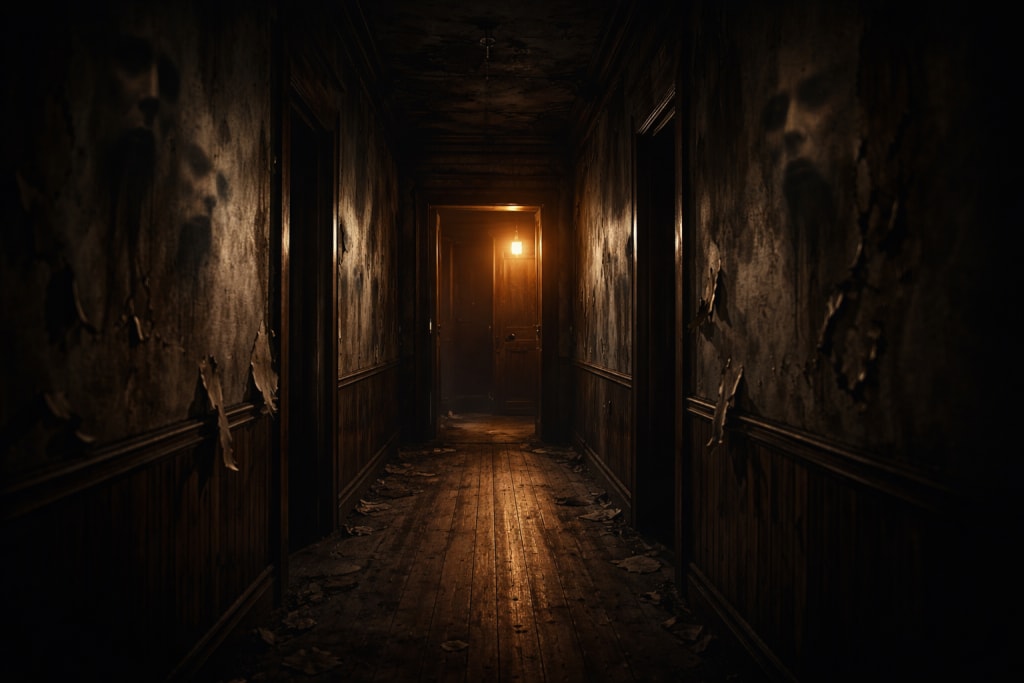
Some places don’t wait to be haunted. They wait to be invited.
When the house first spoke my name, I assumed it was the wind.
Old houses breathe. They settle, sigh, stretch their bones at night. That’s what I told myself when I heard it—soft, almost polite.
“Eli.”
A whisper, thin as dust.
We had moved in three days earlier. My wife Mara said the house felt quiet, which was her word for peaceful. I noticed how the silence pressed against the ears, like something listening back.
The realtor called it a “historic property.” Built in 1911. One owner before us. No children. No deaths worth mentioning.
The first night passed without incident. The second night, the whisper returned.
“Eli.”
Closer this time.
I sat upright in bed. Mara slept beside me, breathing evenly. The digital clock glowed 2:17 a.m.
“Did you say something?” I asked the dark.
Silence.
The sound hadn’t come from inside my head. That much I knew. It had weight. Direction. It came from the hallway.
The third night, Mara heard it too.
“Did you call me?” she asked, half-asleep.
“No.”
We listened together as the house settled again. Floorboards creaked, old wood complaining. Then—
“Mara.”
Her eyes opened wide.
We didn’t speak. We didn’t breathe. We didn’t move until morning.
By the end of the week, the house knew us.
It learned our routines. The way Mara hummed while cooking. How I paced when I couldn’t sleep. It began to anticipate us—lights flickering on before we entered rooms, doors creaking open just as we reached for handles.
We stopped inviting friends over. Not because we were afraid of being embarrassed—but because the house behaved differently when others were present. It went quiet. Watchful.
Like a child pretending to sleep.
The whispers became sentences.
“You left the window open.”
“Don’t forget your keys.”
“She’s upset with you.”
The voice wasn’t male or female. It sounded like memory. Like something familiar you couldn’t place.
Mara started answering it.
I found her one afternoon standing in the hallway, whispering back.
“What did it say?” I asked.
She smiled too quickly. “Nothing important.”
That night, the house called us by our full names.
I searched public records. Old newspapers. Anything.
The previous owner’s name was Eleanor Whitcomb. She lived alone for sixty-three years. No obituary photo. No listed cause of death.
But I found one article.
Local Woman Known for Hospitality.
It described a woman who never married, never traveled, but always welcomed others. She hosted dinners, gatherings, community meetings—until, gradually, people stopped coming.
The last line stayed with me:
“In her later years, neighbors reported Eleanor spoke often to her home, referring to it as ‘we’ rather than ‘I.’”
I showed Mara. She barely reacted.
“She was lonely,” Mara said. “So are houses.”
The night Mara disappeared, the house was warm.
Not heated—warm, like skin.
Her side of the bed was empty. I called her name. The house answered.
“She’s with us now.”
I ran through the halls, screaming, searching. Every door led somewhere wrong. Closets stretched too deep. The bathroom mirror reflected rooms that didn’t exist.
Finally, I reached the basement.
The door had never opened before.
Inside, the walls were covered in names.
Painted. Carved. Written in ink and ash.
Hundreds of them.
Some were crossed out.
Some were circled.
At the center, freshly etched into the concrete:
MARA ELLEN CARTER
Below it, still wet:
ELI JAMES CARTER
The house sighed behind me.
“You belong here.”
I woke up in bed.
Morning light. Birds outside. Mara beside me, asleep.
For a moment, I thought it was a dream.
Then I noticed the new name carved into the headboard.
Small. Careful.
Possessive.
The house no longer whispers.
It doesn’t need to.
It already knows who I am.
And every night, it practices my voice—
getting it right for when I stop answering.
About the Creator
Jhon smith
Welcome to my little corner of the internet, where words come alive
Keep reading
More stories from Jhon smith and writers in Horror and other communities.
Three Knocks Beneath the Sea
Silence has a texture under the sea. It isn’t empty—it breathes. It hums against the steel, curls into the corners, whispers in your skull until you start to hear your own blood. We were two miles beneath the surface when I heard it. Three knocks. Measured. Solid. Familiar. It reminded me of the way my grandpa used to knock on my door after making the long drive to see me. I sat up in my bunk, heart pounding so hard I felt it in my teeth. No one should have been awake except Reyes on night watch. The rest of the crew slept in their metal coffins, their breath feeding the recycled air system. The clock read 02:46. Three more knocks. Louder now. On my door. I stared at it—the trembling hinge, the echo traveling through the walls—and said, “Who’s there?” Nothing. Of course it was nothing. The embarrassment came fast, hot. Calling out to nothing. Just the deep, eternal hum of the Odyssey and the distant groan of the hull flexing against pressure that could crush us in a heartbeat. I stood, bare feet against cold metal, and opened the door. The corridor glowed dull red under the night lights. The air tasted of oil and salt. No one. Only three small wet circles on the door—like fingertips. I touched one. It was freezing. Reyes jumped when I entered the control room. “Jesus, Harper,” he said, clutching his chest. “What are you doing up?” “Someone knocked on my door.” He frowned. “No one’s moving around. Everyone’s accounted for.” “Then what did I hear?” He hesitated, then tapped the sonar display. “I’ve been getting something weird. A return echo—small. Moving along the hull.” The pulse slid across the screen. It wasn’t static. It shifted. “Could be current,” he said. “At two miles down?” He didn’t answer. A flicker. Then nothing. “I’m checking the observation chamber,” I said. “Harper—” But I was already walking. The chamber buzzed softly. The external camera showed nothing but blackness—endless, patient black. I leaned closer. My reflection hovered over the void, pale and unreal. Then something moved. A distortion. Like heat shimmering in air. I flicked on the floodlights. The hull burst into view, silver-gray and sweating condensation. Near the edge of the frame—there. A handprint. Pressed into the metal. I froze. And through the steel, unmistakable, I heard it. Knock. Knock. Knock. “Reyes!” He arrived breathless. “Listen,” I whispered. Three soft blows echoed through the ship, settling deep in my bones. “That’s impossible,” he said. “We’re two miles under.” The Captain woke everyone. Ten of us gathered in the mess, whispering theories—pressure shifts, hull expansion, sonar ghosts. No one mentioned the fact that we had all heard it. Porter squinted at the monitor. “Zoom in.” The feed magnified. Something shimmered against the hull, pulsing faintly. “It’s moving,” he said. The Captain ordered more light. The shimmer vanished. Then a dragging sound scraped across the steel. Knock. Knock. Knock. I had never seen fear spread so fast. These were people who had faced death without flinching. That night, none of us slept. At 6:00 a.m., I found Porter shivering in the mess. “You look like hell,” I said. He raised his hand. Three red circles marked his palm. “It knocked back,” he whispered. “From inside the pipes.” My stomach twisted. “Inside?” He nodded. “It’s in the sub.” I laughed. I don’t know why. A stupid, brittle sound—like this was all a prank. The look on his face snapped me back. “Maybe it was your echo,” I said. “Maybe.” Neither of us believed it. Two men disappeared the next night. No alarms. No breach. Just gone. Bunks empty. Boots still by the door. Reyes found a puddle of saltwater near the aft chamber. No leak above it. Three shallow finger dents pressed into the floor. “We’re surfacing,” the Captain said. The engines failed. Lights dimmed. Emergency red flooded the halls. Knock. Knock. Knock. Porter’s scanner pinged. “Something’s in the wall.” The steel bulged outward, slow as a breath. Then it split. No water came. Black vapor spilled out—alive, veined with faint light. A face pressed through it. Almost human. It raised a hand. Three knocks. Then laughter. My laughter. The bulkhead sealed. Silence returned. Later, the intercom crackled. “Harper,” Porter whispered. “It says you shouldn’t have turned on the lights.” The line went dead. We found him floating, eyes open, a shadow behind him shaped like a man. By morning, half the crew was gone. As we ascended, Reyes stared at the sonar. “It’s following us.” Two blips. Perfectly aligned. The knocks grew louder. Closer. Then the whisper came through every vent, every thought: Don’t open the door. I did. Blue light flooded in. Beautiful. Warm. Familiar. Like home. Like my grandpa’s knock. I laughed as the water filled my lungs. I laughed as the light faded. I laughed as I knocked three times on the outside of the submarine.
By Jhon smith24 days ago in Horror
The Character Who Isn’t on Payroll
Posted to r/nosleep I work at Disneyland. I won’t say my department, but I’m close enough to characters that I see schedules, handoffs, rotations—the boring, logistical side of “magic.” Which is why this has been driving me insane.
By V-Ink Storiesabout 2 hours ago in Horror



Comments
There are no comments for this story
Be the first to respond and start the conversation.