Digital Home Library by Masud Rana
Bio
Digital Home Library | History Writer 📚✍️
Passionate about uncovering the past and sharing historical insights through engaging stories. Exploring history, culture, and knowledge in the digital age. Join me on a journey through #History
Stories (51)
Filter by community
The History of Sea Conquests: A Journey Through the Waves of Power and Exploration
Introduction The sea has been a vital part of human history, serving as both a pathway and a battleground for power, exploration, and conquest. From ancient naval battles to global explorations and the establishment of vast empires, sea conquests have played a critical role in shaping civilizations and world history. This historical journey highlights the most remarkable sea conquests that defined nations and changed the course of history.
By Digital Home Library by Masud Rana12 months ago in History
The Dawn of Humanity: A Glimpse into the Lives and Times of Ancient People
The term "ancient people" encompasses a vast and diverse range of human societies spanning millennia, from the earliest hominids to the complex civilizations of the ancient world. Defining precise temporal and geographical boundaries is challenging, but broadly, we can consider this period to extend from the emergence of Homo habilis roughly 2.8 million years ago to the decline of the Roman Empire in 476 CE, and even later in some regions. To understand the lives and times of these ancient people, we must delve into their origins, adaptations, social structures, beliefs, and technological advancements, recognizing the incredible diversity that existed across different continents and ecological niches. The Paleolithic Era: Survival and Adaptation The Paleolithic Era, also known as the Old Stone Age, constitutes the longest period in human history, accounting for over 99% of our species' existence. This era is characterized by the use of crude stone tools and a hunter-gatherer lifestyle. Early hominids, such as Homo habilis and Homo erectus, faced immense challenges in surviving in a harsh environment. Early Hominids: These early ancestors relied on scavenging, gathering edible plants, and hunting small animals. Their survival depended on their ability to adapt to changing environments and develop rudimentary tools. The discovery of fire was a pivotal moment, providing warmth, protection from predators, and the ability to cook food, improving its digestibility and nutritional value. Hunter-Gatherer Societies: As Homo sapiens emerged, they perfected hunting techniques, developing more sophisticated tools like spear points, bows and arrows, and traps. They lived in small, nomadic bands, following migratory animal herds and seasonal plant growth. Cooperation and social bonds were crucial for survival, as individuals relied on each other for hunting, gathering, and protection. Material Culture and Art: While survival was paramount, Paleolithic people also possessed a rich cultural life. Cave paintings, such as those found in Lascaux and Altamira, depict animals, humans, and abstract symbols, offering insights into their beliefs, rituals, and artistic expression. These artistic endeavors suggest a capacity for symbolic thought and abstract reasoning, marking a significant step in human cognitive development.
By Digital Home Library by Masud Rana12 months ago in History
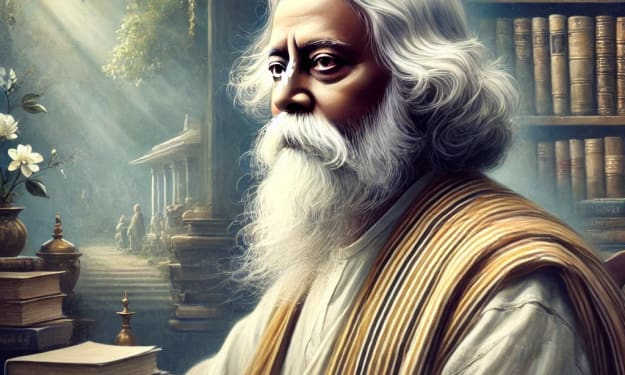
Rabindranath Tagore: The Timeless Bard of Bengal
Introduction Rabindranath Tagore, one of the greatest literary figures of the 19th and 20th centuries, was not just a poet but a philosopher, playwright, novelist, musician, painter, and social reformer. Known as "Gurudev", Tagore became the first non-European to win the Nobel Prize in Literature in 1913 for his world-renowned work "Gitanjali" (Song Offerings). His literary genius, humanitarian vision, and artistic endeavors have left an indelible mark on the cultural and intellectual landscape of not only India but the entire world.
By Digital Home Library by Masud Rana12 months ago in History
The Enduring Power of Grief
In the heart of a bustling city, amidst the cacophony of life, resided a soul named Eleanor. Once vibrant and full of life, her spirit was now a canvas painted in shades of blue, a somber reflection of the pain that had seeped into her being.
By Digital Home Library by Masud Rana12 months ago in History
You & me. Painted in the Seven Colors of the Rainbow
In the quiet town of Serenity Hills, where the skies often wept and the rivers whispered ancient tales, there lived two souls destined to meet. Aryan, a young artist who saw the world through hues and shades, and Aisha, a poet whose words danced like the wind. Their worlds collided on a rainy afternoon when fate decided to paint their story with the seven colors of the rainbow.
By Digital Home Library by Masud Ranaabout a year ago in History
The Development of Civilizations: A Tapestry of Human Ingenuity
The development of civilizations is a testament to the remarkable capacity of human beings to adapt, innovate, and create complex societies. From the earliest hunter-gatherer bands to the bustling metropolises of the modern world, humanity has embarked on a remarkable journey of progress, marked by significant milestones in agriculture, technology, social organization, and cultural expression.
By Digital Home Library by Masud Ranaabout a year ago in History
The Impact of Revolutions: A Force for Change Throughout History
Revolutions, those seismic shifts in the foundations of societies, stand as potent forces in the grand narrative of human history. They are not mere uprisings or rebellions, but rather profound transformations that challenge the existing order and usher in new eras of political, social, and economic change. From the ancient world to the modern era, revolutions have reshaped the global landscape, leaving behind legacies that continue to reverberate today.
By Digital Home Library by Masud Ranaabout a year ago in History
The Rise and Fall of Empires: A Millennia-Spanning Tapestry of Power
The story of empires is the story of humanity writ large, a sprawling narrative encompassing ambition, innovation, conquest, and ultimately, decline. From the ancient empires of Mesopotamia and Egypt to the sprawling colonial powers of the modern era, these vast political entities have shaped the course of history, leaving an indelible mark on culture, politics, and the very landscape of our world.
By Digital Home Library by Masud Ranaabout a year ago in History
The Whispering Cartographer of Aethelgard: A History Etched in Mist
History, as we know it, is often a tale of kings, battles, and grand pronouncements. But what of the stories whispered in the margins, the truths etched in the ephemeral? This is the tale of Elara, the Whispering Cartographer of Aethelgard, and the map that changed a kingdom. The Mist-Bound Realm: Aethelgard was a land perpetually shrouded in mist. Its borders, defined by shifting fog banks and treacherous peat bogs, were a source of constant anxiety. For generations, cartographers had attempted to map the realm, but the mist swallowed their lines, rendering their efforts useless. Fear of the unknown bred distrust, and the kingdom was fractured, its outlying settlements isolated and vulnerable. Elara's Unconventional Approach: Then came Elara, a young woman with eyes as grey as the Aethelgardian sky and a mind that saw patterns where others saw chaos. Unlike her predecessors, Elara didn't rely on rigid measurements or the pronouncements of surveyors. She listened. She listened to the wind whistling through the ancient standing stones, the gurgling of hidden streams, and most importantly, the stories of the people. She traveled from village to village, not with compass and chain, but with a worn leather-bound journal and a satchel of charcoal. She sat by hearths, listening to tales of lost pathways, hidden groves, and the strange, luminous creatures that emerged from the mist. She learned the names the locals gave to the shifting fog banks, the landmarks whispered in hushed tones. The Map of Whispers: Elara's map wasn't drawn on parchment, but on a vast sheet of cured leather, stained with the hues of the local flora. It wasn't a rigid grid of lines, but a fluid, organic representation of the land. The coastline was marked by the ebb and flow of the mist, the forests by the songs of the birds, and the settlements by the stories of their inhabitants. She marked the "Whispering Paths," invisible trails that only those who knew the land intimately could follow. She noted the "Shifting Pools," ephemeral bodies of water that appeared and disappeared with the tides of the mist. She even charted the "Dreaming Stones," ancient monoliths said to hold the memories of the land. The King's Skepticism and the Unexpected Revelation: King Theron, a man of rigid logic and unwavering skepticism, dismissed Elara's map as a fanciful collection of folklore. He demanded a map of tangible borders, of quantifiable distances. But Elara insisted her map held a deeper truth, a truth that could unite the fractured kingdom. One day, a raiding party from the neighboring kingdom, known for their cunning and knowledge of the mist, slipped through the border defenses. They targeted a remote village, believing it to be isolated and undefended. However, using Elara's map, the villagers, guided by the "Whispering Paths," were able to anticipate the raiders' movements. They led them into a "Shifting Pool," a treacherous bog that swallowed the invaders whole. The Transformation of Aethelgard: The king, witnessing the effectiveness of Elara's map, was forced to reconsider his skepticism. He realized that the true borders of Aethelgard weren't lines on a map, but the shared stories and experiences of its people. Elara's map became a symbol of unity, a testament to the power of collective knowledge. The "Whispering Paths" became well-trodden routes, connecting the once-isolated settlements. The "Dreaming Stones" became places of gathering, where stories were shared and the history of Aethelgard was preserved. The Legacy of the Whispering Cartographer: Elara's legacy wasn't just a map; it was a shift in perception. She taught the people of Aethelgard that their land wasn't defined by its limitations, but by its unique and ephemeral nature. She showed them that true knowledge lay not in rigid measurements, but in listening to the whispers of the land and the stories of its people. And so, Aethelgard became a kingdom not of rigid borders, but of shared stories, a testament to the power of a map etched in mist and the wisdom of the Whispering Cartographer.
By Digital Home Library by Masud Ranaabout a year ago in History
Invisible Wounds
Prologue: The Unseen Storm The town of Pripyat had always been a paradox, a place where the hum of nuclear reactors harmonized with the whispers of pine forests. But on April 26, 1986, the harmony shattered. The sky burned with an unnatural light, and the air tasted metallic, like licking a battery. For Anatoly Volkov, a 32-year-old engineer at the Chernobyl Nuclear Power Plant, the disaster was more than an explosion. It was the day his mind became a prison.
By Digital Home Library by Masud Ranaabout a year ago in History
The World Wars (1914–1945): A Crucible of Catastrophe and Transformation
World War I (1914–1918) and World War II (1939–1945) were not just battles of military might but also struggles that determined the future of nations, ideologies, and human civilization. These wars led to the fall of empires, the rise of new superpowers, advancements in technology, and shifts in global alliances.
By Digital Home Library by Masud Ranaabout a year ago in History
The History of Pandemics: From the Bubonic Plague to COVID-19
Pandemics as Catalysts of Change Throughout history, pandemics have reshaped societies, economies, and cultures. From the Black Death that wiped out half of Europe to COVID-19, which redefined global connectivity, these crises expose humanity’s vulnerabilities while driving innovation and resilience. This article explores pivotal pandemics, their causes, impacts, and the lessons they offer for a world still grappling with infectious diseases.
By Digital Home Library by Masud Ranaabout a year ago in History