
The History of Sea Conquests: A Journey Through the Waves of Power and Exploration
From Ancient Tides to Modern Empires: A Voyage of Navigators, Ambition, and Clashing Cultures Across Uncharted Waters

Introduction
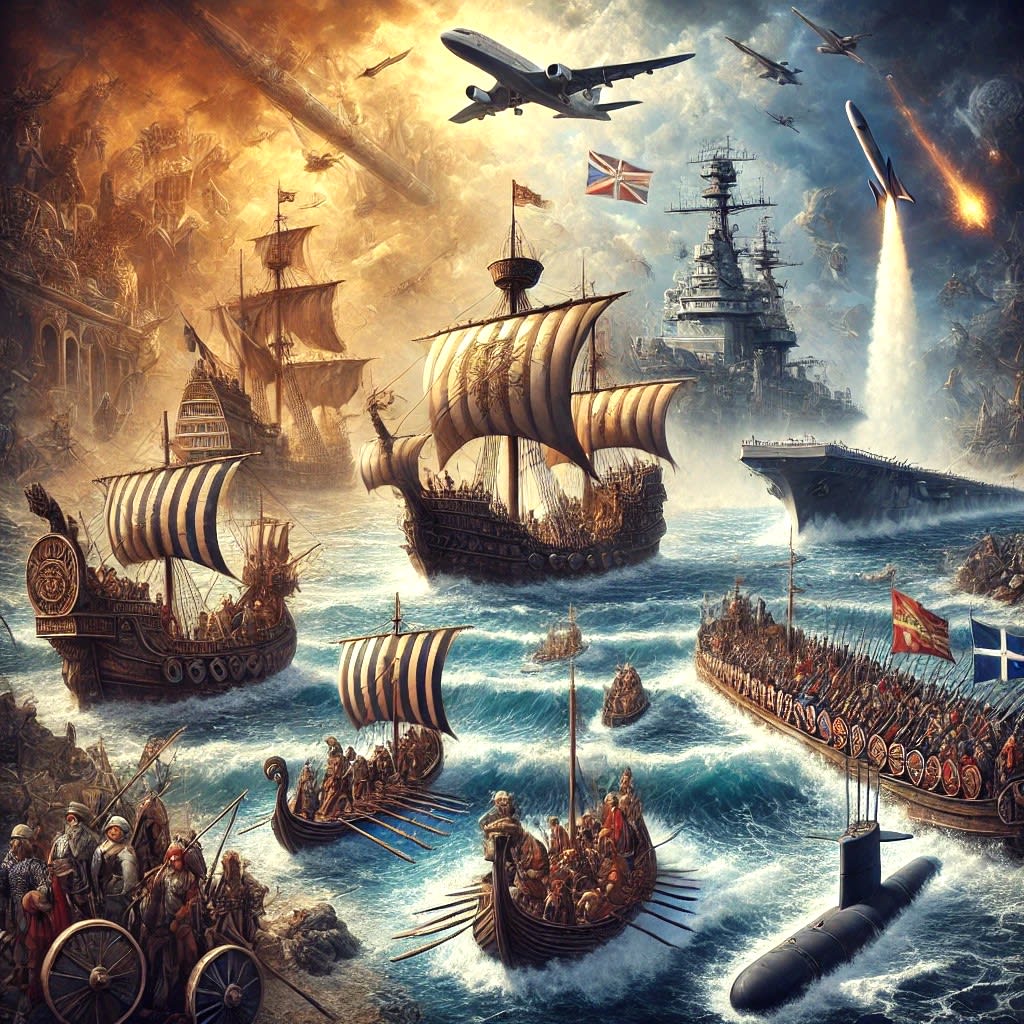
The sea has been a vital part of human history, serving as both a pathway and a battleground for power, exploration, and conquest. From ancient naval battles to global explorations and the establishment of vast empires, sea conquests have played a critical role in shaping civilizations and world history. This historical journey highlights the most remarkable sea conquests that defined nations and changed the course of history.
The Ancient Era of Sea Conquests (2000 BCE – 500 CE)
The Phoenicians: Masters of the Mediterranean
Hailing from present-day Lebanon, the Phoenicians were among the earliest maritime pioneers, mastering the art of navigation and shipbuilding. Their seafaring expertise allowed them to establish thriving colonies across the Mediterranean, including the influential city of Carthage (modern-day Tunisia). By controlling key trade routes, they not only dominated commerce but also spread their culture, language, and innovations to distant shores.
The Persian Naval Conquest (500 BCE)
Under the leadership of Kings Darius I and Xerxes I, the Persian Empire expanded its naval capabilities to assert dominance over the Mediterranean. A defining moment came in 480 BCE during the Battle of Salamis, where the Greek alliance dealt a crushing defeat to the Persian fleet. This pivotal clash shifted the balance of power, halting Persian expansion and securing Greek independence, forever altering the course of naval warfare.
The Roman Naval Expansion (264 BCE – 476 CE)
As the Roman Republic—and later, the Roman Empire—rose to power, so did its formidable navy, transforming the Mediterranean into "Mare Nostrum" (Our Sea). The decisive Punic Wars (264 BCE – 146 BCE) against Carthage, led by legendary figures such as Hannibal and Scipio Africanus, played a crucial role in securing Rome’s naval supremacy. The Roman fleet not only controlled vital trade routes but also safeguarded the empire from piracy, ensuring its dominance for centuries.
The Viking Age of Sea Domination (8th – 11th Century)
The Fearless Viking Raiders
The Vikings from Scandinavia (Norway, Sweden, and Denmark) were known for their advanced longships and brutal sea raids.
They launched attacks on coastal towns in England, France, and even as far as Iceland and Greenland.
The Vikings’ conquest of England and parts of Ireland showcased their dominance over the North Atlantic.
The Discovery of North America
Around 1000 CE, Leif Erikson, a Norse explorer, reached Vinland (modern-day Newfoundland, Canada), making the Vikings the first Europeans to set foot on North American soil, centuries before Columbus.
The Age of Exploration and Colonial Conquests (15th – 17th Century)
The Portuguese Maritime Empire
Under the leadership of Prince Henry the Navigator, Portugal became the first European power to explore new sea routes.
Vasco da Gama's voyage to India (1498) established the Spice Trade Route, bypassing the dangerous Silk Road.
Portugal conquered key coastal territories like Goa (India), Macau (China), and Brazil in South America.
The Spanish Conquest of the New World
In 1492, Christopher Columbus discovered the Americas under the Spanish flag.
Spanish conquistadors like Hernán Cortés (who defeated the Aztecs) and Francisco Pizarro (who conquered the Incas) established the Spanish Empire in the Americas.
The Spanish Armada dominated the Atlantic and Pacific Oceans for over a century.
The British and Dutch Naval Power
The British Empire, led by famous explorers like Francis Drake, defeated the Spanish Armada (1588), marking the rise of British naval power.
The Dutch East India Company (VOC) established control over sea trade routes in Southeast Asia, including Indonesia and the Indian Ocean.
The Age of Imperial Naval Battles (18th – 19th Century)
The Battle of Trafalgar (1805)
The British navy, led by Admiral Horatio Nelson, defeated the combined French and Spanish fleets.
This victory secured British control over the seas and prevented Napoleon Bonaparte from invading Britain.
The American Naval Expansion
The establishment of the U.S. Navy (1775) played a crucial role in the War of 1812 against Britain.
The Battle of Mobile Bay (1864) during the American Civil War showcased the growing strength of the U.S. Navy.
The World Wars and Modern Naval Dominance (20th Century)
World War I (1914-1918)
The Battle of Jutland (1916) between the British Royal Navy and the German Imperial Fleet was the largest naval battle of the war.
The British naval blockade crippled Germany’s economy and played a major role in its defeat.
World War II (1939-1945)
The Attack on Pearl Harbor (1941) by the Japanese Navy brought the U.S. into the war.
The Battle of Midway (1942) turned the tide in favor of the U.S. against Japan in the Pacific.
The use of aircraft carriers, submarines, and naval aviation became crucial to modern sea warfare.
The Modern Era of Naval Power (21st Century)
U.S. Navy Dominance
The United States Navy remains the most powerful naval force in the world today.
With advanced aircraft carriers, nuclear submarines, and naval bases around the world, the U.S. controls strategic sea routes.
The Rise of China’s Navy
The Chinese Navy (PLA Navy) has rapidly expanded its fleet and established dominance in the South China Sea.
China's Belt and Road Initiative (BRI) has strengthened its influence over global maritime trade routes.
Conclusion
The history of sea conquests reflects humanity's ambition to explore, conquer, and dominate the world's oceans. From ancient Phoenician traders to the Viking warriors, from European colonial empires to modern naval superpowers, the control of the sea has always been a symbol of strength and global influence. In the modern era, naval power remains a critical factor in global politics and economic control, proving that the battle for dominance over the seas is far from

About the Creator
Digital Home Library by Masud Rana
Digital Home Library | History Writer 📚✍️
Passionate about uncovering the past and sharing historical insights through engaging stories. Exploring history, culture, and knowledge in the digital age. Join me on a journey through #History
Keep reading
More stories from Digital Home Library by Masud Rana and writers in History and other communities.
The Dawn of Humanity: A Glimpse into the Lives and Times of Ancient People
The term "ancient people" encompasses a vast and diverse range of human societies spanning millennia, from the earliest hominids to the complex civilizations of the ancient world. Defining precise temporal and geographical boundaries is challenging, but broadly, we can consider this period to extend from the emergence of Homo habilis roughly 2.8 million years ago to the decline of the Roman Empire in 476 CE, and even later in some regions. To understand the lives and times of these ancient people, we must delve into their origins, adaptations, social structures, beliefs, and technological advancements, recognizing the incredible diversity that existed across different continents and ecological niches. The Paleolithic Era: Survival and Adaptation The Paleolithic Era, also known as the Old Stone Age, constitutes the longest period in human history, accounting for over 99% of our species' existence. This era is characterized by the use of crude stone tools and a hunter-gatherer lifestyle. Early hominids, such as Homo habilis and Homo erectus, faced immense challenges in surviving in a harsh environment. Early Hominids: These early ancestors relied on scavenging, gathering edible plants, and hunting small animals. Their survival depended on their ability to adapt to changing environments and develop rudimentary tools. The discovery of fire was a pivotal moment, providing warmth, protection from predators, and the ability to cook food, improving its digestibility and nutritional value. Hunter-Gatherer Societies: As Homo sapiens emerged, they perfected hunting techniques, developing more sophisticated tools like spear points, bows and arrows, and traps. They lived in small, nomadic bands, following migratory animal herds and seasonal plant growth. Cooperation and social bonds were crucial for survival, as individuals relied on each other for hunting, gathering, and protection. Material Culture and Art: While survival was paramount, Paleolithic people also possessed a rich cultural life. Cave paintings, such as those found in Lascaux and Altamira, depict animals, humans, and abstract symbols, offering insights into their beliefs, rituals, and artistic expression. These artistic endeavors suggest a capacity for symbolic thought and abstract reasoning, marking a significant step in human cognitive development.
By Digital Home Library by Masud Rana10 months ago in History
government shutdown 2026
**Government Shutdown 2026: What It Means and Why Americans Are Concerned** A possible government shutdown in 2026 has become a major topic of public discussion in the United States. Many people are searching for clear explanations about what a government shutdown is, why it may happen, who will be affected, and how serious the consequences could be. This article provides a detailed and easy-to-understand overview while answering the most common questions people are asking.
By America today 4 days ago in History
Balloonfest 1986
Balloonfest 1986 was meant to be a joyful celebration. It was planned as a world record attempt and a symbol of hope, fun, and community spirit. Instead, it became one of the most famous examples of how a good idea can go wrong when nature is underestimated.
By shaoor afridiabout 6 hours ago in History
The steps to losing a child
Step One: Lose a child. Not what anyone wants to happen and nothing you can do to change it, but you can go through steps to becoming happy again. You can go through steps to loving again. You can go through steps to become a new you because after losing a child you will never be the same person you once were.
By Tabitha Hinkley3 days ago in Fiction


Comments (4)
This detailed summary readily points out the long-term strategic significance of naval power throughout history, illustrating how controlling the seas has built empires and shaped the world. The phrase "Mare Nostrum" (Our Sea) applied by the Romans aptly describes the wish to rule the sea world, a dream shared by numerous civilizations. The article readily weaves together ancient naval with contemporary naval strategy, using the continuous thread of naval dominance through the entire history of mankind.🌞
An intriguing journey through history’s pivotal sea conquests!
👏👏
welcome.💕💕