Badhan Sen
Bio
Myself Badhan, I am a professional writer.I like to share some stories with my friends.
Stories (2116)
Filter by community
WORKPLACE ETHICS
Workplace ethics refers to the set of moral principles, standards, and values that guide behavior and decision-making in a professional environment. It defines how employees, employers, and organizations interact with one another and influence the organizational culture. Strong workplace ethics are essential for fostering a productive, respectful, and harmonious work environment. Ethical behavior in the workplace builds trust, promotes fairness, and supports the achievement of organizational goals. In this article, we explore the importance of workplace ethics, the key principles involved, and how ethical practices contribute to a positive and successful workplace.
By Badhan Senabout a year ago in Interview
ROLE OF EDUCATION IN ECONOMIC GROWTH
Education is one of the most significant factors contributing to economic growth. It not only equips individuals with essential skills and knowledge but also has a direct impact on productivity, innovation, and social mobility. The relationship between education and economic growth is both complex and profound, influencing various aspects of economic development, from labor force quality to technological advancements and entrepreneurship. This article explores how education acts as a catalyst for economic growth and highlights the various channels through which education contributes to the broader economy.
By Badhan Senabout a year ago in Education
HUMAN CAPITAL DEVELOPMENT
Human capital development refers to the process of improving the skills, knowledge, experience, and capabilities of individuals within an organization or society. It is essential for personal and professional growth and plays a crucial role in driving economic development and organizational success. At its core, human capital development focuses on investing in people, enhancing their abilities, and creating an environment where individuals can reach their full potential. In today’s knowledge-based economy, the development of human capital is a key driver of productivity, innovation, and competitiveness.
By Badhan Senabout a year ago in Humans
THE FUTURE OF WORK
The future of work is rapidly evolving, influenced by technological advancements, shifts in societal values, and the changing dynamics of global economies. As automation, artificial intelligence (AI), remote work, and a new generation of workers shape the landscape, the workplace is set to undergo profound transformations. Understanding these changes is essential for businesses, employees, and policymakers to navigate the future effectively.
By Badhan Senabout a year ago in 01
DEATH AND THE EXPERIENCE
Death is an inevitable part of the human condition, and its significance has been contemplated by philosophers, theologians, and individuals throughout history. It is the final phase of life, the end of physical existence, and the conclusion of our journey in the world. Despite being universally shared, the experience of death raises profound questions and emotions, prompting individuals to consider its meaning and the implications for life itself.
By Badhan Senabout a year ago in Humans
ALTRUISM AND ITS IMPLICATIONS
Altruism, the selfless concern for the well-being of others, is a profound aspect of human behavior that has been studied extensively in psychology, philosophy, and sociology. This essay explores the concept of altruism, its underlying motivations, and its broader implications on personal relationships, societal development, and even evolutionary biology.
By Badhan Senabout a year ago in Humans
EXISTENTIALISM AND HUMAN PURPOSE
Existentialism, a philosophical movement that emphasizes individual freedom, choice, and subjective experience, challenges traditional notions of purpose and meaning in human life. Rooted in the works of thinkers such as Søren Kierkegaard, Friedrich Nietzsche, Jean-Paul Sartre, and Albert Camus, existentialism invites us to confront life's inherent uncertainties and create our own meaning.
By Badhan Senabout a year ago in Humans
PHILOSOPHY OF THE MIND
The philosophy of the mind is an intricate branch of philosophy that explores the nature, origin, and functioning of the mind. It examines questions about consciousness, perception, thought, and the relationship between the mind and the body. This essay delves into key topics, debates, and implications of studying the philosophy of the mind.
By Badhan Senabout a year ago in Humans
JUSTICE AND FAIRNESS IN SOCIETY
Justice and fairness are foundational principles that have shaped societies throughout history. They form the basis of laws, policies, and social norms, aiming to promote equality, fairness, and the well-being of all members of society. These concepts are often debated and interpreted in various ways, reflecting the complexities of human life, culture, and values. In this essay, we will explore the meaning of justice and fairness, their roles in society, and the challenges faced in achieving them.
By Badhan Senabout a year ago in Humans
ROLE OF RELIGION IN IMPORTANT SYSTEM
Role of Religion in Moral Systems Religion has been an integral part of human history, shaping not only spiritual beliefs but also the moral frameworks that guide human behavior. Across diverse cultures and societies, religious teachings have often been the foundation for ethical principles and moral decision-making. The relationship between religion and morality is complex, with many people relying on religious beliefs to define what is considered right or wrong. However, the influence of religion on moral systems is multifaceted and continues to evolve in response to the changing social, cultural, and philosophical landscape.
By Badhan Senabout a year ago in 01
FREE WILL VS DETERMINISM
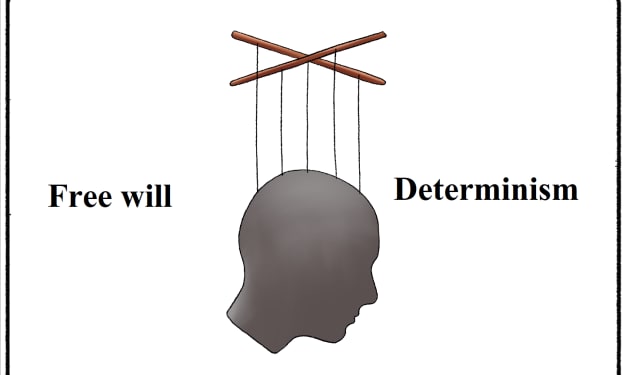
The debate between free will and determinism is one of the oldest and most profound philosophical discussions. At its core, this debate addresses a fundamental question about human existence: Do we have the ability to make choices, or are our actions predetermined by factors beyond our control? This discussion touches on a wide range of issues, including personal responsibility, moral accountability, and the nature of human agency. In this essay, we will explore both perspectives, their implications, and the attempts to reconcile them.
By Badhan Senabout a year ago in Humans
MORAL PHILOSOPHY AND DECISION MAKING
Moral Philosophy and Decision-Making Moral philosophy, often referred to as ethics, explores fundamental questions about right and wrong, good and evil, justice and fairness. It seeks to understand the nature of moral judgments, the values that guide human behavior, and the principles that inform ethical decision-making. The relationship between moral philosophy and decision-making is essential in various fields, from personal conduct to societal laws, and even in the development of technological systems. In this context, understanding the key elements of moral philosophy helps individuals and societies navigate complex moral dilemmas in everyday life and global issues.
By Badhan Senabout a year ago in 01