
FREE WILL VS DETERMINISM
The Battle Between Personal Agency and Predetermined Fate.

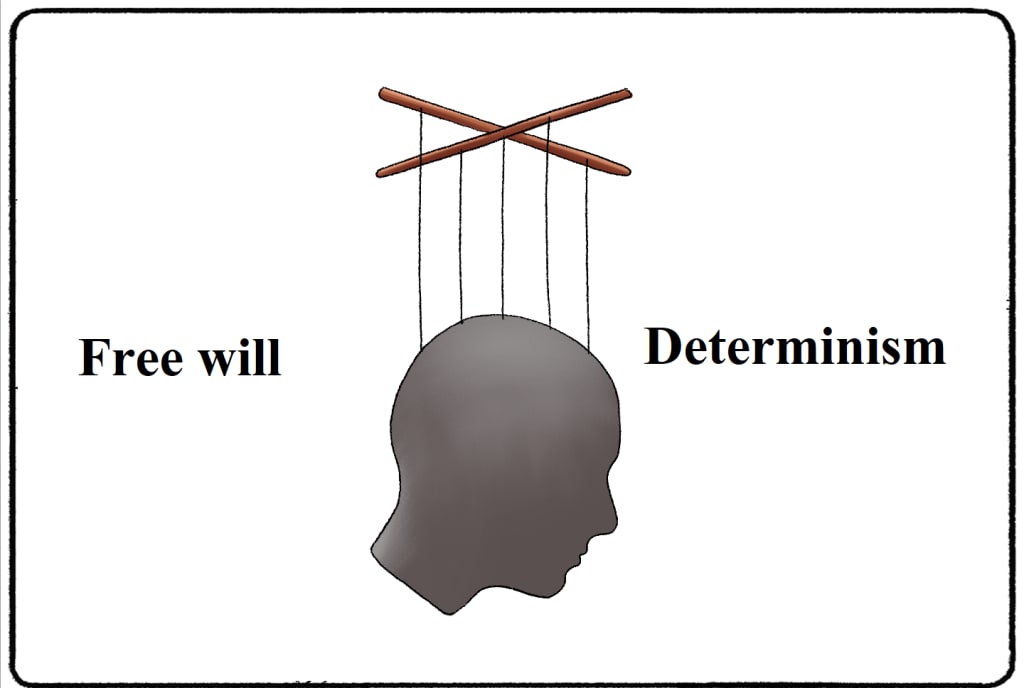
The debate between free will and determinism is one of the oldest and most profound philosophical discussions. At its core, this debate addresses a fundamental question about human existence: Do we have the ability to make choices, or are our actions predetermined by factors beyond our control? This discussion touches on a wide range of issues, including personal responsibility, moral accountability, and the nature of human agency. In this essay, we will explore both perspectives, their implications, and the attempts to reconcile them.
Determinism: The Concept of Predetermined Actions
Determinism is the view that every event, including human actions, is determined by preceding events in accordance with the natural laws of the universe. According to this perspective, the state of the world at any given moment is the result of a continuous chain of prior events and conditions. The universe is seen as a causal system where everything, including human decisions, is governed by laws of cause and effect.
Determinists argue that the notion of free will is an illusion. They claim that our decisions are shaped by factors such as genetics, upbringing, culture, environment, and past experiences. These factors influence our behavior to such an extent that, in theory, if we had perfect knowledge of all the influences acting upon a person, we could predict their actions with certainty. For example, a person’s decision to study for a test may be the result of their educational background, their parents’ expectations, their experiences with past tests, and a host of other factors. According to determinism, there is no true freedom in the decision to study; it is the outcome of prior conditions.
One of the strongest arguments in favor of determinism comes from the natural sciences, particularly physics. Classical physics, as formulated by Newton, proposed that the universe operates like a giant machine, with every event predictable if the initial conditions are known. Modern science, including neuroscience, also suggests that our brains operate based on physical processes, which could imply that our thoughts and actions are the result of biochemical reactions and neural activity, leaving little room for free will.
Free Will: The Ability to Make Independent Choices
In contrast, the concept of free will asserts that individuals have the ability to make choices independent of external causes or internal influences. Proponents of free will believe that people can act contrary to determinism, making decisions based on their desires, reasoning, and personal will. Free will is often linked to moral responsibility. If we are free to choose our actions, then we are accountable for those actions. If our choices were entirely determined, the very notion of praise, blame, or justice would be meaningless.
The concept of free will is central to many ethical and legal systems. It is foundational to the idea of justice, as individuals are held responsible for their actions only if they are capable of making independent choices. For instance, if someone commits a crime, they are judged based on whether they had the freedom to choose otherwise. Without free will, the entire system of justice, which assumes that people can make morally significant choices, would be undermined.
Philosophers who support free will often argue that we experience freedom in our daily lives. When making decisions, individuals feel as though they have several possible choices and can decide between them. For example, deciding whether to go to the gym or stay home may feel like an expression of personal agency. This feeling of self-determination suggests that we are capable of exercising free will.
The Compatibility Problem: Can Free Will and Determinism Coexist?
One of the most interesting aspects of this debate is the possibility of reconciling free will with determinism. Some philosophers propose a middle ground called compatibilism. Compatibilists argue that free will and determinism are not mutually exclusive. According to this view, even if our actions are determined by prior causes, we can still be considered free as long as we act according to our own desires and intentions, without external coercion. In this sense, freedom is not about being uncaused but about being able to act in accordance with one’s own motivations and reasoning.
For example, a person might be determined by their circumstances to choose one course of action, but if they are not being forced or manipulated by others, they are still exercising free will. Compatibilists argue that moral responsibility remains intact because people act according to their desires, even if those desires are shaped by external factors.
On the other hand, incompatibilists maintain that free will and determinism cannot coexist. They argue that if our actions are determined by prior causes, then we are not truly free to choose. For them, the ability to act otherwise, in any given situation, is the essence of freedom. If we are determined, we are just following a predetermined script, and our actions are not our own.
Implications for Society and Human Behavior
The debate between free will and determinism has significant implications for how we view human behavior and society. If we are determined, then we may be less inclined to hold people accountable for their actions, since they would be seen as products of their environment and biology. However, if we believe in free will, we may emphasize personal responsibility and moral accountability, as individuals are seen as agents capable of shaping their own destinies.
The question of free will versus determinism also affects how we view punishment and rehabilitation in the criminal justice system. If individuals are determined, then punishment may be seen as a way to modify behavior rather than to exact moral retribution. On the other hand, if people are free to make choices, punishment may be viewed as a just consequence for making immoral decisions.
Conclusion
The debate between free will and determinism is a complex and ongoing philosophical issue that touches on the nature of human agency, responsibility, and morality. While determinism suggests that our actions are governed by prior causes, free will asserts that we have the capacity to make independent choices. Whether these two concepts can coexist, as compatibilists suggest, or whether they are inherently incompatible, remains a subject of much debate. Regardless of where one stands on the issue, the discussion continues to challenge our understanding of human nature and our role in the world.
About the Creator
Badhan Sen
Myself Badhan, I am a professional writer.I like to share some stories with my friends.
Keep reading
More stories from Badhan Sen and writers in Humans and other communities.
HUMAN RIGHT AND EQUALITY
Human rights and equality are fundamental principles that underpin the structure of a just society. They are integral to the well-being of individuals and the harmonious functioning of communities around the world. Human rights refer to the basic rights and freedoms that all people are entitled to simply because they are human. These rights are universal and inalienable, meaning they cannot be taken away, and they apply to everyone, regardless of race, gender, nationality, or any other status.
By Badhan Senabout a year ago in Humans
Golden Globes 2026 Reflect a Changing Hollywood Awards Night
Award shows often feel distant from everyday life, but every so often, one night captures a deeper mood. The Golden Globes 2026 did exactly that. It was not just about trophies or fashion. It was about where Hollywood stands right now. Audiences are changing. Stories are changing. Expectations are changing too. This ceremony felt quieter in some ways, yet heavier with meaning. There was pride, discomfort, nostalgia, and uncertainty all sharing the same room. The Golden Globes have always been a mirror of the industry, and in 2026, that mirror showed both growth and lingering cracks. To understand why this night mattered, we need to look beyond the red carpet and into what the evening truly revealed.
By Muqadas khan4 days ago in Humans


Comments (1)
Good work and believe it or not we were given free will by the Lord and we need to make the choices we do to please him in some way. Determinism is one way of looking at that for we are or at least some of us determined to follow the Lord.