Annie Kapur
Bio
I am:
🙋🏽♀️ Annie
📚 Avid Reader
📝 Reviewer and Commentator
🎓 Post-Grad Millennial (M.A)
***
I have:
📖 280K+ reads on Vocal
🫶🏼 Love for reading & research
🦋/X @AnnieWithBooks
***
🏡 UK


Stories (2895)
Filter by community
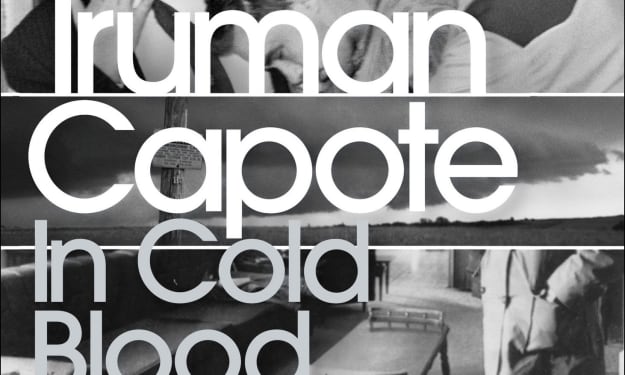
"In Cold Blood" by Truman Capote
I first read this book when I was about fifteen years’ old and it was because I had seen it in the local library but it was a tattered copy and so, I bought my own - intact. From not even opening the book, I felt like this was an important text. I wrote the following about it in my diary even before actually reading the book: “there’s something strange about this book. It’s as if it is asking me not to read it but it’s pulling me in. Something about the phrase ‘in cold blood’ sounds unnerving and dangerous. I’ve heard a bit about it but I was never sure to rely on other people’s verdicts of novels. Apparently though, according to some people - this isn’t really a novel at all. Then what is it?” That was the question I had asked: “What is it?” It isn’t really a novel because it isn’t really fiction and, as I know after many re-reads over the years, it isn’t entirely accurate either and so, it isn’t a non-fiction novel. It is an embellishment of the truth for the sake of entertainment and so, it is half and half, something that humans have been doing for centuries. Yet, it is entirely new. It is the new, modern version of criminal justice novels. It was true-crime and this is where I had first encountered a book of which the entire genre would come to change everything about what I believed literature could be. I would be obsessing over true crime for near a decade afterwards and it would be because of “In Cold Blood”. The first question you always ask yourself when you read “In Cold Blood” for the first time and that was the same question I asked myself when I finished the book. I wrote in my diary: “This was a strange book, I’ve never really read anything like it. The moment I finished it, I just sat there thinking about the same question over and over again - ‘what happens if it’s all entirely true?’”
By Annie Kapur5 years ago in Criminal
Book Review: “Bland Fanatics” by Pankaj Mishra
Pankaj Mishra’s book “Bland Fanatics” is basically our answer to Edward Said’s “Orientalism” - well, at least the first few essays are. Often presented as overtly pretentiously worded articles, Mishra actually fails on the key points of his argument, often skirting around the issue and addressing things that are possibly less important. However, there are things that I agree with when he does make a point and certainly, there are important arguments to be had here - I am just wondering whether Mishra has his own priorities, considering his political sway, a little bit mixed up for the time being. Sentences and paragraphs inside Mishra’s essays are often overly word-heavy and require to be broken down to understand them, which is something else I take issue with. Mixed within political jargon and inaccessible writing, Mishra has managed to create a barrier between himself and the common reader who possibly did not go to university or has not got the education required to understand the ins and outs of politics in the modern world. The real question here is: does Mishra fail to actually enforce his point as he commits himself to word-heavy sentences and paragraphs? Is this entire book just one big irony?
By Annie Kapur5 years ago in Geeks
"The Cask of Amontillado" by Edgar Allan Poe
I first read this story when I was a younger child because I used to have some tapes of the stories of Edgar Allan Poe read by the likes of Vincent Price and Christopher Lee (yes, I was a fairly odd child). Oh, and when I say ‘child’, I mean about nine years’ old, or roundabout that age. I used to play these tapes on my radio and cassette player and well, they scared the absolute crap out of me. After a while, as I grew up, I got these ‘tapes’ on a digital file and managed to put them on an MP3 player that plugged into my desktop computer. I no longer had to wind my cassette tapes with a pencil just to listen to scary accents reading my favourite gothic stories. The one story that always terrified me though was “The Cask of Amontillado” - it wasn’t “The Raven” or “The Pit and the Pendulum” and no, it wasn’t “Tell Tale Heart” or “The Murders in the Rue Morgue” - it was always “The Cask of Amontillado”.
By Annie Kapur5 years ago in Geeks
"The Hours" by Michael Cunningham
I did not get around to reading this until I was twenty-two years’ old and yet, it was a great book and I found the experience almost overwhelming. I was actually reading it for university and because I had to, but for some years before - one of my friends had been recommending it to me for an awfully long time and I had not actually read it off their recommendation (I’m pretty sure that annoyed her, but at least I eventually read it!). When I first read it, I was sitting bored out of my mind in a class on historical theories of western philosophy and someone was talking about Schopenhauer to which I thought ‘what is the point? we are all just going to die anyway…’ (laughs in Schopenhauer). Unfortunately enough, I’d already read the text on western philosophy that we were studying some years before and so, I began a new text, zoned out and thanked god that there were a lot of other students in the class. “The Hours” by Michael Cunningham was one of the greatest and most beautifully post-modern books I’d read since “Cloud Atlas” by David Mitchell.All about the great influence of Virginia Woolf on the lives after and considerably similar to her own, this book covers the lives of three women that are about to become intertwined only in their own experiences of womanhood, grief, goodness and their want to be more than themselves. I was fascinated by the language and even though I wasn’t a huge fan of the movie, I was definitely a huge fan of the book that was written like a symphony. It is truly a masterpiece of post-modern fiction. My first reading experience at twenty-two was well worth it and I often thank god that I left it for as long as I did. I thoroughly believe in reading books at the right time in order to get the right experience and this was definitely one of those books you need to do that with. It has such incredible atmosphere, the characters are so thorough and beautiful and the way in which it is written has such incredible description. It is one of the best written books of the last twenty years and yet, not many people I know have actually read it. Even the other people on my course didn’t seem to bother. I have no idea why - it was an amazing book.
By Annie Kapur5 years ago in Geeks
Book Review: "How to Destroy America in Three Easy Steps" by Ben Shapiro
Ben Shapiro’s introduction to his new book “How to Destroy America in Three Easy Steps” begins with capturing the very depths of the free-thinking mind of the new generation of political libertarians, liberals and conservatives alike. He ignites conversation, question and rethinking with his incredible argument that America moves towards disengagement and misinformation. Shapiro proves to be back on top form with his book “The Right Side of History” being a massive success and, from a readers point of view whether you like him or not, you have to admit that he knows what he’s talking about. As America tries to uphold herself in her 250 year civil rights’ history since the war, Shapiro lets us all in on a secret: that we are the problem and yet, we are also the solution. His writing style is clear, concise and consistent with a man who proves that ethics and morals, standards and cultural traditions seem to arise over conflict, mass mob culture, labelling and chaos. As both the right and the left of the American Political slip into chaos, Ben Shapiro is there explaining why they are both completely wrong.
By Annie Kapur5 years ago in The Swamp
"Invitation to a Beheading" by Vladimir Nabokov
Often, people ask me what my favourite Nabokov novel is and I have to say that the one I have read that is most unlike his other works is possibly “Invitation to a Beheading” because it represents something that is familiar to us in his bibliography that is written in an entirely different way. We get the question of morality and happiness, the difference between right and wrong and then, we get it written in a style that is often described as “kafkaesque” though I beg to differ. I first read this book when I was sixteen years’ old and nearing the summer of my life before sixth form. It was a scorching hot day and reading Nabokov whilst drinking juice was often considered the high life of the teenage literary nerd. This book is about a man called Cincinnatus C. who is due to be executed and often, we experience the various morality filters of different characters, including guards, family members and the protagonist himself. The characters I always associated most with the morality question were the protagonist, Cincinnatus and a man called Pierre, who mostly plays the sort of almost villainous shadowy trait of humanity in which we do things we are not proud of but often do them anyway. Pierre seems to represent not only morality, but the obsession and want to do something good, but the decision to do what one wants instead. It’s almost very Nietzsche of him I think. This book is written in a style that often, I would not associate with Nabokov - it written almost exclusively in an omniscient style, but also with an aspect of trickery. It is like Nabokov is trying to trick us into an ending. Some may say that the ending is anti-climatic but I believe that it is often more philosophical than we first think and subsequent readings have shown me this.
By Annie Kapur5 years ago in Geeks
Book Review: “Chasing the Light” by Oliver Stone
As we are all probably well aware by now, Oliver Stone is one of my favourite directors ever with his film “JFK” (1991) being one of my favourite films of all time. He has directed amazing movies like “Any Given Sunday” and the legendary “Platoon” which is based on his own experiences as a soldier in the Vietnam War. But little do we know about what happened before all of this great directing. Oliver Stone lets us into his life in which there are many, many setbacks for him. His perseverance through broken relationships, both family and in love, failed odd jobs and many more left him without money and often without hope. But, this man still managed to find the time to write out scripts upon scripts which were rejected each and every time. Of course, there was no doubt that one day, he would write a script that would become a great movie as we read this book after a lengthy, successful career. Oliver Stone writes passionately about his experiences, with vigour, reality and does not seek to be anything he is not. He tells his story in words that all can understand and all will come to understand the story behind this legend which is one of constant kicks and punches. In the end though, he does not give up.
By Annie Kapur5 years ago in Geeks
"Haunted Castles" by Ray Russell
I first read this book as a teenager because I had found it amongst a bunch of 70s paperback horror novels when I bought Peter Straub’s “The Throat” from the marketplace in my hometown (unfortunately, said book seller no longer is with us, rest his soul). But, my initial copy of Ray Russell’s three-story collection was tattered, torn and definitely second-hand. It was missing the publication page and it was dusty and raw. When I went home, I put down the Straub book and got stuck into the Russell collection almost straight away. It was amazing but it also scared the living daylights out of me. It was absolutely terrifying and a gothic masterpiece. There was an obvious relation to older horror novels and gothic texts in Russell’s attempt at showcasing the more dubious and deceptive side of human nature. But most of all what I liked about it is that when I came to re-read the book, I had actually completely forgotten about what I’d experienced the first time. I had a brand new copy which was published by Penguin and it was immaculate. I remembered reading the book but not what I had thought of it and so, sitting in the back of the car, on my way to the seaside, I re-read the whole thing. I ended up having a massive anxiety attack in the car because of the wide open spaces and since, I have constantly associated the book with being absolutely terrified. The book itself was not the initial reason for the attack but I think it may have contributed. Books can terrify me in ways that films only dream that they could. It just feels far more immersive when it is in a book and there are clear parallels between some of the stories in this book and older, wiser, darker books of our past - like Victor Hugo’s “The Man Who Laughs” and a number of others.
By Annie Kapur5 years ago in Horror
"The Man in the Picture" by Susan Hill
When I first read “The Man in the Picture” by Susan Hill I must have been around thirteen and then, I re-read it when I was about twenty-one. I like doing that with books because you discover things about the book you didn’t realise initially because you were so young. The things I unfolded when I was twenty-one were extreme in the field of psychological torture. It was actually far more frightening the second time I read it than the first. When I first read it, I was on a sort of ghost-story binge and so I was reading things like MR James, EF Benson, HP Lovecraft, Charles Dickens and others. But, in Susan Hill’s works I noticed a more modern gothic with a definite old flavour to it, it is something I absolutely fell in love with when it came to her works and “The Man in the Picture” was one of her newer ones. By then I had already read “The Woman in Black” and “Mrs. De Winter” and so, I was used to her gothic, atmospheric and often terrifying writing style. I would say that her books are best read at night, whilst it is raining, next to a dim lamp or better yet, by candlelight. Top it off with a slight thunderstorm and you might just have the perfect setting in which to read a Susan Hill novel. “The Man in the Picture” is no exception. It is a chilling book that you really need to read more than once in order to really get it.
By Annie Kapur5 years ago in Horror
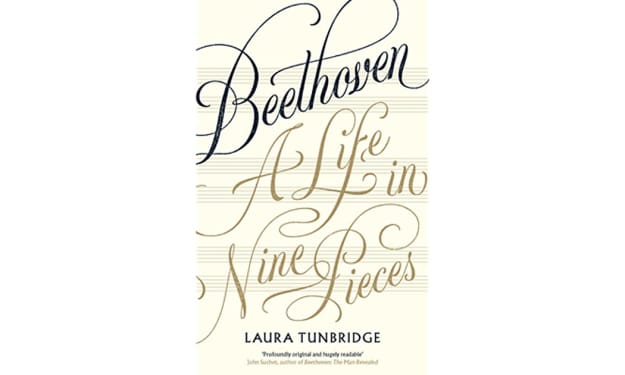
Book Review: “Beethoven: A Life in Nine Pieces” by Laura Tunbridge
Many may just call this a great biography about Beethoven, but that really isn’t it at all. This book is more like a celebration of his life whilst also filling in the gaps that had previously been marred by popular culture. The latter presents us with a scowling image of a man toiling over a masterpiece in a famous piece of artwork, but Tunbridge argues that this isn’t actually it at all. Beethoven was far more than just a discontent who worked day and night on his music - he was a three dimensional personality and a man who was way ahead of his time whilst also being a product of it. Tunbridge seeks to let us explore into the world of Beethoven and how he really went about his pieces and his masterpieces in the contexts of the social, cultural and political realms. It is a wonderful book that I’m sure that Beethoven himself would be very proud to have written about him.
By Annie Kapur5 years ago in Beat
"Julius Caesar" by William Shakespeare
When I was thirteen years’ old I went through a massive Shakespeare phase and the first thing I did was re-read all the plays that I had read before and then, I finalised to start a new one. The new play I started first and foremost was “Julius Caesar” and I can honestly say that even though I did not have high hopes for the play to begin with, I was absolutely entranced by the end of it. I did not want to play to be over, it was absolutely fascinating to see exactly how the conspiracy worked, and ultimately, why it didn’t work. The characters were each individual, even the guy who has his identity mixed up with a guy who has the same name as him and gets himself arrested. The symbols, ghosts and violence of the play is extreme and even the language is just what you’d expect from Shakespeare - multiple layers in which you definitely won’t get it all first time. From the plot which climaxes with the assassination of Julius Caesar to the downfall in which suicide and war are the only options, this play has everything you could want in a terrifying tragedy. It has the supernatural, the satirical, the murderous, the torturous, the conspirators, the violent, the fiery, the brutal and ultimately, the suicidal. It is possibly one of Shakespeare’s most violent plays after “Titus Andronicus” and I can honestly say that every time I have taught this play, it has been nothing but appreciation for Shakespeare’s over-the-top violence and gore. From start to finish, it was a masterpiece that thirteen-year-old me first opened up, only to be consumed by future re-reads throughout my teen years and beyond. It was like reading into a great painting from history. You don’t quite get it all first time - but when you see Rome covered in blood, you think you’re finally on your way to understanding what it is all about. At least, you hope so.
By Annie Kapur5 years ago in Geeks
"The Prince" by Niccolo Machiavelli
I first read this book as an early teen after hearing the word “machiavellian” pop up around public figures at the time like George Bush Jr. and Tony Blair (yes, I grew up in that era). I had no idea what this word meant as a thirteen-year-old and so, when I looked it up and saw that it was related to a person, I was looking through the works by him in no time. When I first found the list, I was initially thinking about reading the “Discourses on Livy” and when I realised I had to look up a word in the title, I proceeded on to an easier title: “The Prince” is what I read instead. Honestly, I’m glad I chose this one first because it really does explain a lot. It is written quite simply and so, I didn’t need to do much looking up, annotating and researching. I noticed immediately that the first part concerns gaining power and the second part concerns maintaining it. I can honestly say that I was shocked that many political figures were actually so much like this in real life - especially concerning the second half of the book. When I re-read it, I like to concentrate a lot of my attention on to Chapters 17-19 because these are the ones I believe to hold the key to the machiavellian identity. When I went to university, I was 20-years-old when I wrote my essay on machiavellian authorities and powers on the Renaissance stage and how they had an impact on to how certain characters of a play were viewed. If we apply this to real life, we can’t actually be much further from the truth as a machiavellian is not a particularly villainous person or a psychopath - just one who knows how to gain and maintain power and they know how to do it very well. I have read this book over ten times in my life and I still own the first copy I bought when I was thirteen (it is the same copy I re-read). It now contains various annotations from over the years and never fails to shock me into realising what people will do for power, some of the quotations are absolutely timeless in every sense of the word. They will make you shudder to see that the rules of the machiavellian prince are applicable from every world leader from the malevolent Genghis Khan to the charismatic golden-boy, Barack Obama.
By Annie Kapur5 years ago in The Swamp