
Whispers in Blue: The Story Behind Degas’ Dancers
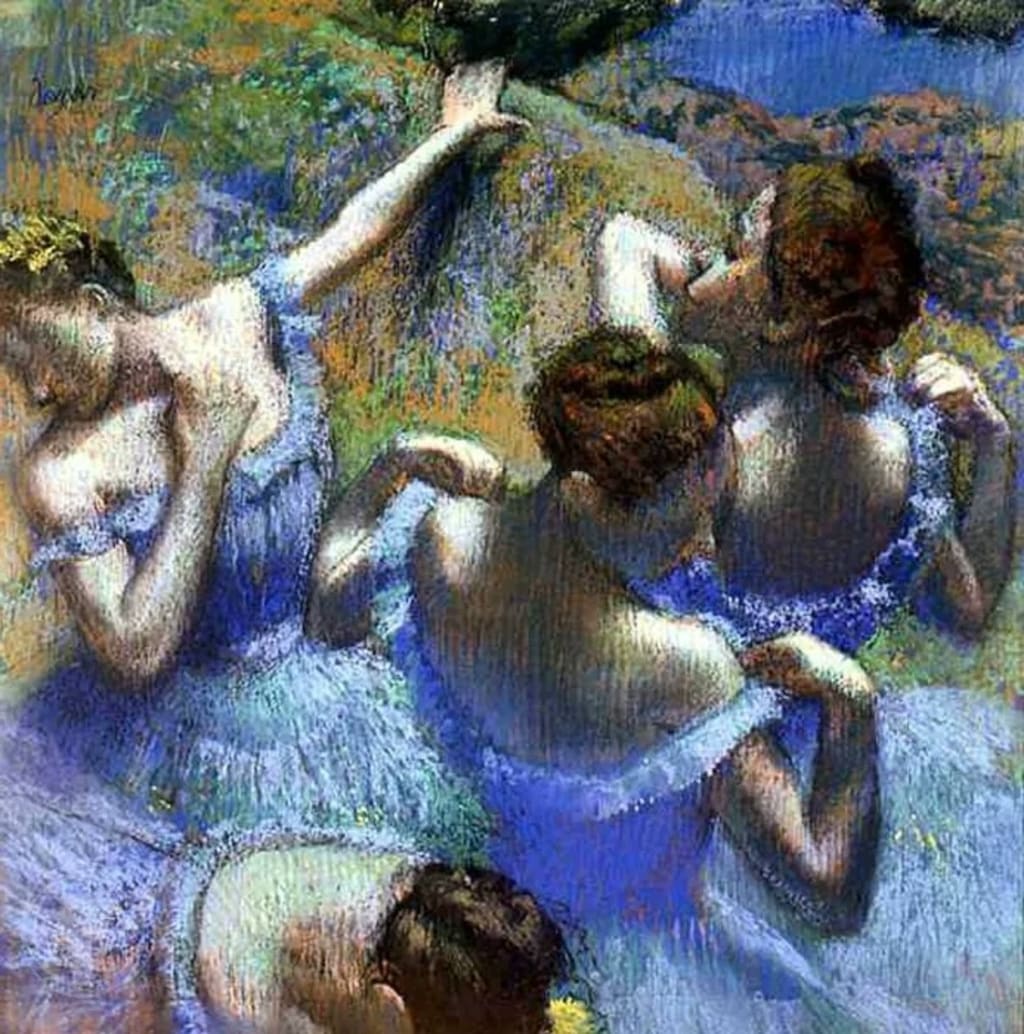
A poetic reimagining of Edgar Degas’ 1897 masterpiece “Blue Dancers” — where movement, memory, and emotion entwine in the quiet elegance of rehearsal.

Title: Whispers in Blue: The Story Behind Degas' Dancers
The rehearsal room was hushed, though not silent. The wooden floor creaked like the hull of an old ship. Dust drifted lazily through the late afternoon light, golden and tired as it spilled through the high windows. In a quiet corner of the room, Edgar Degas sat still, eyes half-lidded, sketchbook on his lap, his gaze fixed on the blue.
Four girls stood like petals of the same flower—slightly apart, yet turning toward a shared center. They moved in rhythm not to music but to memory, to instinct, to an echo of a piano long since gone quiet.
The girl nearest to Degas was Clara—barely seventeen, her limbs wiry from years of training. Her hands fluttered as she adjusted the bow at her waist. She was always adjusting, always correcting, never quite sure she belonged. Her mother had once danced here, long ago, before love and illness claimed her bones. Clara bore that legacy like a bruise beneath the skin.
Next to her, Elise brushed invisible dust from her tutu. Her fingers, pale and slender, betrayed a nervous energy. Elise had come from the provinces with a letter of recommendation and a dream stitched into her bodice. She danced with the desperation of someone who knew this stage might be her only one.
Behind them, Camille stretched her arms above her head, her eyes closed in the grace of a swan. She was the quiet one, the one who never laughed too loud or cried too long. She danced as if gravity did not apply to her, as though her body remembered flight.
And then there was Margot.
Margot was the sun around which the others turned—unknowingly, perhaps unwillingly, but inevitably. Her movements were effortless, her form a study in balance and breath. She was not the most technical dancer, nor the most disciplined, but she possessed that rare thing: presence. When Margot danced, time bowed before her.
Degas had sketched these girls before. Many times. He knew their backs better than their faces, their poses better than their postures at rest. He was drawn to the moments before the performance—the lull between sweat and spectacle, the grace that came not from choreography, but from the simple act of being.
Today, he painted them in blue.
Not the vivid blue of summer skies, nor the somber blue of a storm. No, this was the blue of velvet shadows and soft silence—the color of reflection and breath held in anticipation.
The rehearsal had ended an hour ago, but they lingered, as dancers often did, caught in the gravity of their shared devotion. They talked softly—about slippers worn thin, instructors too harsh, the ache in their hips and the dreams in their chests. Their voices wove around each other like ribbon.
Clara watched Margot out of the corner of her eye. She envied her, but it was a gentle envy—like watching a bird take flight and knowing your wings were still growing. “Do you ever get scared?” she asked.
Margot smiled faintly, as if remembering something far away. “Always,” she said. “But I dance through it.”
Degas made no sound, but his pencil moved quickly, hungrily. He wanted to capture that—not the fear, but the dancing through it.
Camille, noticing him, lowered her arms and turned ever so slightly away. “Monsieur Edgar,” she said quietly, “you always catch us at our most tired.”
He smiled, without lifting his head. “That’s when you’re most real.”
They laughed, a little. It was a sound like bells dropped into water—delicate, muffled, fleeting.
He had painted them many times—sometimes in oils, sometimes in pastels. Sometimes only in memory, days later. He did not ask them to pose. He let them exist and tried to keep up.
Blue was the only color that felt right for today.
It softened the edges. It held their forms together, like a binding spell. The dresses floated, the bows curled, the necks bent like lilies under moonlight. There was no spotlight here, no stage. Only the hush of dreams rehearsed in half-light.
The girls gathered their things eventually. Time crept forward, as it always must. They stepped out into the Paris dusk, their shadows long and overlapping. They would return tomorrow, and the day after, until their bodies no longer obeyed or the world found some other use for them.
Degas remained, his brush sweeping the last curve of a shoulder, the final whisper of tulle.
He didn’t paint ballerinas for the stage, for the sparkle and adoration. He painted them because they were metaphors—for fragility and fight, for beauty forged in silence, for the small acts of grace that happen away from the curtain.
Blue Dancers wasn’t a portrait. It was a memory. A quiet ballet in a world that moved too quickly.
And maybe, just maybe, it was a prayer—that these girls, with their aching feet and quiet fears, might one day know how radiant they looked, even when they weren’t looking.
About the Creator
Soul Drafts
Storyteller of quiet moments and deep emotions. I write to explore love, loss, memory, and the magic hidden in everyday lives. ✉️
Reader insights
Outstanding
Excellent work. Looking forward to reading more!
Top insights
Easy to read and follow
Well-structured & engaging content
Excellent storytelling
Original narrative & well developed characters
Expert insights and opinions
Arguments were carefully researched and presented
Eye opening
Niche topic & fresh perspectives
Heartfelt and relatable
The story invoked strong personal emotions
Keep reading
More stories from Soul Drafts and writers in Art and other communities.
More Than a Painting: The Story of Madonna Litta
Title: The Silent Bond – A Story Inspired by Leonardo da Vinci’s “Madonna Litta” In the stillness of a Renaissance room, where the light barely dances across the stone floor and the heavy curtain parts to reveal the sky, a young woman cradles her child. Her gaze is soft, her expression serene, yet beneath the tranquility, there is an unspoken intensity — a bond beyond words, brushstrokes, or time. This is the world captured in Leonardo da Vinci’s “Madonna Litta,” a painting as enigmatic as it is tender.
By Soul Drafts7 months ago in Art
What Voice Cloning Technology Means for Creators and Digital Identity
The rise of artificial intelligence has reshaped the creative landscape in countless ways, from AI-generated visual art to automated music composition, and one of the most intriguing frontiers today is voice cloning. With tools that let users clone your voice using only a short sample of speech, creators and digital communicators are discovering new ways to produce audio content that feels natural and expressive.
By aliyashahzadi5 days ago in Art



Comments
There are no comments for this story
Be the first to respond and start the conversation.