
More Than a Painting: The Story of Madonna Litta
A Fictional Journey into the Mind of da Vinci and the Mysterious Muse Behind His Iconic Painting

Title: The Silent Bond – A Story Inspired by Leonardo da Vinci’s “Madonna Litta”
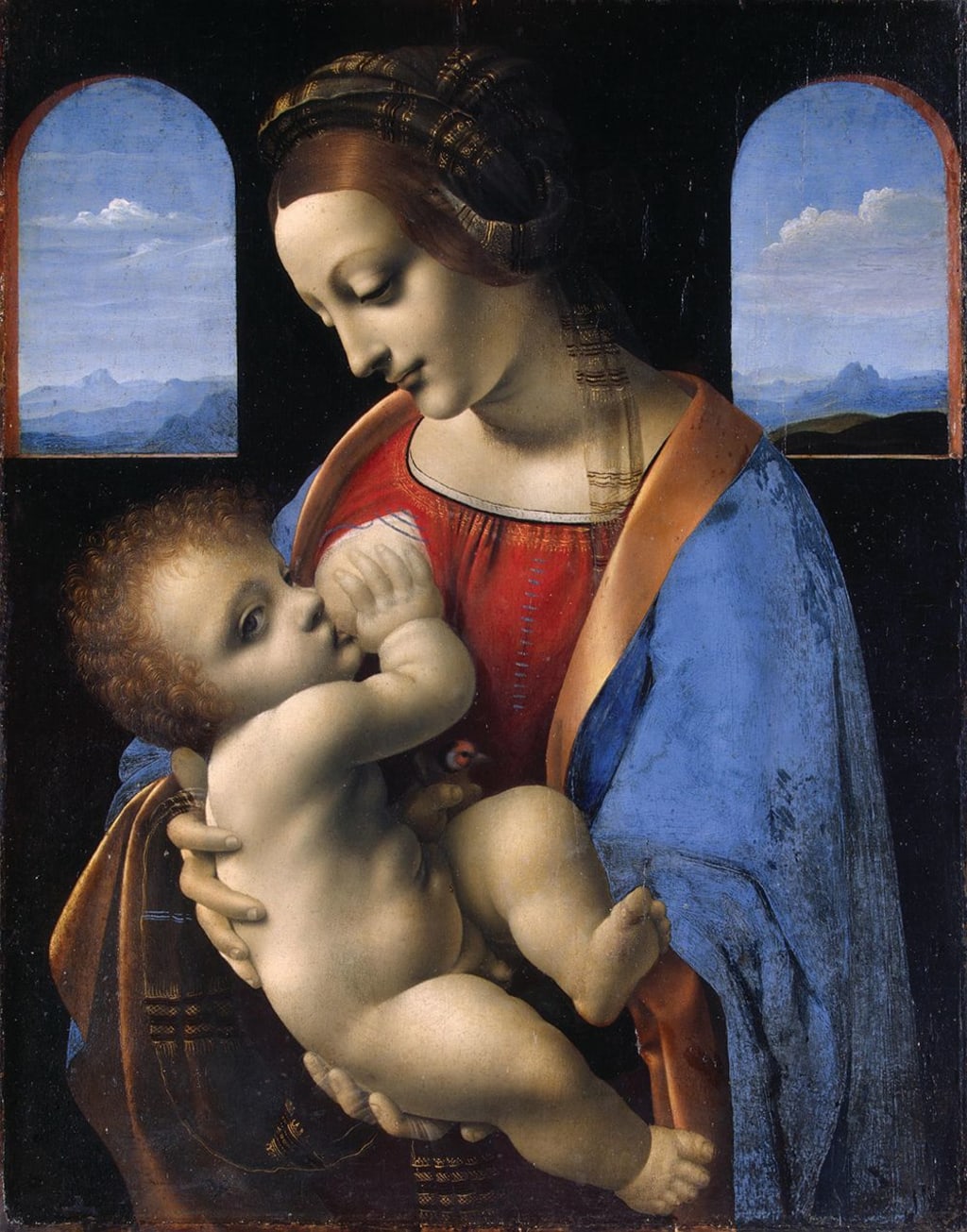
In the stillness of a Renaissance room, where the light barely dances across the stone floor and the heavy curtain parts to reveal the sky, a young woman cradles her child. Her gaze is soft, her expression serene, yet beneath the tranquility, there is an unspoken intensity — a bond beyond words, brushstrokes, or time. This is the world captured in Leonardo da Vinci’s “Madonna Litta,” a painting as enigmatic as it is tender.
Painted around 1490–1491, likely during Leonardo’s years in Milan, “Madonna Litta” depicts the Virgin Mary breastfeeding the infant Christ, a common theme in Christian iconography. But in Leonardo’s hands, it transcends the symbolic and enters the realm of deeply personal human experience. And yet, despite the layers of emotion infused into the painting, the story behind it remains cloaked in mystery — and, perhaps, myth.
Let us imagine, then, a story.
The Milanese Court, 1491
The winter was mild that year, though the stone corridors of the Sforza court still held onto their chill. Duke Ludovico Sforza, known as Il Moro, was building his legacy not just through politics and war but through art. His court had become a sanctuary for thinkers, architects, musicians, and painters. Among them stood Leonardo da Vinci — a man whose hands never ceased sketching, whose mind was never still.
It was during this time that Leonardo, ever curious about anatomy and emotion, began a study not of nobility or myth, but of motherhood. He had seen mothers in the market, watched their instinctual gentleness, the way their bodies curved toward their children. He wondered: could art ever truly capture that moment of sacred intimacy?
In a modest home outside Milan, a young woman named Lucia lived quietly with her newborn son. She had once been a lady-in-waiting, known for her calm spirit and luminous beauty. Her life had taken a quieter turn, far from the whispers and expectations of court. When Leonardo met her — through a midwife he sketched for anatomical studies — he saw in her not just a model, but a presence. Lucia agreed to sit for him, not out of vanity, but because she sensed in Leonardo a reverence that had nothing to do with flattery.
Days turned into weeks. In a softly lit studio, with windows high and dust motes catching the morning light, Leonardo painted. Lucia would come with her child, and together they would sit in silence. The baby, restless at first, would grow still in her arms, lulled by her heartbeat, her warmth, the gentle rise and fall of breath.
Leonardo observed everything — the slope of her neck, the arch of her hand as it supported the child’s head, the half-smile that lingered on her lips even in her weariness. But most of all, he watched the gaze. That unbreakable thread of love between mother and child. It was not something he could fully explain in words. It was something he would have to show in paint.
The Painting
In “Madonna Litta,” Mary is dressed in rich crimson and deep blue, colors of sacrifice and divinity. Her veil, drawn delicately over her hair, speaks of modesty and grace. But it is her face — youthful, focused, inward — that holds the viewer. Her eyes are not looking at the child, but through him, as if contemplating a future that only she can sense. The Christ child, chubby and alert, feeds eagerly, grasping at her robe. He is no ethereal figure here, no golden-haloed abstraction, but a real child, hungry, alive, human.
Behind them, arched windows open to a clear, mountainous landscape — perhaps a reminder of the divine beyond the domestic. Or perhaps, like much of Leonardo’s work, it symbolizes the coexistence of nature and humanity, the eternal and the immediate.
While the painting is sometimes debated in attribution — with some suggesting it may have been completed or touched up by Leonardo’s student Giovanni Antonio Boltraffio — the design and essence bear Leonardo’s unmistakable touch. The intimacy, the anatomical precision, the spiritual undertones without overt religious symbolism — all hallmarks of the master.
Legacy and Interpretation
For centuries, “Madonna Litta” has stirred the hearts of those who view it. Though now housed in the Hermitage Museum in St. Petersburg, the painting continues to speak in a universal language. It doesn’t need Latin inscriptions or dramatic gestures. The emotion is quiet, yet profound.
Some art historians suggest the painting is less about theological doctrine and more about the sanctity of motherhood itself. In an age where Madonna images often emphasized divinity at the cost of humanity, Leonardo turned the tide. His Virgin is not remote or regal — she is real, tender, infinitely strong in her softness.
This subtle revolution in religious art — the shift toward emotional realism — would ripple through Renaissance painting, influencing generations. And it began here, with a mother, a child, and a man obsessed with capturing truth through beauty.
The Story That Lives On
Whether Lucia truly existed as described, or whether she was a figment of Leonardo’s imagination, we may never know. But in the “Madonna Litta,” she — and every mother like her — lives eternally.
This is not just a portrait. It is a moment carved out of time, a meditation on love, sacrifice, and the divine made flesh. It reminds us that even the greatest of stories — the rise of kings, the miracles of prophets — begin in the arms of a mother, in the quiet miracle of life being nourished.
Leonardo, always seeking to understand the cosmos, found his universe in a single gaze between mother and child.
And that gaze still meets ours, more than 500 years later.
About the Creator
Soul Drafts
Storyteller of quiet moments and deep emotions. I write to explore love, loss, memory, and the magic hidden in everyday lives. ✉️
Reader insights
Good effort
You have potential. Keep practicing and don’t give up!
Top insights
Easy to read and follow
Well-structured & engaging content
Eye opening
Niche topic & fresh perspectives
Heartfelt and relatable
The story invoked strong personal emotions
Keep reading
More stories from Soul Drafts and writers in Art and other communities.
The Silence Behind the Pearl
The Silence Behind the Pearl They called her Griet, though no one really knew if that was her name. In the narrow alleyways of Delft, where cobblestones held the whispers of merchants and painters alike, her face became legend long before anyone knew her story. And yet, it was never her voice they remembered. Only the way she looked back over her shoulder—caught between movement and stillness—her lips slightly parted, her eyes questioning, a single tear-shaped pearl catching the dim, filtered light.
By Soul Drafts7 months ago in Art
The Best Philosophy in the World Is the One You Can Live
Ask ten philosophers what the best philosophy in the world is, and you will receive at least ten different answers—possibly delivered with footnotes, counterarguments, and mild contempt for the other nine. This disagreement is not a flaw of philosophy; it is its essence. Philosophy was never meant to be a universal prescription handed down like a rulebook. It exists to help human beings live better lives. By that standard, the best philosophy in the world is not the most elegant or complex—it is the one that can be lived.
By Fred Bradford4 days ago in Art
The River and the Drops
High in the mountains, where no one watched and no one applauded, tiny drops of water slipped from melting snow. Each drop was small, almost invisible, and carried a quiet fear within itself. They began their journey without knowing where they were going, only knowing that they were moving away from where they began.
By Sudais Zakwan7 days ago in Art
Silver Screen Magic with Mae West
American actress and singer Mae West became a popular film actress during the Great Depression. She started entertaining in vaudeville, then performed on Broadway, and finally went to Hollywood. She signed up with Paramount Pictures and made her debut in the 1932 film “Night After Night.” She also starred in musicals, comedies, and crime dramas. The American Film Institute named her one of the best classic Hollywood actresses.
By Rasma Raisters6 days ago in Geeks


Comments
There are no comments for this story
Be the first to respond and start the conversation.