
Noises in the scene
Activism in Brazilian contemporary art

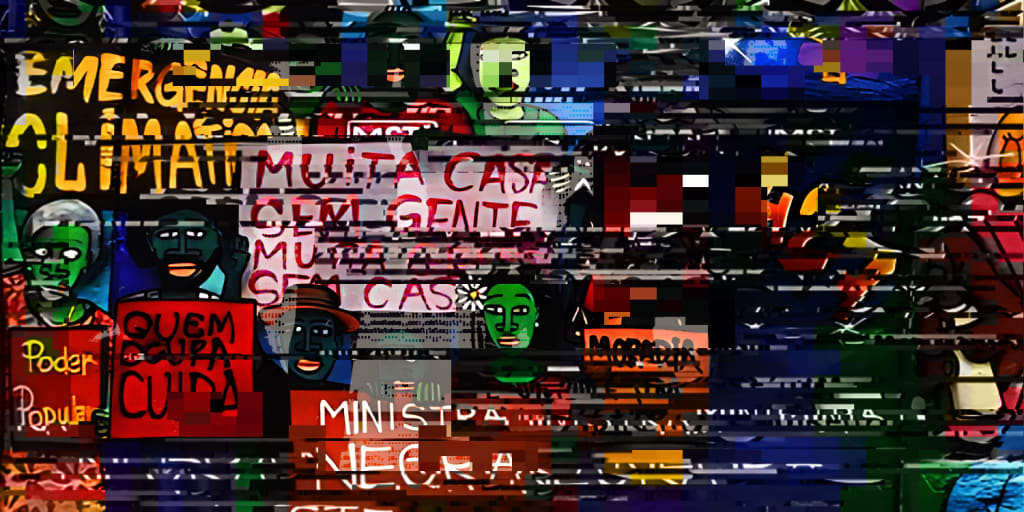
“The challenge to grand, unifying narratives and the centralized discourse of a universal art has extended to other marginalized groups, who have begun to redefine their place in the globalized cultural exchange. [...] these artists use their marginalized status as a starting point to create works that attest to the diversity of their sources and affirm their evolving identities.”
— Maria Melendi in ‘Estratégias da arte em uma era de catástrofes’
New perspectives on issues that directly impact the society can bring art closer to a larger and more diverse audience, even if it was once confined to exclusive spaces. In a marginal condition in the face of globalization, Brazilian artists are increasingly gaining ground and making their voices heard on a larger scale. The professional activities and works of these cultural agents are often permeated by a notion of 'sub-citizenship' (or the now less used term 'Third World citizenship), a factor that directly influences artistic production. In this context, the debate between public and private and the universalization of basic rights, such as access to housing, emerge as recurring themes. The following works, 'Fósseis' by Walla Capelobo and 'Persianas' by R. Trompaz, establish a reflective space through artistic intervention and the production of activist discourse in the face of social barriers encountered in the artists' personal lives, yet also present in the lives of many others who do not have the opportunity to achieve such eloquent expressions about major social problems.
Hacking the land
Congonhas, a small city in the central region of Minas Gerais State, southeastern Brazil, is part of a mining industry hub, an economic activity present in the state since the beginning of colonization, influencing its own name. Among other minerals, iron is found in abundance there, and more specifically in the cities of the region, directly influencing the local economic and social dynamics. In this scenario, Walla develops a multifaceted work that begins with the dissemination of groundhog kilns. The occupation of the land through local, family and small-scale productive activities empowers the inhabitants of the region who are constantly confronted with the expansion of the interests of large mining corporations. The artist from Minas Gerais, together with the inhabitants of the region, forges in these furnaces made in the soil her series 'Fósseis' [Fossils], using congonha leaves as a mold, an abundant shrub in the region and which the native people referred to as "that which feeds".
"The metal [iron or steel] itself possesses little art history. What associations it possesses are those of this century: power, structure, movement, progress, suspension, destruction, brutality."
— David Smith in ‘David Smith’ exhibition catalog, MoMA, 1957.
By subverting the conventional use of materials, Walla accelerates the natural process of fossilization, transforming congonha leaves into iron objects through the use of ceramic kilns. These objects are then buried throughout the region, creating a biological aesthetic and advocating for ecological balance. Through the use of iron, the artist establishes a rich interplay between material, form, and context, fostering a sense of conservation and sustainability. This work, which bridges land art, performance, and sculpture, creates a strong connection with the local community, promoting an active use of the land through art and offering unique perspectives. It challenges the conventional large-scale, expensive production art that usually modifies the landscape.
“A vernacular land art might include commemoration that looks to the smaller scale, land-based notions of nature, remembering small farms and common lands, the disappearing histories of places and ecosystems.”
— Lucy Lippard in ‘Undermining’.
In addition to its rich conceptual framework, both in the final object and the conceptual process, the work also reveals irony, challenge, and a dystopian vision. However, it does not abandon the classical art endeavour of building memory. The communicative nature of the work is most evident in the experience of the local inhabitants, as compared to photographs of artwork, a practice essential for the dissemination, appreciation, and preservation of land art and performance.
Urban Interference
R. Trompaz's work invites reflections on segregation, urban life, and housing policies. The city, territory where modernity has taken shape, continues to evolve, absorbing technological innovations and their impacts on the relationships between its inhabitants.
“[...] there is a kind of "dematerialization" of urban references, which accompanies new citizen perceptions, in such a way that a city of time is superimposed on the city of space, thus impregnating citizens' representations of contemporary subjectivity.”
— Armando Silva em ‘Imaginários, Estranhamentos Urbanos’
Starting with urban cues such as skylines, facades, architectural perspectives, and other elements, the São Paulo-based artist takes us on an investigative and symbolic journey through his work, flirting with abstraction and revealing an intense visual research. His expressive, monochromatic compositions are based on blinds, a type of curtain that mediates the relationship between interior and exterior, public and private, according to the needs of those inside. The intense expressiveness of his strokes, covering the entire surface and creating dynamism between figure and ground, incites a perceptual play. The gestural quality of his pictorial language suggests a deep exploration, and the results of his discoveries are honestly transposed onto the support. Thus, the serial nature of 'Persianas' encourages the viewer's participation in the creative process, through the continuous observation of the development of his symbols and visual repertoire. Moreover, these works together demonstrate the artist's commitment to developing a confrontational, innovative, and urban expression. Without distancing himself from the attitude of an authentic form of urban expression, such as 'pixo' (a kind of grafitti, very popular in Brazil), Trompaz paints not on walls, as if seeking to sensitize solid and immutable interfaces, but rather inside and outside of blinds, the eyelids of windows.
“There is a point where artists too must take some responsibility for the things and places they love, a point at which the colonization of magnificent scenery gives way to a more painfully focused vision of a fragile landscape and its bewildered inhabitants.”
— Lucy Lippard in ‘Undermining’
About the Creator
Bruno Bispo
Passionate about advertising, design and art. You can read some of my writings about this subjects in English here on Vocal. If you prefer, read it in Portuguese here.
Keep reading
More stories from Bruno Bispo and writers in Art and other communities.
The Best Philosophy in the World Is the One You Can Live
Ask ten philosophers what the best philosophy in the world is, and you will receive at least ten different answers—possibly delivered with footnotes, counterarguments, and mild contempt for the other nine. This disagreement is not a flaw of philosophy; it is its essence. Philosophy was never meant to be a universal prescription handed down like a rulebook. It exists to help human beings live better lives. By that standard, the best philosophy in the world is not the most elegant or complex—it is the one that can be lived.
By Fred Bradford6 days ago in Art
When the Artist Becomes the Art
We like to think we can separate the art from the artist, but can we, really? Art is born from the same place as sin. It mainly emerges from conflict: between what is felt and what is permitted, between the self that is lived and the self that must be hidden. No figure embodies this tension more vividly than Oscar Wilde: a man who transformed his own contradictions into style, wit, and devastating clarity. His novel The Picture of Dorian Gray is not merely a tale of aesthetic decadence but the battleground on which this question is fought.
By Yasmine Lagrasabout 20 hours ago in Art
A Dart at Dusk
Seconds ago, the sullen sun set on the two of us… my exuberant furry companion and me. A fresh breeze embraces us, delivering welcome relief from the day’s oppressive heat. His typical stumbling and staggering along — apace with a sloth — has turned into trip-trapping, high-stepping, almost skipping along.
By Angie the Archivist 📚🪶7 days ago in Petlife



Comments
There are no comments for this story
Be the first to respond and start the conversation.