
When Gods Fell From the Sky Rubens and the Violent Beauty of the Fall of the Titans
A Cataclysm Caught in Oil and Canvas
It isn’t just a painting. It’s a cosmic catastrophe rendered in muscle, marble, and movement.
Peter Paul Rubens’ The Fall of the Titans is not simply a mythological scene. It’s an explosion of ambition, a swirling tempest of rebellion, punishment, and divine chaos. Stretching across massive canvases, Rubens didn’t just paint a moment — he painted a myth colliding with mortality, order strangling anarchy, and beauty erupting through terror.
But why did Rubens choose this moment? And what does this fall — so brutal, so balletic — really say about the gods, about us, and about power itself?
Let’s step into the underworld.
The Myth: A War for the Heavens
Before the Greek gods we know — Zeus, Hera, Athena — there was another order: the Titans. Children of Uranus and Gaia, they ruled the cosmos until one of their own, Cronus, overthrew his father and took the throne.
But power never rests.
When Cronus learned his son Zeus would one day do the same to him, he devoured all his children. Except one — Zeus survived, grew, and rebelled. He freed his siblings and led a decade-long war: the Titanomachy.
It ended with thunder. The Olympians won, the Titans fell. Imprisoned in the deepest part of the underworld, they were sealed beneath Mount Othrys. Cosmic reshuffling, divine overthrows — mythology’s first revolution.
And Rubens, centuries later, gave it color, shape, and fury.
The Artist: Rubens as Mythmaker
Rubens was not a quiet painter. He was a master of motion — of bodies tumbling, twisting, triumphing. In the 17th century, his canvases burst with energy at a time when Europe’s own political and religious wars were reshaping the continent.
When Rubens took on The Fall of the Titans, he wasn’t just telling a story from Hesiod or Ovid. He was painting power — what it does, what it breaks, and who gets to wield it.
And in typical Rubens fashion, he went big.
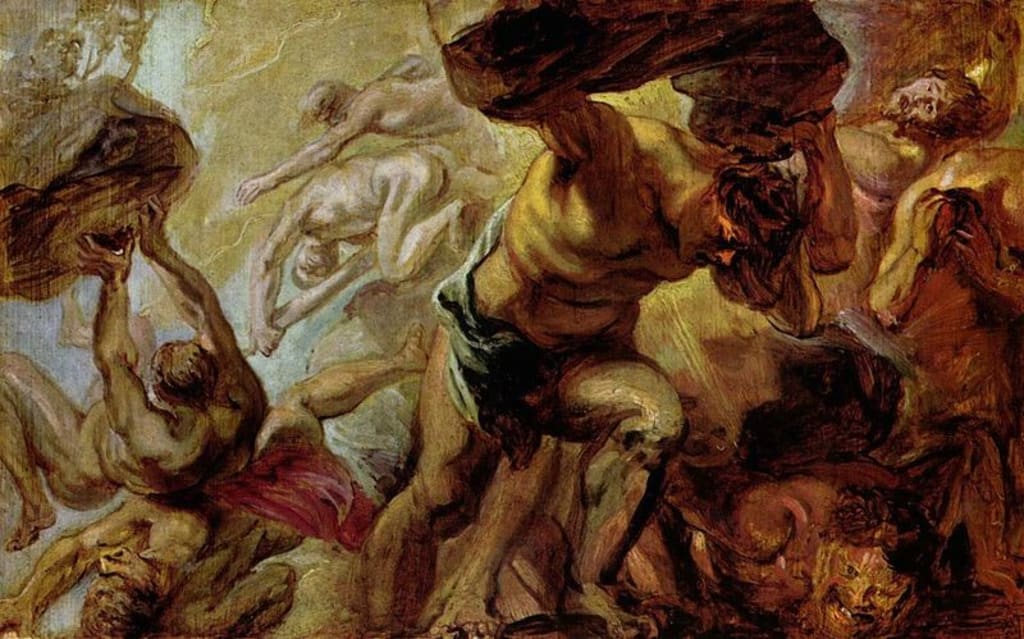
The painting (technically a sketch for a planned cycle) brims with nearly nude Titans falling in every direction — crushed by boulders, pierced by light, suffocated by divine wrath. It’s a composition so dense with flesh and flame that you almost can’t find a resting point.
And that’s the point: this isn’t meant to be calm. It’s chaos controlled.
Anatomy of a Fall: What’s Happening in the Painting?
At first glance, it’s a spiral — bodies twisted and stacked like a divine avalanche.
But look closer.
• Top of the canvas: Light rains from above — the realm of Olympus, barely visible. Thunderbolts crack the sky. You don’t see Zeus, but you feel him in the violence.
• Middle: Titans crash into one another — muscles tensed, mouths open in screams. Some reach upward, clawing at their fate. Others collapse, their expressions frozen in disbelief. These were once gods. Now, they’re debris.
• Bottom: Darkness swallows them. A chasm yawns open. You’re staring into Tartarus itself — the mythic prison that makes hell seem hospitable.
The scale is overwhelming, but Rubens choreographs the fall like a symphony. It’s not random. It’s myth shaped by the painter’s hand, rhythmically tumbling in crescendo.
Symbolism: What Rubens Is Really Saying
At its core, The Fall of the Titans is about the cost of rebellion — but also the inevitability of power shifting.
Rubens, painting in an era of divine right monarchies and Catholic absolutism, may have been echoing a warning: challenge the throne, and you will be crushed. This would be a fitting message for courts and cardinals who commissioned him.
But perhaps, beneath that, there’s a deeper, more radical truth: no power lasts forever.
The Titans ruled. Then they fell. The Olympians rose. And in turn, even they would be challenged by mortals — heroes, philosophers, and ultimately, time itself.
Rubens paints not just gods, but the life cycle of empires.
A Modern Lens: Why It Still Hits Hard
We live in an era of institutional mistrust, toppling monuments, and revolutions — cultural, political, technological. The idea of once-untouchable giants falling feels… timely.
Rubens’ painting becomes more than myth. It becomes metaphor.
Think of:
• CEOs dethroned by scandal.
• Governments collapsing under their own weight.
• Artistic elites challenged by digital creators.
The Fall of the Titans reminds us: those on top today can crash tomorrow — violently, beautifully, publicly.
And sometimes, that fall is necessary for a new world to rise.
The Flesh of Rebellion: Rubens’ Obsession with the Body
Rubens’ Titans aren’t ethereal. They’re built like marble gladiators — each muscle sculpted with surgical precision.
Why? Because in Rubens’ world, the divine is physical. The soul is expressed through the s inew. Emotion is shown in flesh.
This ties back to Renaissance ideals, where the body wasn’t just a vessel but a language. Rubens speaks that language fluently. In his Titans, pain isn’t symbolic — it’s anatomical. You feel it in the tendons, in the weight, in the fall.
Legacy: The Titans Still Fall
Rubens’ vision influenced generations. Later artists — from Géricault’s Raft of the Medusa to the cinematic battle scenes of Zack Snyder — owe something to his orchestration of collapse.
In fact, The Fall of the Titans continues to be referenced not only in art but in fashion campaigns, comic book mythology, and even political cartoons.
Because the story never stops being relevant. There are always Titans. There are always rebels. And there’s always someone watching from above — ready to send the next thunderbolt.
Why This Painting Still Matters
Art isn’t just decoration. It’s prophecy. It reflects the power struggles of its age and antic ipates the ones to come.
Rubens painted gods in freefall, but he also painted us — our ambitions, our hubris, our losses. His brush gave myth blood and thunder, not just for beauty, but for truth.
And as long as there are giants in the world — literal or symbolic — The Fall of the Titans will remain not just a painting, but a warning, a story, a mirror.
About the Creator
Zohre Hoseini
Freelance writer specializing in art analysis & design. Decoding the stories behind masterpieces & trends. Available for commissions.
Keep reading
More stories from Zohre Hoseini and writers in Art and other communities.
Dog Shoes for Small Dogs and Puppy Shoes A Practical, Paw-Friendly Guide
Small dogs and puppies may look tough, but their paws often need more protection than people realize. Their bodies are lighter, their paws are smaller, and many of them spend a lot of time on surfaces that were never designed for delicate paw pads. Add cold sidewalks, hot pavement, rough gravel, wet grass, or even slippery indoor floors, and you start to see why dog footwear has become more than just a cute trend.
By aliyashahzadi4 days ago in Art
So You Decided To Become a Nurse Practitioner:
So you decided to become an "Advanced Practice" nurse. Congratulations!... is what I would say if this was a good idea. Grad school? In this economy? What were you thinking? Likely it was something along the lines of either 1) “I've seen these other chucklefucks do it— Why can't I?” or even 2) “I've got a nice career, I should shake it up. I miss feeling like I have no clue what I'm doing.”
By Sandor Szabo4 days ago in Fiction




Comments (1)
This article really makes Rubens' painting come alive. It's fascinating how he took this myth and turned it into a visual spectacle. I wonder how he decided which moments of the Titanomachy to focus on. And considering the chaos in the painting, how did he manage to give it such a sense of order and movement? It makes me want to see the actual work.