
The Secret History of Fashion as Art: From Versailles to the Met Gala
The Turning Points That Redefined What We Wear
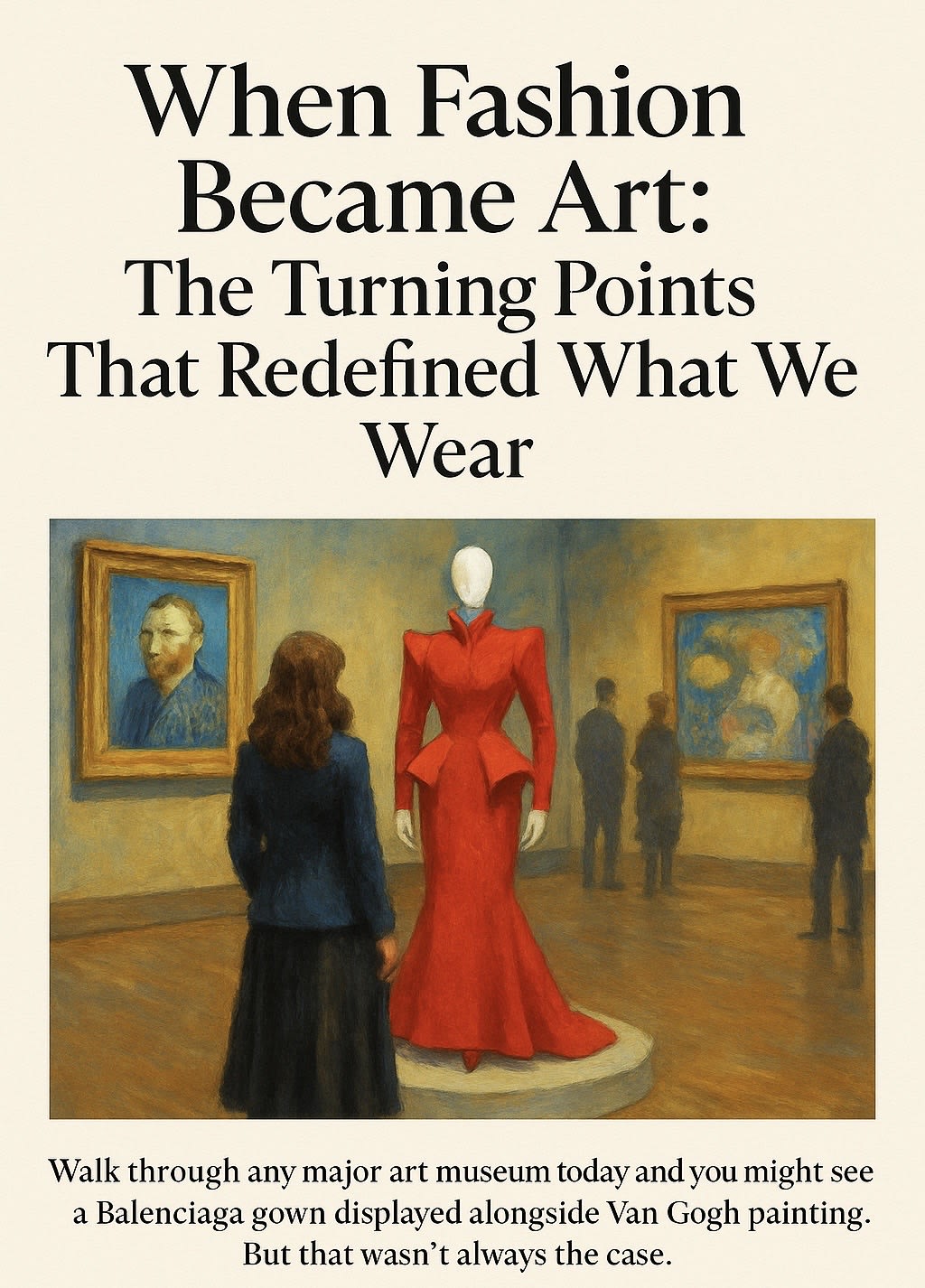
Walk through any major art museum today and you might see a Balenciaga gown displayed alongside a Van Gogh painting. But that wasn’t always the case.
For centuries, fashion was seen as craft — beautiful, yes, but practical, frivolous, even vain. Only in the last century has it stepped into the same room as “high art,” demanding intellectual attention, cultural analysis, and critical respect. So when did fashion stop being just clothes and start becoming a canvas?
The answer isn’t simple. It’s a timeline of aesthetic rebellion, cultural shifts, and visionary designers who used fabric the way painters use oil and poets use ink.
⸻
The Art of Adornment: From Function to Expression
In the ancient world, clothing signified status. Egyptian linen, Roman togas, or Chinese silk robes were all worn not just for utility, but to signal wealth, power, and culture.
But the modern idea of fashion — personal, seasonal, and artistic — didn’t truly take hold until the 18th century.
The French court under Louis XIV began to treat dress as a kind of theater. The king himself was known as the “Sun King,” not just for his politics but for his dazzling daily costumes. Fashion became performative. Visual. Symbolic.
Yet still: it was decorative, not intellectual. That would change.
⸻
The Birth of the Fashion Designer as Artist
Enter Charles Frederick Worth, mid-19th century. A British tailor working in Paris, Worth was the first to sign his garments like paintings. He staged fashion shows and treated garments as designed, not sewn. In doing so, he founded the first haute couture house — and reframed the designer as a creator, not a craftsman.
This wasn’t just needle and thread anymore. It was authorship.
⸻
The Avant-Garde Explosion: When Art and Fashion Collided
The 20th century brought disruption. Art movements like Cubism, Dada, and Surrealism spilled beyond canvas into everyday life — and fashion absorbed it like velvet.
• Elsa Schiaparelli collaborated with Salvador Dalí. A shoe became a hat. A lobster dress became scandal.
• Yves Saint Laurent in 1965 created the famous Mondrian dress, a literal homage to De Stijl painting, worn by women across Europe.
• Vivienne Westwood in the 1970s exploded punk fashion into anti-establishment political commentary.
These weren’t just garments. They were philosophies.
Fashion became statement. An act of rebellion, performance, even protest. It mirrored the chaotic beauty of 20th-century art.
⸻
Museums Take Note: The Institutional Turn
Perhaps the biggest turning point in fashion’s artistic rise came when museums — the great arbiters of cultural value — opened their doors to it.
• The Costume Institute at The Met, originally formed in 1946, gained mainstream attention with exhibitions like “Alexander McQueen: Savage Beauty” (2011), which drew over 600,000 visitors.
• Shows like “Camp: Notes on Fashion” or “Heavenly Bodies” proved fashion could ask the same questions as art: What is beauty? What is identity? What is truth?
Suddenly, a dress was not just fabric — it was a sculpture in motion. A narrative. A relic.
⸻
Designers as Philosophers
Modern fashion’s greats are not just stylists — they’re thinkers. Many come from art backgrounds. They quote theory. They study sculpture, film, architecture.
• Rei Kawakubo (Comme des Garçons) deconstructs the body with shapes that challenge form and gender.
• Iris van Herpen merges 3D printing with haute couture, building gowns that float like galaxies.
• Martin Margiela turned anonymity into aesthetic, rejecting the cult of the designer even as his influence grew.
They don’t just sell clothing. They explore human identity through cloth.
⸻
Fashion as a Mirror — and a Megaphone
In an age of fast media, fashion moves faster than almost any other visual language. A single look on a runway can spark viral debate, political critique, or social conversation.
Think:
• Beyoncé’s Afrofuturist Grammys looks.
• Billie Eilish redefining beauty standards on red carpets.
• Harry Styles blurring gender binaries with a Gucci lace gown in Vogue.
Fashion today is not just seen. It’s shared, memed, studied, dissected. It has become the most immediate form of visual commentary in the world.
⸻
So, Is Fashion Art?
That question — once controversial — now feels outdated.
Fashion isn’t just art. It is living art: kinetic, intimate, wearable. It expresses emotion and identity in ways sculpture never could. It evolves with culture, reacts to the times, and reflects our deepest longings and fears — all stitched into form.
From the courts of Versailles to the Met Gala, the catwalk to the museum wall, fashion has always been more than fabric. It’s how we write ourselves into the world.
⸻
Stay tuned for our upcoming article: “The Met Gala as Modern Myth-Making: Art, Costume, and Celebrity in the Age of Spectacle.”
About the Creator
Zohre Hoseini
Freelance writer specializing in art analysis & design. Decoding the stories behind masterpieces & trends. Available for commissions.
Keep reading
More stories from Zohre Hoseini and writers in Art and other communities.
The Best Philosophy in the World Is the One You Can Live
Ask ten philosophers what the best philosophy in the world is, and you will receive at least ten different answers—possibly delivered with footnotes, counterarguments, and mild contempt for the other nine. This disagreement is not a flaw of philosophy; it is its essence. Philosophy was never meant to be a universal prescription handed down like a rulebook. It exists to help human beings live better lives. By that standard, the best philosophy in the world is not the most elegant or complex—it is the one that can be lived.
By Fred Bradford5 days ago in Art
The River and the Drops
High in the mountains, where no one watched and no one applauded, tiny drops of water slipped from melting snow. Each drop was small, almost invisible, and carried a quiet fear within itself. They began their journey without knowing where they were going, only knowing that they were moving away from where they began.
By Sudais Zakwan7 days ago in Art
Silver Screen Magic with Mae West
American actress and singer Mae West became a popular film actress during the Great Depression. She started entertaining in vaudeville, then performed on Broadway, and finally went to Hollywood. She signed up with Paramount Pictures and made her debut in the 1932 film “Night After Night.” She also starred in musicals, comedies, and crime dramas. The American Film Institute named her one of the best classic Hollywood actresses.
By Rasma Raisters6 days ago in Geeks


Comments
There are no comments for this story
Be the first to respond and start the conversation.