
"The Tragedy of Hamlet, Prince of Denmark"
"A Prince's Descent into Tragedy"
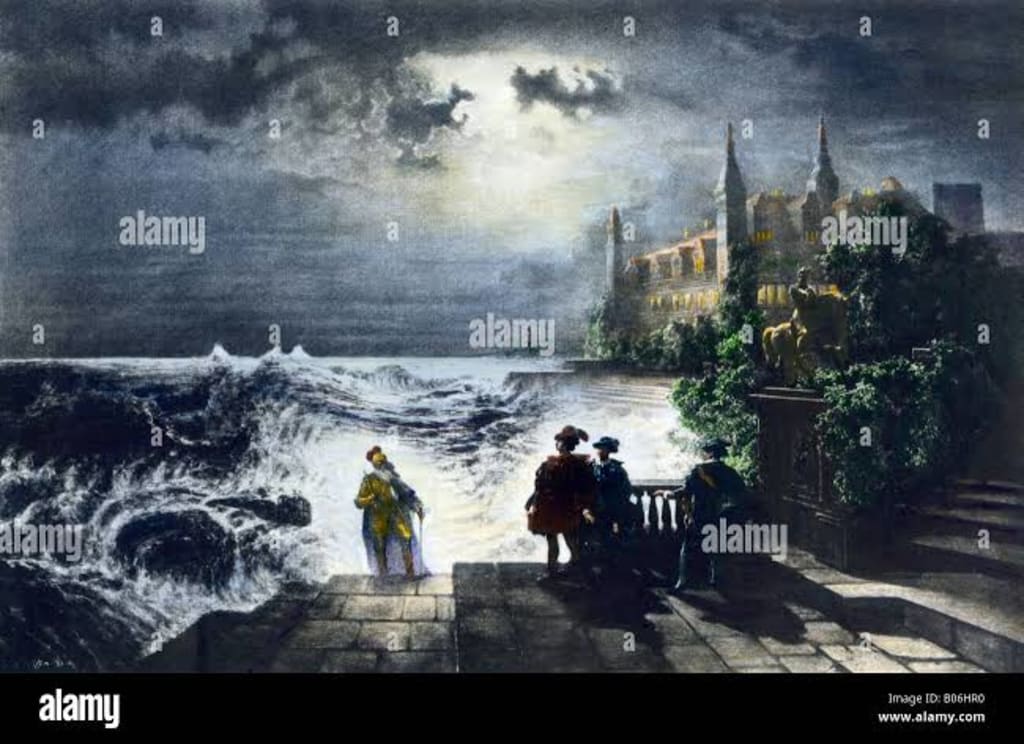
Hamlet: A Prince's Descent into Tragedy
In the cold halls of Elsinore Castle in Denmark, Prince Hamlet mourned his father, the late King Hamlet. Only weeks had passed since the old king’s mysterious death, yet Queen Gertrude, Hamlet’s mother, had already remarried. Her new husband was none other than Claudius—Hamlet’s uncle—who now sat on the throne. This sudden shift filled Hamlet with grief and suspicion. Something about his father’s death didn’t feel right.
Late one night, the ghost of the dead king appeared on the castle ramparts. Clad in armor, pale and silent at first, the ghost beckoned Hamlet to follow him. Once alone, it spoke. It was, indeed, King Hamlet’s spirit, and it told a horrifying tale: Claudius had murdered him by pouring poison in his ear as he slept. The ghost demanded justice—"Revenge my most foul and unnatural murder." With his heart pounding and mind reeling, Hamlet swore to avenge his father’s death.
But revenge, Hamlet knew, was not simple. He was thoughtful, philosophical, a man of conscience. While the ghost had spoken convincingly, what if it was a demon tricking him? He needed proof. To uncover Claudius’s guilt, Hamlet devised a plan. A troupe of actors visited Elsinore, and Hamlet asked them to perform a play that mirrored the murder of his father. As the staged poisoning unfolded before the court, Claudius stood up in distress and stormed out. Hamlet had his answer.
Despite the confirmation, Hamlet still hesitated. He knew that killing Claudius would be a sin, especially if Claudius was in prayer and might die forgiven. In this delay, Hamlet’s actions became erratic and confusing to those around him. People began to whisper of his madness—some believed it was caused by his love for Ophelia, daughter of the king’s advisor, Polonius. Others, like Claudius, feared that Hamlet knew too much.
One day, Hamlet confronted his mother in her chambers, and while speaking with her, he heard a noise behind a curtain. Thinking it was Claudius spying on them, he thrust his sword through the fabric—only to discover he had killed Polonius instead. The death sent shockwaves through the court. Ophelia, devastated by the loss of her father and confused by Hamlet’s behavior, descended into madness and eventually drowned, whether by accident or suicide, no one could say.
Claudius, now deeply afraid of Hamlet, sent him away to England with secret orders for his execution. But Hamlet outwitted his would-be killers and returned to Denmark.
Back at Elsinore, Ophelia’s brother, Laertes, returned in fury. Claudius, ever cunning, turned Laertes’s grief into a weapon. He proposed a duel between Laertes and Hamlet, but with a dark twist: Laertes would use a poisoned sword, and Claudius would prepare a poisoned drink as a backup.
The duel began before the court. Hamlet and Laertes fought skillfully, but in the chaos, both were wounded by the poisoned blade. Queen Gertrude, unaware of the plot, drank from the poisoned cup and died. As Hamlet realized the treachery, Laertes confessed everything. With his dying breath, Hamlet finally took his revenge and stabbed Claudius, forcing him to drink the rest of the poison.
As life faded from him, Hamlet turned to his loyal friend Horatio and asked him to tell the world the truth of what had happened. Then, with the words “The rest is silence,” Hamlet died.
Fortinbras, the prince of Norway, arrived soon after and took control of Denmark, finding a court of corpses and a nation in ruins. Hamlet was carried away as a fallen hero—not for his strength, but for the tragedy of his heart, torn between justice and conscience.
Themes and Meaning
This story is not just about revenge. It is about hesitation, morality, and the deep pain that comes from betrayal. Hamlet is not a hero of action, but a thinker—a man who knows that every decision comes with consequence. His downfall is not just the result of a corrupt court, but of a heart too heavy with questions no sword could answer.
About the Creator
Dog Shoes for Small Dogs and Puppy Shoes A Practical, Paw-Friendly Guide
Small dogs and puppies may look tough, but their paws often need more protection than people realize. Their bodies are lighter, their paws are smaller, and many of them spend a lot of time on surfaces that were never designed for delicate paw pads. Add cold sidewalks, hot pavement, rough gravel, wet grass, or even slippery indoor floors, and you start to see why dog footwear has become more than just a cute trend.
By aliyashahzadia day ago in Art



Comments
There are no comments for this story
Be the first to respond and start the conversation.