
"Behind the Pattern: A Descent into Madness"
"A Study of Confinement and the Female Psyche"
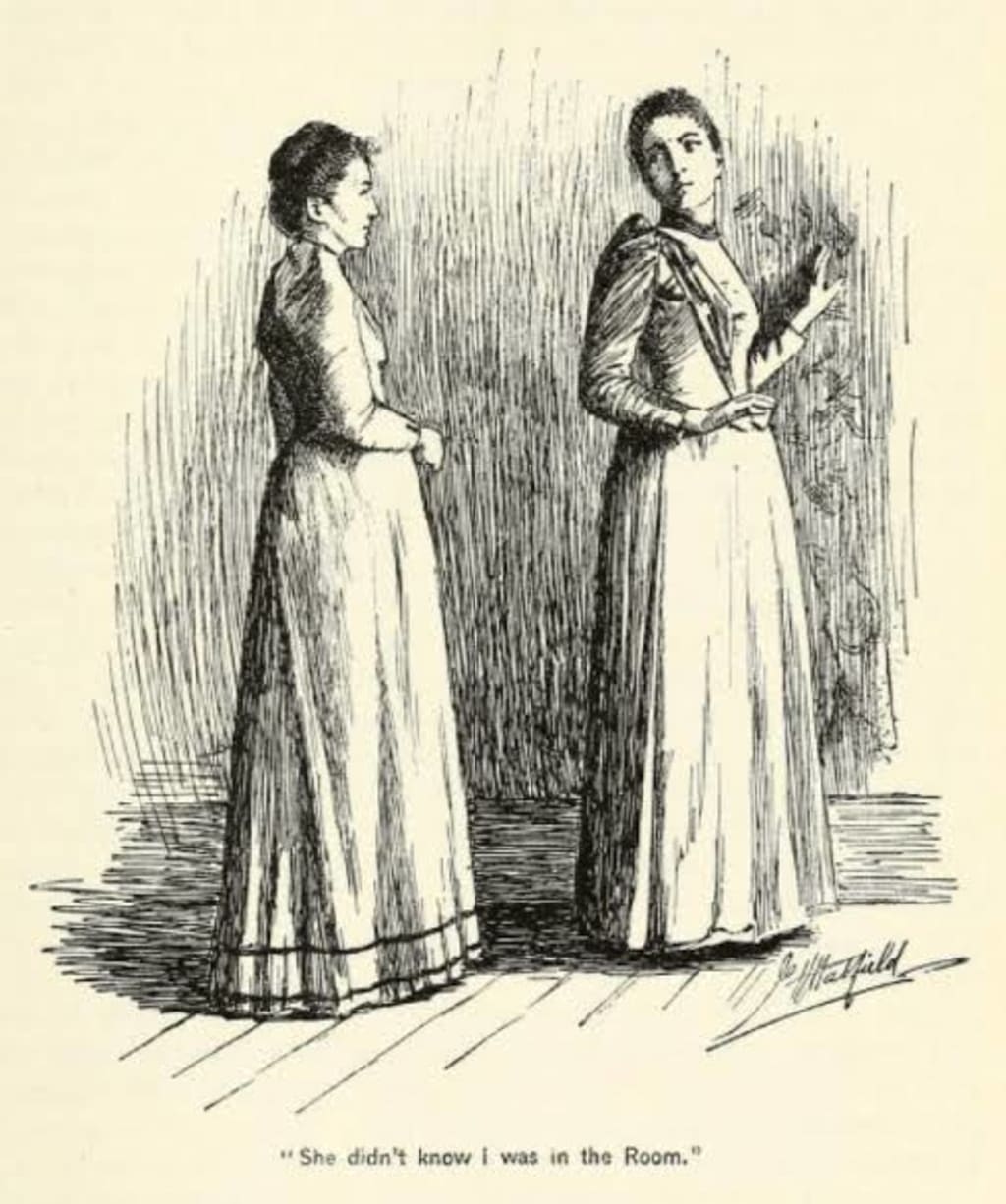
The house was too quiet.
Not the peace that settles gently over a room when the day ends, but a brittle, strained quiet that presses on the ears. Margaret noticed it first on the third day. The wind outside barely moved the lace curtains that hung over the tall windows, and even the floorboards, once fond of creaking under her steps, had gone still.
“I think the silence is getting to me,” she whispered to her journal. It was the only thing she was allowed to write in, though even that was frowned upon. Doctor Fenley said too much stimulation would disturb her nerves. And her husband, Thomas—he agreed. Of course he did.
The room she’d been placed in—“for rest,” they said—was on the third floor, far from the daily workings of the house. It had once been a nursery, judging by the small iron rings bolted into the walls and the faint chalk drawings on the wooden floor. Margaret tried not to look at those too long. They seemed to shift when she wasn't watching.
But it was the curtains that drew her.
Lace, delicate and aged, drooped heavily over the tall, narrow windows. The pattern was once elegant—floral vines and curling leaves—but now it was tattered and yellowed with age. When the sunlight came through, the shadows of the pattern splattered across the room like cobwebs, wrapping around the bedpost, creeping across the floor, even crawling up her arms as she sat quietly in the rocking chair.
She told Thomas about the shadows once. He laughed.
“It’s lace, darling,” he said. “Your nerves are playing tricks.”
But they weren’t. Margaret knew patterns. She was a painter before the baby came. Before the silence. Before they said she needed to be removed from the city, from the studio, from her own thoughts. They called it rest. She called it exile.
At night, the lace came alive.
In the darkness, the moonlight poured through the curtains, casting their patterns in sharp relief across the room. That was when she began to see the figures.
At first, it was just one. A woman—no, a shadow of one—trapped within the pattern. The lace caught her arms like thorns, held her hair in tight spirals, pressed against her face until she nearly vanished. Margaret watched her struggle night after night. She never moved beyond the curtain’s edge.
And then there were more.
Shapes twisting and turning in the fabric. Women, some with hair streaming like seaweed, others with mouths open in screams she couldn’t hear. Their bodies tangled in the vines, their hands pressed to invisible glass. Each time Margaret blinked, the shadows shifted. Each time she awoke, they had moved closer.
Margaret stopped sleeping. Sleep made her vulnerable. That’s what the woman in the curtain warned her.
By the second week, she no longer tried to reason with Thomas. He brought her tea and kissed her forehead like a child. He smiled in that way men do when they’ve already decided not to believe you.
The curtains whispered now.
They told her stories, in a rustling that danced just at the edge of understanding. Stories of women who had been locked away, “for their own good.” Women who were told to be quiet, to be still, to stop dreaming, stop painting, stop thinking. The curtains remembered them. They carried their shapes.
Margaret began tearing at the lace.
First with her fingers—delicate, respectful—picking at the threads like a careful seamstress. But the fabric was old, and soon the threads unraveled easily. She worked at them during the day, pretending to tidy up, folding them neatly into little bundles. By night, she stuffed the torn lace under the bed, behind the dresser, beneath the floorboards.
When Thomas found the windows bare, he was angry.
“What have you done?” he demanded. “You need the curtains. The light—too much light disturbs your rest.”
“No,” she replied. “The curtains disturb my truth.”
He had no answer to that.
By the third week, she no longer saw the shadows. Not because they were gone, but because she understood them now. They were not trapped women—they were warnings. Reflections. Each one had once sat in this very chair, stared at this very window. She was simply the latest in a line of watchers.
But she would not be watched.
When Thomas came up the stairs on the final day, she stood in front of the open windows, hair tangled, eyes wide. The breeze carried her voice clearly.
“I’ve set them free,” she said. “And I’m next.”
The wind fluttered through the empty window frame where the curtains had once hung. It moved like breath. Like wings.
Thomas reached for her, but Margaret didn’t flinch. She stepped back into the light, into the breeze, into the space where no pattern could hold her.
She had finally stepped beyond the lace.
About the Creator
Jim Sloan
By Brian D’Ambrosio At 90, Jim Sloan has lived several lifetimes’ worth of work—carpenter, sign painter, excavator, sawmiller, road-builder and the go-to rattlesnake remover of Galisteo, New Mexico. Art may be the through-line, but it has never been the source of his income, nor the center of his universe. Sloan has always kept one foot in the studio and the other in the soil, without bothering to decide which world he truly belongs to. The truth is that he fits cleanly into neither, and he has long since stopped trying.
By Brian D'Ambrosio 2 days ago in Art
Getting Serious About Comedy (Part I)
If I were asked to remark on my life and the childhood that paved some road leading me to this point, I would have to say something about all the funny people who surrounded me for the last 26,872 days (and counting). Somewhere along that road, I became a big fan of laughter and the comedy that spawns it – and, I mean not only my own laughter, but the laughter of others, some of which I have actually been responsible for inducing.
By John Oliver Smith7 days ago in Humor



Comments
There are no comments for this story
Be the first to respond and start the conversation.