
The Things We Leave Unsaid
Not every goodbye sounds like one.

When Emma Langley’s father passed away, the town barely noticed. He had been a quiet man — a retired teacher who lived alone in a small white house at the end of Hawthorn Road. The mailbox still had his name on it in fading black letters: James Langley.
For years, Emma had promised to visit more often. But the city was loud, her job demanding, and her days seemed to run faster than her thoughts. Now, standing in front of the house, suitcase beside her, she realized how silence could be louder than noise.
The key still fit. Inside, the house smelled the same — like old books and cedar wood. Dust floated in the sunlight. Everything was neat, untouched, as if he had simply stepped out for a walk. His hat still hung by the door. His glasses lay beside an unfinished crossword.
Emma placed her bag down and exhaled. The air felt heavy — not from grief exactly, but from everything they never said.
They hadn’t spoken properly in almost two years. Their last conversation had ended with an argument — about something small, unimportant. But that’s how it often is. The smallest words turn into the biggest walls.
She walked slowly through the rooms, running her hand over the furniture, remembering. The old piano still stood by the window. When she was little, he used to play while she sat on the floor coloring. She’d asked him once why he never sang.
“Because some songs are meant to be listened to, not joined in,” he’d said.
Now the piano keys were covered with dust. She pressed one — a soft, broken note filled the room like a ghost sighing.
In the study, she found stacks of notebooks, lined neatly on a shelf. Her father’s handwriting — small, patient, careful. On the cover of one, written in pen: For Emma, when she’s ready.
Her breath caught. She sat down at his desk and opened it.
The first page began, If you’re reading this, it means I didn’t get the chance to say everything I wanted to.
The words blurred for a moment before she blinked them clear.
He had written about small things — the morning walks, the birds that nested near the window, the old neighbor who still fed the stray cat every evening. But as the pages went on, his words grew heavier, slower.
I know I wasn’t always easy to talk to. I thought protecting you meant keeping you away from mistakes. I see now it only made you feel alone.
I was proud of you, Emma. I just never said it the right way.
Her hand covered her mouth. The letters seemed alive, pulsing softly in the quiet room. She kept reading until her vision blurred again.
You’ll find a box in the attic. Inside is something that once mattered to both of us. Keep it, or don’t — just remember, silence is a poor substitute for love.
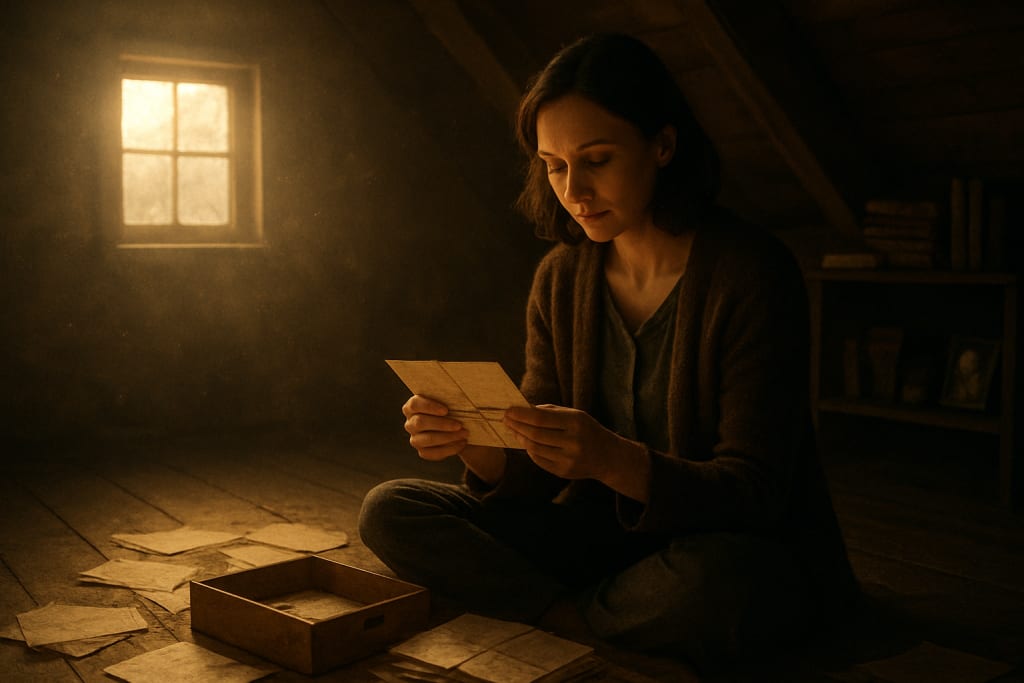
The attic ladder creaked as she climbed. Dust motes floated in the sunlight from the small square window. There, tucked under a sheet, was a wooden box — the kind he used to store old keepsakes. She knelt and opened it.
Inside lay a stack of letters tied with a faded blue ribbon, and on top of them, a drawing — a little girl and her father standing under an apple tree, smiling. Her old handwriting in the corner: Me and Dad, best friends forever.
She let out a soft, broken laugh. The letters were all addressed to her — birthday wishes, encouragements, memories. He had written them every year, even after they stopped talking. None had been sent.
Each one carried a season of love he hadn’t known how to show out loud.
By the time she reached the last letter, the sun had set. The house felt different now — warmer, somehow awake. She sat on the attic floor, surrounded by paper and years, whispering to no one,
“I’m sorry too.”
Later that night, Emma walked outside. The yard was quiet except for the steady hum of crickets. She looked up at the old apple tree — still standing, though its branches leaned with age. When she was little, she used to climb it, shouting for him to watch. He always did, smiling like it was the most important thing in the world.
She placed one of the letters under the tree, letting the wind tug gently at the edges.
“Thank you,” she whispered.
The stars were faint, but the sky was clear. For the first time in years, she didn’t feel angry at time for moving forward. She felt grateful it had paused long enough to let her read what silence had hidden.
When she left the next morning, she didn’t lock the door. The sunlight spilled through the windows as if the house itself was breathing again. On the table, she left her own note — short, handwritten, and honest.
You were right, Dad. Some songs are meant to be listened to. But this one, I’ll keep singing for you.
About the Creator
Charlotte Cooper
A cartographer of quiet hours. I write long-form essays to challenge the digital rush, explore the value of the uncounted moment, and find the courage to simply stand still. Trading the highlight reel for the messy, profound truth.
Keep reading
More stories from Charlotte Cooper and writers in Art and other communities.
'Till Death We Do Art
There would be nothing divine in this world without art. Nature may surpass the divine to all intents and purposes, but like everything it absorbs and is absorbed by, it remains here, stuck on the surface of this world, ever-present, physically bound to the universe.
By Avocado Nunzella BSc (Psych) -- M.A.P 18 days ago in Art
Sahara Desert of Merzouga: The Complete Travel Blog Guide
Sahara Desert of Merzouga is one of the top places, you should not miss when visiting Morocco. It's place where golden dunes stretch endlessly, camels walk across the horizon, and nights sparkle with a sky full of stars. Located near the Algerian border, Merzouga is the gateway to the spectacular Erg Chebbi dunes, the most lovely sand dunes in Morocco. Merzouga desert is highly recommended among travelers due to its lovely high, clean and golden dunes offering visitors the chance to enjoy their vacation. Morocco Tours Company
By Othmane Anaam4 days ago in Art




Comments
There are no comments for this story
Be the first to respond and start the conversation.