
The Train That Waited Until Dawn
Sometimes the things we miss find their way back in silence.

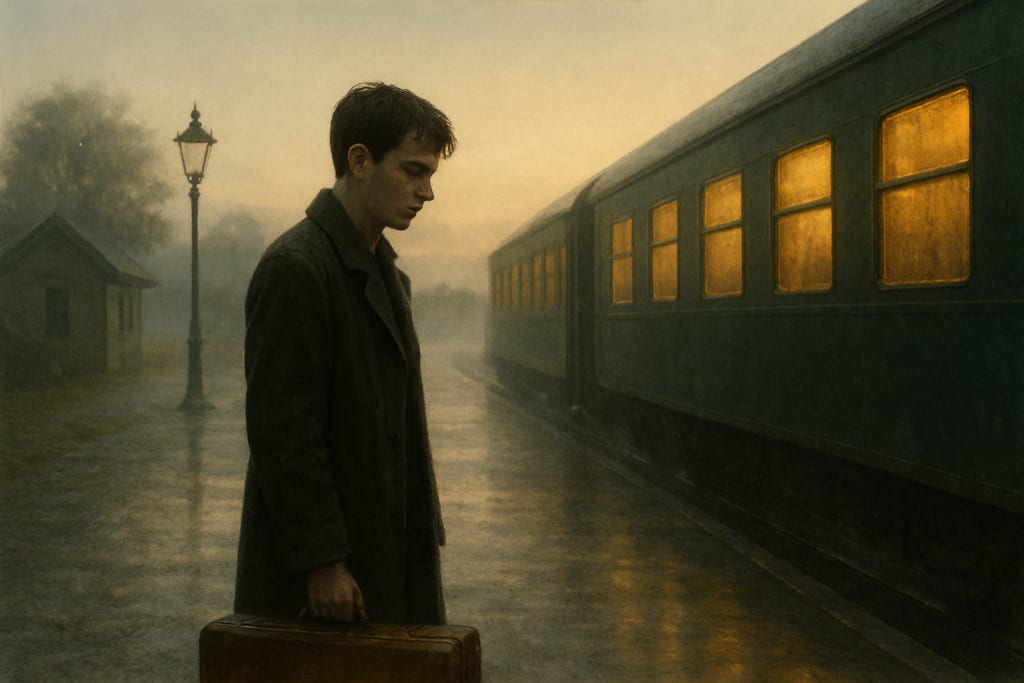
The night train from Birchfield to Marlow had always been almost empty — a quiet line that only a few people bothered to take anymore.
But on a cold February night, a young man named Eli Turner stood on the platform, suitcase in one hand, ticket in the other, wondering if he was too late — not for the train, but for everything else.
The station clock showed 11:48 p.m. The wind carried the smell of iron and rain, and the distant hum of the arriving train rolled through the fog like an old memory.
Eli had grown up in this town — the kind of place that forgets people faster than it remembers them. He left at nineteen, chasing a job in the city, promising to write, to visit, to call. But life had a way of drowning promises under noise and deadlines.
He hadn’t been back in six years.
Now he was returning for one reason — to see Marian, his grandmother, who had raised him after his parents’ accident. The call came two days ago: she had passed away in her sleep, quiet as always. The funeral would be in the morning. He almost didn’t go. Then guilt, or maybe love, pulled him onto that train platform.
When the train arrived, it sighed like something tired. Only a few passengers boarded — an older couple holding hands, a man asleep against his backpack, a woman in a red coat reading a letter under the yellow carriage light.
Eli found a window seat and placed his suitcase on the rack. The train jerked forward with a low groan. Outside, the town slid away — small houses, flickering streetlamps, then only the black stretch of countryside.
He leaned his head against the glass. His reflection stared back — older, sharper around the eyes, wearing a face that had learned how to hide things. The rhythm of the train reminded him of Marian’s heartbeat when she used to hold him as a child, whispering stories about the stars.
“You’ll go far someday,” she’d said once. “But don’t forget where far began.”
He hadn’t thought of that in years.
The woman in the red coat glanced up from her letter and smiled faintly at him — a tired, knowing smile. He nodded back, unsure why it felt comforting.
“Long trip?” she asked.
“Home,” he said. “Or what’s left of it.”
She folded the letter carefully. “Funny how we call it home even after it changes.”
They didn’t speak again, but her words settled somewhere deep inside him.
As the night deepened, rain began to patter against the window. The train slowed near an old crossing, where the fields spread wide and silent. He remembered this spot — Marian used to take him here every spring to watch the first blossoms. She’d say the wind carried wishes if you let it. He used to believe that.
He reached into his jacket pocket and pulled out a folded piece of paper — a note she’d sent him a year before, written in her small, uneven handwriting.
“Don’t work too hard, Eli. The garden’s lonely without your laughter.”
He’d never replied.
The guilt came heavy then, like rain pressing on the roof. He stared out into the darkness until his eyes blurred. Somewhere out there, the fields still waited, and maybe the wind still carried wishes.
When the train stopped halfway through the journey, the conductor’s voice echoed through the carriage: “Ten-minute delay, folks. Signal issue ahead.”
Eli got up, stretching his legs. The platform outside was small — just a wooden bench and a dim light flickering over wet gravel. He stepped out, the cold air biting his hands.
A stray cat padded near his feet, thin and gray, shaking off raindrops. Eli bent down and smiled. “Hey, you waiting for someone too?” he murmured. The cat blinked slowly, like it understood, then disappeared behind the bench.
When he turned back toward the train, he noticed the woman in the red coat standing by the door, holding her letter to her chest. “You know,” she said softly, “trains are strange. They carry people forward, but they also take them back to everything they ran from.”
He didn’t answer. He didn’t need to.
The whistle blew — low, lonely — and the passengers climbed aboard again. The train rolled forward through the mist, faster this time. Eli watched the horizon pale — not sunrise yet, but close.
As the first light crept through the clouds, the fields appeared — soft, glistening with dew. And there, for a brief second, he saw the garden by his grandmother’s old house — or maybe just imagined it. Tulips and wild grass, the porch swing she never let him fix because “a little creak keeps it honest.”
Tears came suddenly, quietly. He pressed his palm to the cold window.
“I’m here, Grandma,” he whispered. “I’m coming home.”
The train reached Marlow just after dawn. The sky glowed faint pink, and the rain had stopped. He stepped onto the platform, suitcase in hand, and looked down the empty tracks. The world smelled of wet earth and beginnings.
For the first time in years, he didn’t feel late.
About the Creator
Charlotte Cooper
A cartographer of quiet hours. I write long-form essays to challenge the digital rush, explore the value of the uncounted moment, and find the courage to simply stand still. Trading the highlight reel for the messy, profound truth.
Keep reading
More stories from Charlotte Cooper and writers in Art and other communities.
The House That Waited for Spring
The rain had been falling since morning, slow and steady, like the world was washing itself clean. The streets of the small town were almost empty, except for a woman standing under a broken umbrella, staring at the front window of a little antique shop.
By Charlotte Cooper5 months ago in Art
'Till Death We Do Art
There would be nothing divine in this world without art. Nature may surpass the divine to all intents and purposes, but like everything it absorbs and is absorbed by, it remains here, stuck on the surface of this world, ever-present, physically bound to the universe.
By Avocado Nunzella BSc (Psych) -- M.A.P 18 days ago in Art
Things to do in Casablanca:
Casablanca is one of lovely destinations around Morocco. Casablanca is considered the largest city in Morocco. It's famously known for its historic attractions, cultural sites and natural landscapes. Additionally, the city is well- known for its clean beaches offering visitors a lifetime experience. This blog cover the top things to do in Casablanca:
By Othmane Anaam4 days ago in Art
Rachel Reviews: Lakefront Wolves by Joseph Deegan
Meet Finn. He's an 18 year old kid who has potential. He's bright with great school scores and he's also an athlete, a footballer of some prowess. He has it all going for him, it would seem, and yet, he's determined to send what could be a well-planned, stable existence firmly off the rails. He drinks, he smokes, he takes drugs, he has violent tendencies and he's in danger of losing not only his mind but all that he holds dear.
By Rachel Deeming6 days ago in BookClub




Comments
There are no comments for this story
Be the first to respond and start the conversation.