
The Legal Writer’s Guide: How to Get Started in Graffiti Without Catching a Case
Get started with your graffiti life with us


Alright, listen up.
You got the itch. Your handstyle’s finally looking decent, your black book’s filling up, and you want to paint something larger than a dumpster. Just be smart enough not to catch a case before you get real good at it.
And this one's for you – the new wave writers who want to get up, build a name, and stay free indeed!
Welcome to the Legal Writer's Playbook.

Know the Culture Before You Touch a Wall
"If you don't know the origin of graffiti, then you're not yet a writer, you're just somebody with spray paint."
The modern form of graffiti art began to flourish in the latter part of the ’60s and ’70s in cities like New York and Philadelphia:
These tags, or signatures, spread like wildfire, with names such as TAKI 183 being emblazoned upon any surface they could reach.
Pieces, which stands for "masterpieces," evolved from their use as tags to their present form as colorful, intricate letters covering subway cars and walls.
Writers weren't just "destroying property." They were making a claim to visibility for themselves within cities that hadn't previously paid much attention to them.
Today, graffiti holds a strange, shifting space:
- It remains illegal in many contexts.
- Yet it is also seen as art, displayed in galleries, supported by cities, and used in advertising campaigns.
- Understanding that history is not an option but is, rather, something that gives you
- Respect for culture
- Respect for
- Context for the rules
- Fuel for your own style
Before You Paint: Watch documentaries such as "Style Wars," "Wild Style," or "Bomb It." Follow serious writers and muralists online, studying letter forms, control, and color theory. You are entering into a tradition. Treat it as such.
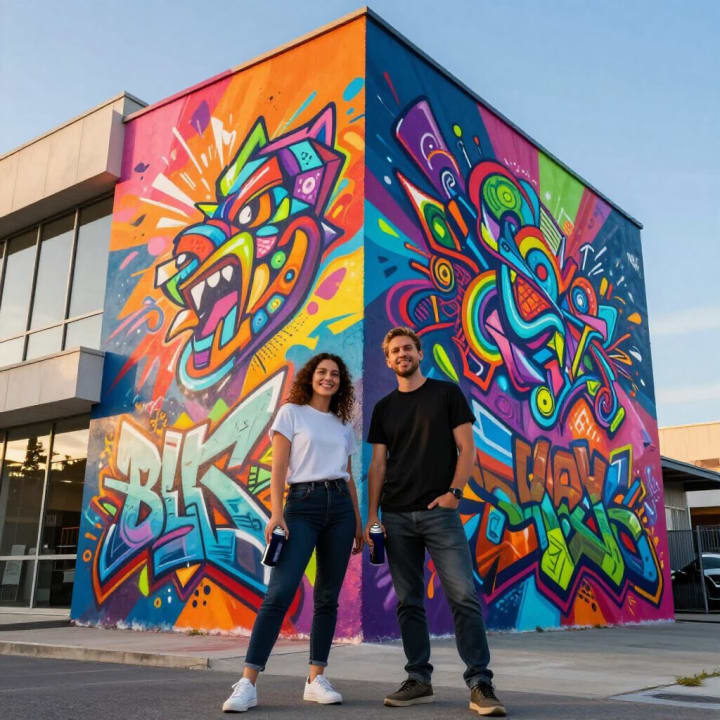
Legal Walls: Your First Real Canvas
You don’t need to jeopardize your freedom to hone your style. Legal walls exist, and so do legal spots. These are where many serious writers honed their craft.
How to Find Legal Spots
a) Search Online
Hit Instagram and search:
- #[YourCity]Graffiti
- #[YourCity]StreetArt
- #[YourCity]LegalWalls
Look for:
- Graffiti crews
- Street art festivals
- Local mural collectives
Check Facebook groups or Discord servers for:
- “Urban art”
- “Street art”
- “[Your City] creatives”
Writers talk. Scenes leave traces. Follow them.
b) Check Community Hubs
Go where youth and culture gather:
- Skateparks
- Youth centers
- Community gardens
- Cultural centers
These spots often:
- Already have painted walls
- Want more art
- Are open to mural ideas if you ask
Come on in, introduce yourself, and ask who's in charge of the walls. Believe me, you'd be surprised how many times the answer is, 'We've been wanting to do something with that wall for years
c) Look for City or Nonprofit Programs
Many cities now have:
- Mural programs
- Street art festivals
- Youth arts initiatives
They might:
- Offer you legal walls
- Provide paint or supplies
- Connect you with more projects
Search:
- “[Your city] mural arts program”
- “[Your city] public art program”
- “[Your city] street art festival”
Yes, it’s more “official” than hopping a fence—but if you want big walls, visibility, and no legal trouble, this is where it’s at.

Getting Permission: How to Ask Like a Pro
The difference between vandalism and a mural can be a 5-minute conversation.
You see a beautiful, clean wall on a local café, barber shop, or gym and think, “That would be crazy with a piece on it.” Here’s how to turn that thought into a legit opportunity.
Step 1: Show Up Right
Dress normally, nothing that screams “I was just in a train yard.”
Bring:
- Your blackbook or printed sketches
- Photos of any previous work (even canvases or school projects)
- First impressions matter. You’re not just a “graffiti kid”—you’re a visual artist pitching a collaboration.
Step 2: Talk Their Language
Business owners care about:
- How does their place looks
- What customers think
- Community reputation
So when you talk, focus on:
- “A unique mural that will make your storefront stand out.”
- “Creating a local landmark people photograph and share.”
- “Making your wall feel less empty or neglected.”
Avoid jargon like “bombing” and “getting up” in this conversation. That’s for writers, not landlords.
Step 3: Pitch a Clear Idea
Don’t walk in saying, “Can I paint whatever I want?”
Instead:
- Show them a specific sketch or two
- Explain your idea in one or two sentences
Example: “I’m thinking of a colorful lettering piece with some characters that reflect the neighborhood’s energy and your café’s vibe.”
If they’re nervous:
Offer to keep it:
- Non-political
- Non-offensive
- Family-friendly (if the area calls for it)
- You can still stay true to your style while respecting the space.
Step 4: Get Permission in Writing
Once they say yes, lock it down:
- Ask for a quick text or email:
“I, [Owner Name], give [Your Name] permission to paint a mural on the exterior wall at [Address] between [Dates].”
- Screenshot or save it
That way, if anyone questions you while you’re painting, you can show proof you’re allowed to be there.

Your First Legal Piece: From Sketch to Wall
You’ve got a spot. Now don’t waste it.
a) Scout the Wall
Go check it before painting day:
- What’s the surface like? (Brick, concrete, rough stucco?)
- How big is it? (Roughly measure)
- Where does the sun hit and when?
- Is there heavy foot or car traffic?
This will help you plan:
- How much paint you’ll need
- Whether you need a ladder
- What time of day is best to work
b) Plan Your Piece
Legal walls are where you practice big:
- Take a photo of the wall
- Print it or import it into a drawing app
- Sketch your piece on top so it fits the space
Focus on:
- Clean letterforms
- Simple but strong color schemes
- Clear composition
- Don’t overcomplicate your first big wall. Simple and clean beats messy and “ambitious.”
c) Gear Checklist
For a modest wall (around 10x10 ft), you’ll usually want:
8–12 cans of quality paint (brands like Montana, Loop, Ironlak, etc.) I recommend Loops Pro Tools
Assorted caps:
- Fat caps: fills and backgrounds
- Skinny caps: outlines and details
- Gloves (if you like to keep your hands clean)
- Mask (especially indoors or in low-vent spaces)
- Chalk or light paint for your outline
- Ladder (if the wall is tall)
Good paint makes a huge difference in:
- Coverage
- Color
- Control
If you’re broke, start small. As you build connections, some programs or businesses will help with supplies.
d) Painting Day: How to Work the Wall
Basic flow:
- Clean the surface (if needed) – brush off dirt, loose paint.
- Background /base coat – block in big areas of color.
- Rough outline – sketch your letters and characters.
- Fill-ins – lay down solid fills for each letter.
- Shading / 3D / effects – add depth and details.
- Outlines – clean, sharp lines around letters.
- Highlights / final touches – small details that make it pop.
- Sign it – your name or crew, small but clear.
Take breaks, step back often, and look at your piece from a distance. Walls read from afar, not from 6 inches away.
And always leave the spot cleaner than you found it: no piles of cans, no trash, no mess.

Respect: The Unwritten Rules (Legal or Not)
Even on legal walls, the culture has rules. Break them, and you’ll be known for the wrong reasons.
Don’t go over a piece that’s better than yours unless:
- The wall is known as a “rotation” wall, where things constantly change
- You’ve got permission from the artist or scene
- Never tag on someone’s fresh piece
Don’t paint hateful, racist, or bigoted content—you’re killing your own reputation
- Respect the neighborhood
- Family areas might call for different energy than club districts
- If locals ask what you’re doing, talk to them—this builds trust
- Legal or not, graffiti is a community culture, not just a solo hustle.
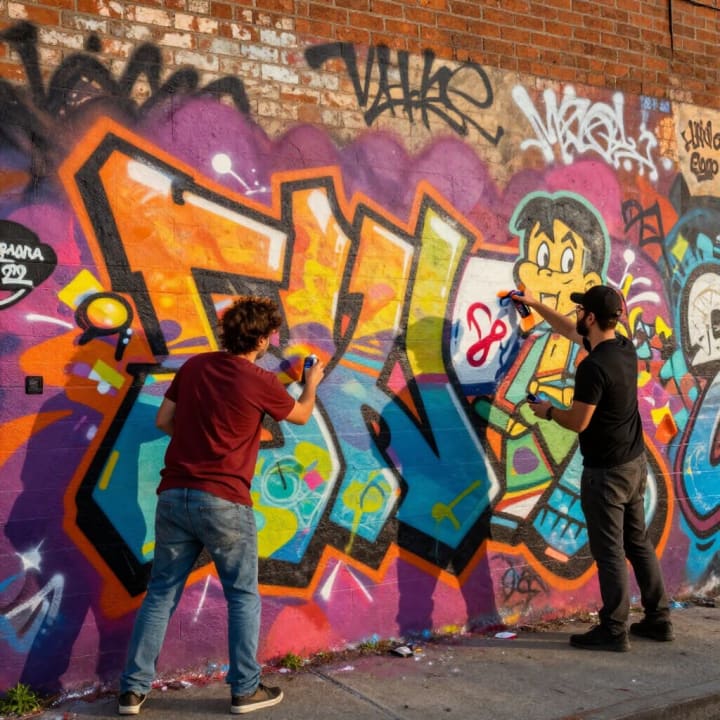
Find Your People: Crews, Mentors, and Community
Graffiti was built by crews—groups of writers painting, learning, and watching each other’s backs.
To plug in:
- Follow local writers and muralists on social media
Go to:
- Street art festivals
- Gallery shows featuring graffiti/street art
- Paint jams or legal wall days
Be humble:
- Don’t front like you know everything
- Ask real questions
- Listen more than you talk
A good mentor or crew can:
- Put you onto better walls
- Teach advanced techniques
- Help you avoid dumb mistakes (artistic and legal)
You’re not just building a name—you’re joining a culture.
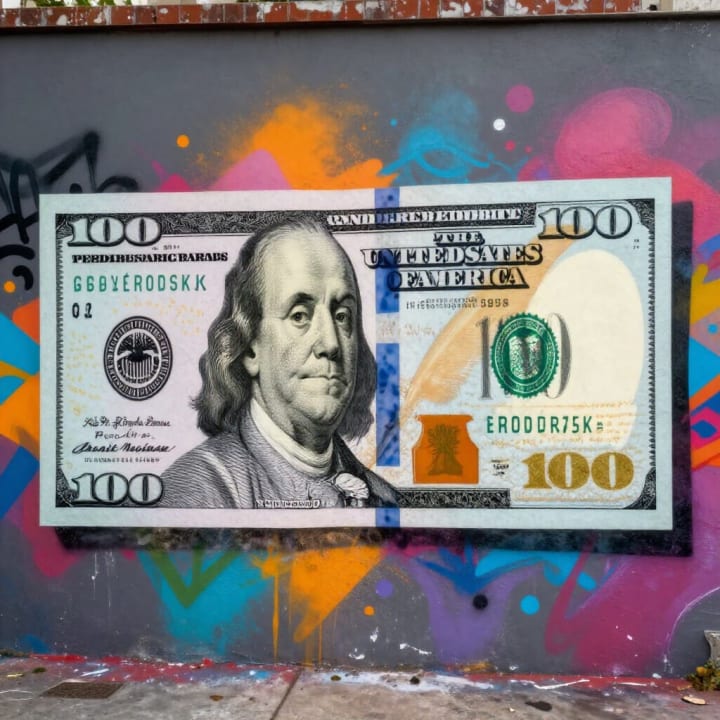
From Free Walls to Paid Walls: Getting Commissioned
If you stick with it, someone will eventually say, “How much to paint my wall?”
That’s when graffiti overlaps with professional mural work.
Start Building a Portfolio
- Every legal wall, every canvas, every sketch worth showing—document it.
- Take high-quality photos in good light
- Keep a simple site or portfolio (Instagram can be enough at first)
Show variety:
- Letter pieces
- Characters
- Clean murals
- Color control
- Talk Money (Without Losing Yourself)
When someone asks your rate, consider:
- Wall size
- Time required
- Supplies costs
- Your experience level
Early on, you might:
- Do some walls just for materials and exposure (especially for community projects or small local spots)
- Gradually raise your prices as your skills and demand grow
Key point:
- Payment doesn’t make you a sellout.
- Selling out is compromising your entire artistic identity just to please a client.
You can:
- Keep your letter style and character flavor
- Adapt themes or colors to fit the client
- That’s how a lot of respected writers now:
- Travel, paint festivals, and large walls worldwide
- Make a living off what they love
- Stay connected to their roots

Stay Legal, Stay Long-Term
There’s a romantic story about sneaking into yards and hitting trains at 3 AM. There’s also a real story about fines, records, and doors closing on you before you’re even 25.
You don’t have to prove you’re “real” by catching charges.
You prove you’re real by:
- Putting in the hours on your letters
- Learning can control
- Respecting the culture
- Building relationships
- Creating walls people remember
Legal paths give you:
- Time and space to develop
- Visibility without paranoia
- A future in art, if you want one—teaching, commissions, gallery work, design, murals

Stay Up, Stay Free
Starting legal doesn’t make you less of a writer. It makes you a smarter one.
Use legal walls to:
- Grow your style
- Learn the craft
- Connect with your scene
- Show people what graffiti can really be
- Grab your blackbook.
- Find a wall.
- Ask the right way.
Then paint something that makes the next kid walking by think:
“Damn. I wanna do that.”
That’s how the culture lives on—through skill, respect, and art that can’t be ignored.
About the Creator
xJRLNx
Im a dude letting out his madness with the help of Ai.
Creativity in the Dark
Creativity does not always arrive in bright rooms with clean desks and clear intentions. More often, it slips in quietly—late at night, when the world has dimmed its expectations and the mind is no longer on display. This is creativity in the dark: private, unpolished, and deeply human.
By LUNA EDITH3 days ago in Art
The Theft of Three Hundred Thousand Rupees
The Theft of Three Hundred Thousand Rupees (Article No. 1427) Bano and Shehla, the sisters of Mansoor and Munir Shami, studied at Tower House Grammar School, a private institution run by Begum Nayab, who was both its owner and principal. She was known as a kind, intelligent, and principled woman. Her school, which offered education from playground to matriculation, had an excellent reputation. Parents from far-off areas sent their children there because of its strong discipline and high academic standards.
By Sudais Zakwan3 days ago in Art
Autonomy Is The Real Privilege
Good morning, freedom-seekers! Today we’re gonna be looking at autonomy. A strange word, I know; one many would probably look at blankly and run away from on sight. We’re gonna figure out what it actually means, consider how it’s achieved, and decipher just how deeply most of us are tangled up in dependence without realising it.
By That ‘Freedom’ Guy5 days ago in Humans



Comments
There are no comments for this story
Be the first to respond and start the conversation.