
The Last Days of Ramadan
A Laborer’s Struggle for Dignity, Faith, and Family
The Last Days of Ramadan
BY: Khan
As Eid drew closer, Ramadan Mian’s anxiety deepened. For him, the month of Ramadan was not only a time of worship but also a rare period of peace. It was the only month in the whole year when his struggles felt a little lighter, when faith seemed to fill the cracks that poverty had carved in his life. But now, as the blessed days neared their end, a silent dread crept into his heart. Once again, he would have to face the long, exhausting cycle of hunger, hardship, and humiliation that awaited him in the months ahead.
Things hadn’t always been this grim. A few years ago, he managed to make ends meet with his daily labor. He wasn’t rich, but life felt manageable. There was hope. Then came the economic crisis — slow, suffocating, and merciless. Prices soared like flames, and opportunities for work dwindled until they were almost gone. The government’s ever-changing policies only worsened things. Now, no matter how long or hard he worked, his income barely lasted a week.
At home, six mouths depended on him — his frail mother, his wife, and three children. Feeding them, clothing them, and keeping a roof over their heads felt like carrying a mountain on his shoulders.
The children, of course, were too young to understand any of this. Their innocent minds were busy with dreams of Eid — new clothes, sweet vermicelli, and shiny coins of Eid money in their small hands. They would chatter excitedly about how the whole neighborhood would be filled with joy, laughter, and the smell of festive food.
Ramadan Mian would sit quietly and smile at them, though deep inside, each word of theirs pierced his heart like a thorn. He wished he could share their excitement. But all he could think of was how to arrange the money for their Eid clothes — how to buy sugar, milk, and a little ghee so that at least the traditional sewaiyan could be made.
When Ramadan began, he had felt a strange relief. “At least now,” he told himself, “I’ll only have to manage one meal a day.” His old mother, despite her illness, insisted on fasting, saying that maybe this way her son’s burden would be lightened. His wife, too, encouraged the children to fast by telling them they would earn great reward from Allah. The little ones would complain of hunger, but then they would proudly say, “We are fasting like Abba and Ammi!”
In that small, dimly lit home, faith was their only wealth.
Some days, the richer families in the neighborhood sent over plates of dates, fruits, or fried snacks for iftar. Whenever that happened, it felt like a gift from heaven. Those nights, the house would come alive — laughter would return to the children’s faces, and even his mother’s weary eyes would shine with gratitude.
But as the days passed, the end of Ramadan approached faster than he could prepare for it. The moon of the last ten nights had risen. Eid was almost here.
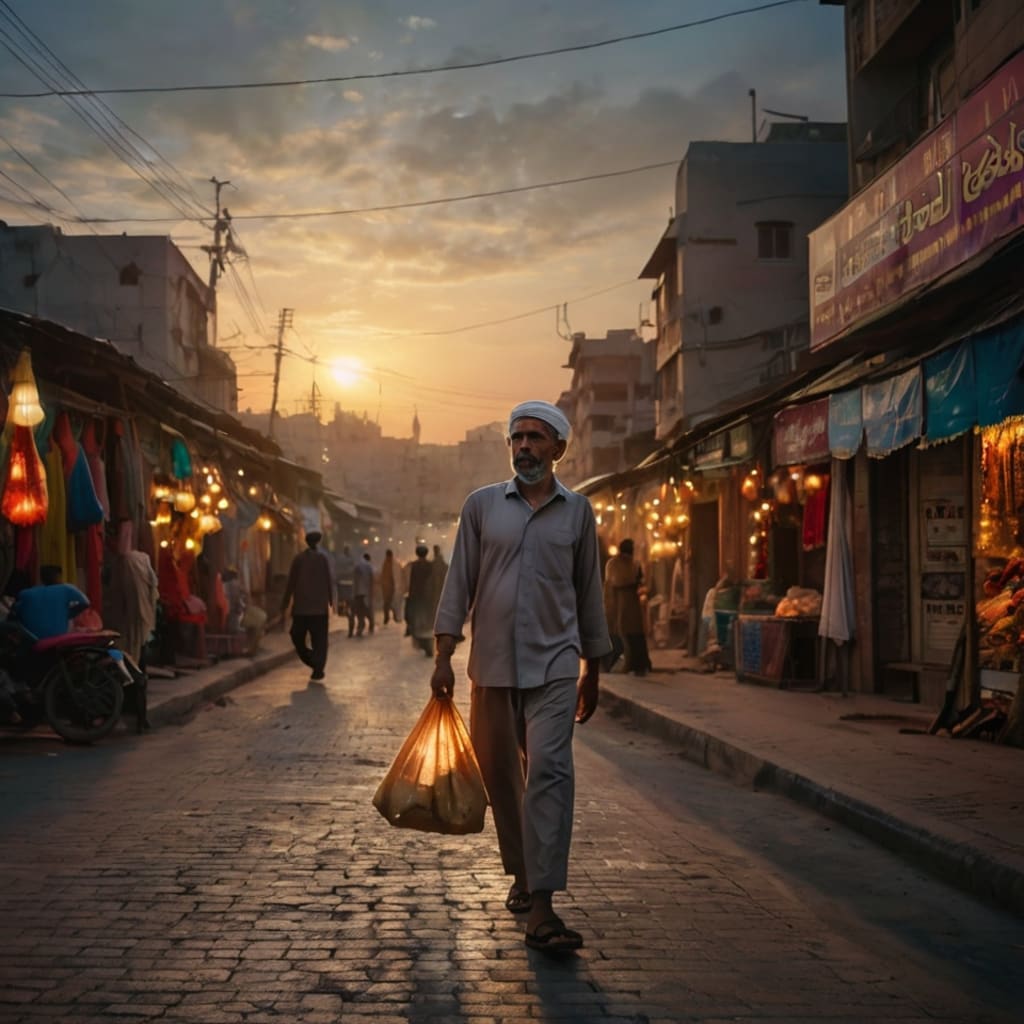
Each time he went out to look for work, he saw the bazaar glittering with lights. Stalls were overflowing with colorful dresses, sparkling bangles, and toys that made children’s eyes widen with delight. The aroma of freshly fried sweets filled the air. Yet all of this beauty felt like a world that did not belong to him.
He would stand there for a few moments, then quietly walk away before anyone noticed his torn clothes or tired face.
That night, lying awake on his thin mat, he thought of his children’s eager faces. What would he say to them when they asked about their Eid clothes? How would he tell them that he couldn’t buy even a single new shirt this year? His heart grew heavy, and for a long time, he just stared at the flickering oil lamp beside him.
He remembered the days when he could still afford little joys — a handful of sweets for the children, a small gift for his wife, a smile from his mother. Now, even those simple things felt like distant memories.
He closed his eyes and whispered a prayer. “Ya Allah, I don’t ask for wealth or luxury. Just enough to keep my children happy this Eid.”
The next morning, he left early in search of work. The streets were alive with the sound of shopkeepers calling out to customers. But no one seemed to need an extra pair of hands that day. After hours of wandering, his body ached, and his empty stomach growled with hunger.
As he sat by the roadside, staring blankly at the crowd, someone tapped his shoulder. It was an old acquaintance — a kind-hearted man named Karim who owned a small bakery.
“Ramadan bhai! You look tired,” said Karim. “Come, I need help packing sweets today. I’ll pay you a little extra — Eid is near, after all.”
Tears filled Ramadan Mian’s eyes. “Allah bless you, Karim bhai,” he said softly.
That day, he worked harder than ever, his heart filled with gratitude. By evening, Karim handed him a small envelope with his wages — enough to buy simple clothes for his children and a few basic ingredients for Eid. He even gave him a small box of sweets to take home.
When he returned that night, his children ran to greet him. He smiled — a smile that came from deep within. For the first time in many months, he felt light. His wife, seeing the small bag of clothes and the sweets, could not hold back her tears.
On Eid morning, his children dressed in their new clothes — modest but clean — and went out joyfully to greet their friends. His mother prayed for his long life, and his wife placed a bowl of sewaiyan before him.
As he took the first spoonful, he looked up at the sky and whispered, “Alhamdulillah.”
And though the world outside remained harsh and uncertain, in that moment, inside that small home, there was peace — the kind of peace that only faith, patience, and gratitude can bring.
About the Creator
'Till Death We Do Art
There would be nothing divine in this world without art. Nature may surpass the divine to all intents and purposes, but like everything it absorbs and is absorbed by, it remains here, stuck on the surface of this world, ever-present, physically bound to the universe.
By Avocado Nunzella BSc (Psych) -- M.A.P 18 days ago in Art
Sahara Desert of Merzouga: The Complete Travel Blog Guide
Sahara Desert of Merzouga is one of the top places, you should not miss when visiting Morocco. It's place where golden dunes stretch endlessly, camels walk across the horizon, and nights sparkle with a sky full of stars. Located near the Algerian border, Merzouga is the gateway to the spectacular Erg Chebbi dunes, the most lovely sand dunes in Morocco. Merzouga desert is highly recommended among travelers due to its lovely high, clean and golden dunes offering visitors the chance to enjoy their vacation. Morocco Tours Company
By Othmane Anaam4 days ago in Art




Comments
There are no comments for this story
Be the first to respond and start the conversation.