
The Artist Who Never Finished a Single Piece Of Art In His Whole Life
For years, he painted in silence, never completing a single artwork. But one unfinished sketch revealed the masterpiece hidden within his story

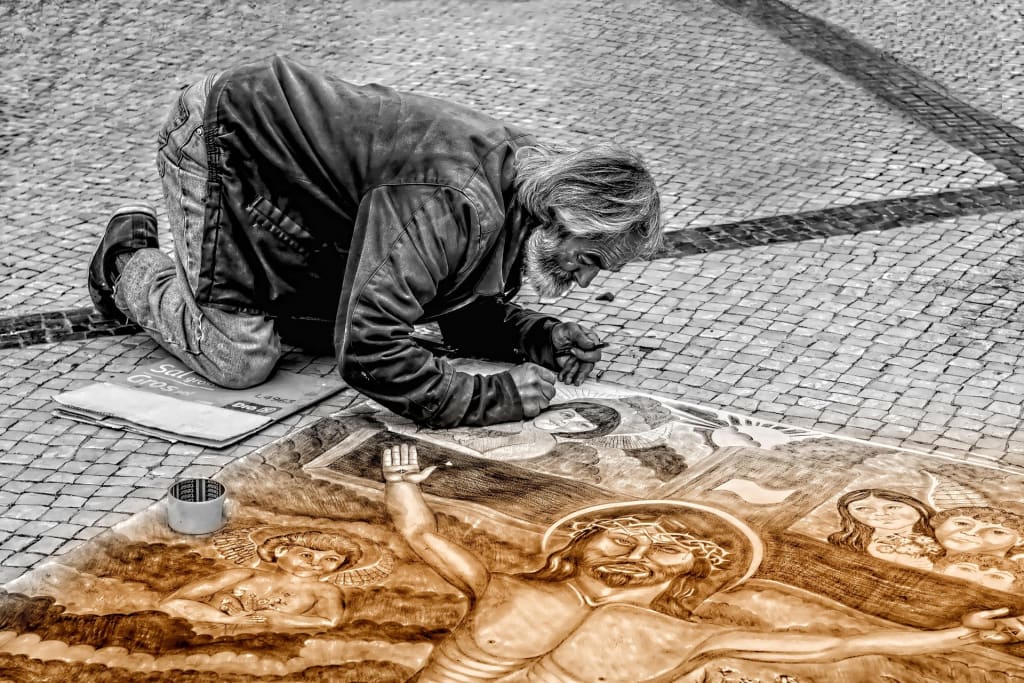
There are artists whose works hang in galleries, framed and lit, admired by the world. And then there was Elijah Ward—a man whose name appeared on no canvas, whose brushstrokes were always halfway done, whose art never saw completion.
For over 30 years, Elijah painted.
And for 30 years, he never finished a single piece.
I first met Elijah in the old quarter of Charleston, where the cobbled streets met the ocean breeze, and the past clung to the buildings like ivy. I was fresh out of journalism school, freelancing for a small arts magazine that nobody really read but that paid just enough for coffee and rent.
A fellow writer told me about a strange recluse who lived above a defunct bookstore on Bay Street. “He paints,” she said, “but he’s never sold or shown a single piece. Some say he has a hundred unfinished canvases stacked like tombstones in his apartment.”
My curiosity, as always, was louder than my caution.
I knocked on his paint-chipped door one Tuesday afternoon, expecting to be ignored or yelled at. Instead, I was greeted by a man in his late 50s with wisps of grey in his beard and blue paint on his fingertips.
"You're not selling anything, are you?" he asked.
"No," I said. "But I want to understand why you never finish your paintings."
He studied me with painter’s eyes—quiet, calculating, intimate.
Then he opened the door.
His apartment smelled of turpentine, old coffee, and something sweetly melancholic. Every wall was stacked with canvases, sketches, and half-sculpted clay. Some works were breathtaking—portraits that captured emotions too complex for words. Others were abstract explosions of color and motion. But none were finished.
Brushes rested mid-air in strokes. Faces lacked pupils. Landscapes ended in blank white corners.
"Why?" I asked again.
He sighed. "Because nothing is ever truly finished."
He told me his story as if confessing to the walls.
He had been a prodigy in art school. Professors called him "the next Sargent". By age 25, he had galleries calling, collectors offering checks with too many zeroes.
But perfection became his prison.
Every time he got close to finishing a piece, he saw its flaws magnified. A line too sharp, a shade slightly off. So he would stop. Start again. And again. And again.
"Finishing felt like lying," he said. "Like pretending something broken was whole."
That line stayed with me.
He showed me one of his earliest works—a woman sitting by a window, her face turned away. The detail was exquisite, but her eyes were missing. "She looked too real," he whispered. "So I left her unfinished."
I visited Elijah every week for a month.
We talked art, philosophy, failure. He never asked my name, only calling me "the curious one."
Then one day, something changed.
I found him sitting quietly, staring at a blank canvas.
"I had a dream," he said. "About my mother. She was finishing a painting I abandoned. She smiled at me and said, 'This is how you say goodbye.'"
He started sketching.
The days that followed were different. Focused. Intense.
He worked on one canvas for hours. No distractions. No hesitations.
The painting was of a boy sitting at a kitchen table, sunlight pouring in from a window. A jar of pencils lay beside him. A woman in the background, blurry but warm, was watching him with pride.
I recognized Elijah in the boy.
And I realized—the woman was his mother.
When he placed the brush down, he looked at me and said, "This is the only one I had to finish."
A week later, Elijah passed away in his sleep.
No one claimed his body for days. I arranged the funeral myself, using the money he’d stashed away in a rusted coffee tin labeled "Someday."
I couldn’t let his work disappear. So I wrote his story.
Titled The Artist Who Never Finished a Single Piece, it was picked up by a major arts journal. Then another. Soon, collectors, curators, and even museums reached out, desperate to see his work.
I curated a posthumous exhibit. It was called Unfinished Symphony.
People wept. Critics praised his bravery. Young artists said they finally understood their own perfectionism.
And in the center of it all, under a soft light, was that final painting.
The only one he ever finished.
What Elijah Taught Me:
Not all masterpieces hang in galleries.
Sometimes, the pursuit of perfection kills the soul of the art.
The courage to finish just one thing can echo louder than a thousand abandoned dreams.
His legacy wasn’t in completion.
It was in honesty.
And the unfinished brushstrokes that told a fuller, deeper story than perfection ever could.
Final Thought:
Elijah’s story made me rethink the meaning of success. He never signed a painting, never cashed in, never finished—until it mattered most.
That last painting wasn't just art.
It was closure.
And maybe, just maybe, that’s the true definition of a masterpiece.
If you’ve ever left something unfinished out of fear—it’s time to go back.
Finish it.
Not for the world.
But for you.
About the Creator
Hamad Haider
I write stories that spark inspiration, stir emotion, and leave a lasting impact. If you're looking for words that uplift and empower, you’re in the right place. Let’s journey through meaningful moments—one story at a time.
Keep reading
More stories from Hamad Haider and writers in Art and other communities.
What Voice Cloning Technology Means for Creators and Digital Identity
The rise of artificial intelligence has reshaped the creative landscape in countless ways, from AI-generated visual art to automated music composition, and one of the most intriguing frontiers today is voice cloning. With tools that let users clone your voice using only a short sample of speech, creators and digital communicators are discovering new ways to produce audio content that feels natural and expressive.
By aliyashahzadi8 days ago in Art
“What If It Happens?”
Monday, 11 April 2022 Ishrat Jahan One of our friends, Mr. Farooq, is a middle-aged man, yet he has still not been able to free himself from his deeply suspicious and fearful nature. These days, I happened to have some free time, so I thought it would be a good idea to meet him and try to untangle the puzzle of his constant worries. By coincidence, he himself arrived at my humble home, jolting along in a rickshaw.
By Sudais Zakwana day ago in Art




Comments
There are no comments for this story
Be the first to respond and start the conversation.